

The refugee wave and the gains and losses for Europe.
(Baonghean) - In recent times, the immigration crisis seems to have become a "nightmare" for many countries in Europe. Of course, the European community has not yet agreed on a final solution to this crisis, but it is worth noting that the problem also stems from the refugee community itself.
While British newspapers reported that around 4,000 ISIS fighters had infiltrated European countries under the guise of refugees, on September 6th in Spain, police arrested a 19-year-old female student suspected of recruiting soldiers for the self-proclaimed Islamic State (ISIS). Undeniably, the threat of non-traditional security threats is one of the reasons many Western countries are apprehensive about the influx of refugees from areas with unstable security. Given that most refugees arrive in Europe illegally and initial reception centers are overloaded, controlling immigration into Europe presents a difficult challenge and creates loopholes for malicious elements.
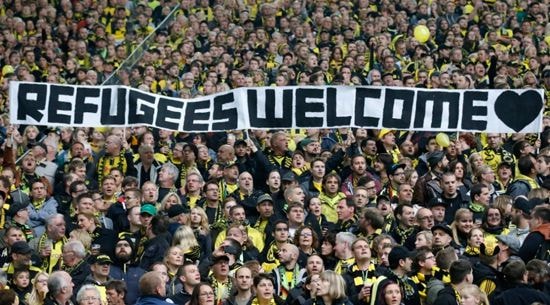 |
| The German people warmly welcomed the refugees. |
Another reason for the hesitation of European officials is how to find a "gap" in their socio-economic system for these "unwanted" visitors. The European economy has been unfavorable recently, with relations with Russia showing no signs of improvement. Agriculture is the sector most significantly affected, with plummeting agricultural prices failing to cover production costs. Around 5,000 European farmers from various countries even protested in Brussels during a meeting of European agriculture ministers on September 7th. The question is: what role will refugees play in the European economy? Will they provide a new labor force for countries with aging populations, or will they, on the contrary, add to the burden on social welfare systems?
These are the problems plaguing European authorities, but for the local population, the truth is that not everyone is enthusiastic about these "uninvited guests." In fact, Europe has been an ideal destination for the diaspora for many people since the immigration crisis. In many cities across Europe, authorities have even designated "camps" for migrants, and sadly, these areas are nothing short of "black holes" for the locals. Cultural and lifestyle differences are the biggest barriers preventing locals from accepting immigrants, especially since a significant portion of immigrants are often irresponsible regarding environmental hygiene and social order, and contribute to social problems to varying degrees.
Thus, besides criticizing the attitude of European countries towards the immigration crisis, it is impossible not to consider the issue from their perspective and, to some extent, sympathize. Furthermore, some countries have shown much more initiative in taking responsibility for the immigration crisis, for example, Germany. Given the increasing wave of immigration into Germany, the German Parliament, in early September, allocated 10 billion euros from now until the end of the year to ensure the well-being of refugees in the country. On September 9th, Chancellor Angela Merkel continued to urge Europe to agree on an unlimited quota for the distribution of refugees. Speaking before Parliament, Merkel emphasized: “We cannot declare that we will share a specific number of refugees; we need to think about how we will deal with those who arrive. We cannot simply set a ceiling and declare that we don’t care about what exceeds that number.”
Even more remarkably, in Germany, refugees receive enthusiastic support from local volunteer organizations. Drinking water, food, clothing, and many other essential items are being distributed by numerous volunteer groups in Berlin to migrants who have just arrived in Germany. Initially, only a few volunteers were present to distribute water to newcomers and care for those who were sick or injured along the way. But over time, this group has grown into organized volunteer teams that are constantly present at hotspots to help migrants. Within just a few weeks of operation, the volunteer group had reached a size of over 1,000 people per day.
The enthusiasm and kindness of the volunteer groups have had a positive impact. Now, not only volunteers but also the government is involved in the relief efforts. Medical personnel have been brought in to provide care, public water fountains have been set up, and many artists have flocked to the area to bring comfort to the refugees. In addition, several specific measures have been announced, including: a program to build and increase the number of refugee reception centers, capable of accommodating 150,000 people in the winter; replacing cash allowances for refugees at reception centers with in-kind assistance; and allocating more funds for language and integration courses for migrants.
Chancellor Angela Merkel, in particular, strongly supports these charitable activities. "What we are experiencing is something that will survive and change the country in the coming years," AFP quoted Merkel as saying after 20,000 migrants arrived in Germany in just one weekend. "We want this change to be positive, and we believe we can achieve it," she added. Merkel found the sight of hundreds of Germans welcoming families fleeing the war in Syria "very moving" and "spectacular." "This is very valuable, especially considering our history," she said, expressing her joy that "Germany has become a country that foreigners believe will offer hope."
Nhat Minh