

Mr. Hoang Vien and his historic house
(Baonghean) - In Hamlet 1, Hung Chau Commune (Hung Nguyen District), there is an old house that used to be...placeIt served as a hiding place for revolutionary cadres during the years of resistance. The owner of that house was Mr. Hoang Vien, one of the first Party members of Hung Chau commune.
HISTORICAL SITE ON NHON MOUNTAIN
Visiting the Hoàng Viện house, a historical site, we found it was once a meeting place for the Central Vietnam Party Committee during the Nghệ Tĩnh Soviet Uprising (1930-1931). During the democratic struggle (1936-1939) and the general uprising to seize power (1945), the house became a "base" for the Party to lead the revolutionary movement.
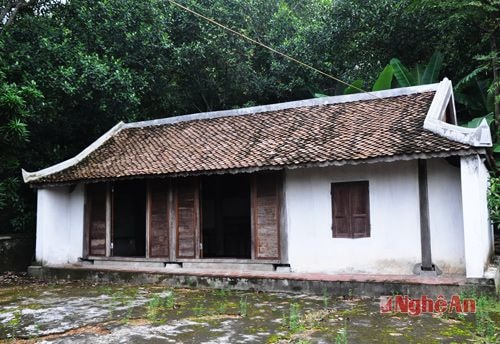 |
| The house of the Hoang Vien family was recognized as a National Historical Monument in 1991. |
According to documents preserved by the descendants of the Hoang family in Hung Chau and the local government, Mr. Hoang Vien was a diligent, hardworking, and industrious farmer. He was also a progressive thinker, actively involved in social activities, and had a wide network of connections. In July 1930, when the revolutionary movement under the leadership of the Party was developing strongly, the Phuc My Party branch (now Hung Chau commune) was established at Mr. Hoang Vien's private residence, consisting of three comrades: Nguyen Ngo Dat (provisional secretary), Le Vien, and Nguyen Thuyen.
Later, the Party cell admitted four more comrades: Hoang Vien, Hoang Em, Hoang Xi, and Nguyen Hua. Under the direct leadership of Comrade Le Xuan Dao - Secretary of the Hung Nguyen District Party Committee, the Phuc My Party cell grew stronger, and the revolutionary movement spread and took root in the lives of the people. This was the reason why the Central Vietnam Regional Party Committee chose Phuc My village as a base of operations, especially from September 1930 - the time when the Nghe Tinh Soviet movement reached its peak.
Behind the village was Nhón Mountain, making it easy for the comrades involved in the activities to retreat when pursued by the enemy. The Provincial Party Committee decided to choose Mr. Hoàng Viện's house as a meeting place, workplace, and hiding place for cadres. Behind Mr. Hoàng Viện's house were two underground tunnels used to store documents and also as shelters and escape routes if pursued by the enemy.
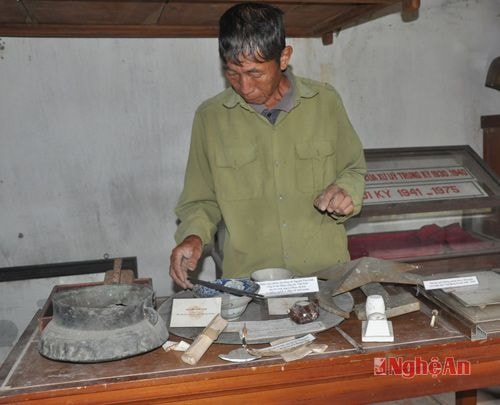 |
| These artifacts are currently being preserved at the historical site of Mr. Hoang Vien's house. |
The house of the Hoang Vien family was chosen as the "base" of the revolutionary movement, and the surrounding families were also selected as places to operate and support the struggle. These included the houses of the Hoang Tuon, Hoang Em, and Hoang Xi families, which sheltered cadres and organized the printing of various documents, leaflets, and propaganda newspapers. The revolutionary base in Phuc My was regularly protected by the local Red Self-Defense Team, with Mr. Hoang Nhi (Hoang Vien's son) directly guarding it.
As the base of the revolutionary "headquarters," the revolutionary movement in Phuc My flourished, with the people actively participating in revolutionary organizations such as the Red Self-Defense Force, the Red Peasant Association, and the Red Relief Force. The revolutionary spirit spread increasingly, becoming an example for other localities in the region to follow. The significant mark of the Nghe Tinh Soviet Uprising was defined on September 12, 1930, when tens of thousands of farmers from Hung Nguyen and workers from Ben Thuy formed a powerful wave of struggle, causing the enemy to be bewildered and terrified. And here, in December 1930, the Soviet government was established, bringing many benefits to the working people.
PRIDE AND CONCERN
Local history and records of the Hoang family also note that in 1939, during the democratic struggle movement, comrades Tran Quy, Bui San, Chu Huy Man, and Tran Van Quang returned to Phuc My to try to build up the movement. Once again, the Central Committee of the Vietnam People's Army decided to re-establish a revolutionary base here. At the end of 1940, Comrade Muoi Cuc (Nguyen Van Linh) was sent here to work and chose the house of Mr. Hoang Vien as a place to stay and organize meetings to discuss important issues.
Also in this house, nearly five years later, on August 8, 1945, the inter-provincial Viet Minh held a conference to disseminate information and discuss plans for a general uprising to seize power for the revolution. Then, a few weeks later, along with people from all over the country, the people of Nghe An rose up to seize power, contributing to the earth-shattering revolution.
In 1991, the State recognized Mr. Hoang Vien's house as a National Historical Monument. Chau Son hamlet (part of Phuc My village) was awarded a Certificate of Merit for its contributions to the nation for "upholding the spirit of patriotism, actively fighting against imperialism, and making a worthy contribution to the victory of the August Revolution"; 11 families in the village were also awarded Certificates of Merit for their contributions to the nation, and 4 other families were awarded commemorative medals.
The Hoàng Viện family's house still preserves several artifacts related to sheltering revolutionary cadres during the years of the revolutionary struggle, when the Party was still operating secretly. These include a wooden hammer and sickle flag; a seal; a copper pot, tray, bowl, and plate used to serve Party leaders. Alongside these are some documentary photos, certificates, and other artifacts. Notably, we found two handwritten copies of the newspapers "Lao Khổ" (issue 13) and "Tiến Lên" (issue number unknown), carefully preserved.
The newspaper "Lao Kho" (Labor Suffering) had a solemn article: "Workers and peasants throughout the country have stormed before the imperialists and shouted: 'Don't touch the workers and peasants of Nghe Tinh!'" Meanwhile, the newspaper "Tien Len" (Forward) had a hammer and sickle symbol in the upper right corner, next to the headline: "Commemorating the Nghe An Soviet," and at the bottom the words "September 10, 1931."
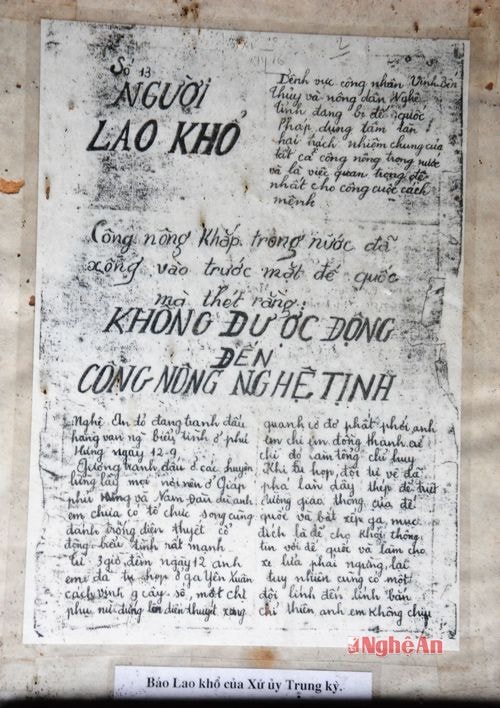 |
| The newspaper "The Suffering Worker" is currently preserved at the historical site of Mr. Hoang Vien's house. |
Those who have visited the house of Mr. Hoang Vien all share a common concern: the site is deteriorating due to time and has not received adequate investment befitting a national historical monument. The government has provided 200 million VND to upgrade and repair some parts of the site, but many other parts are still deteriorating. Therefore, some documents and artifacts are at risk of being damaged.
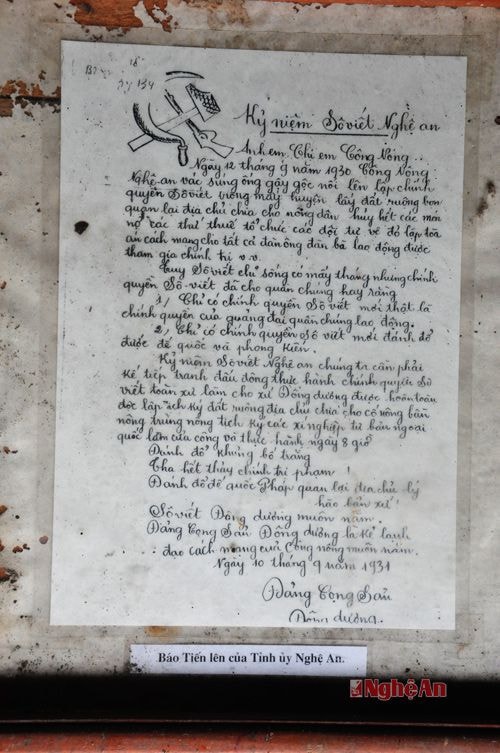 |
| The newspaper Tien Len was printed in 1931. |
Mr. Nguyen Ngoc Quyen, Secretary of the Party Committee of Hung Chau commune, said: “In 2014, the Provincial People's Committee issued a decision approving the detailed construction plan for the project to restore and upgrade the house of Mr. Hoang Vien - the base of the Central Vietnam Party Committee in 1930-1931. We hope the project will be implemented soon to fulfill the aspirations of the family, clan, Party committee, government, and people of Hung Chau commune.”
Cong Kien
| RELATED NEWS |
|---|