

Improving the efficiency of winter crop production.
(Baonghean) - This winter crop season, the entire province plans to plant 42,000 hectares, including 28,000 hectares of corn, 1,500 hectares of peanuts, 12,500 hectares of various vegetables, and approximately 8,000 hectares of other crops. Farmers in various localities are striving to complete the planting area with a variety of high-yielding and high-quality seeds.
Actively implement comprehensive solutions.
Dien Chau District is considered a highly effective locality in winter crop production. Besides the 15 communes with strong potential for growing vegetables, farmers in the remaining 23 communes are also actively improving their cultivated land area to increase production value. This winter crop season, the entire district has planted over 7,000 hectares of various crops, primarily corn (over 4,000 hectares), vegetables (2,600 hectares), and peanuts (400 hectares). To date, farmers have completed planting 400 hectares of peanuts (100% of the plan), nearly 3,000 hectares of corn (75% of the plan), and the remaining areas are expected to be completed within the next 4 to 6 days. As for the vegetable growing areas, farmers have completed land preparation and are getting seeds and supplies ready for planting in the next few days.
In the Con Trung rice fields, Ms. Nguyen Thi Loc from Hamlet 11A, Dien Thinh Commune, said: “Peanuts here are planted in staggered seasons and yield high productivity. Last season, some families harvested up to 1.4 quintals per sao (approximately 1000 square meters). If the winter peanut crop is of good quality, we can sell the seeds for the spring crop at a price of 40,000 VND/kg, so each sao can bring in a profit of around 3 million VND. To ensure good growth of the winter peanut crop, families sow early so that when the rainy season arrives, the peanut plants have already developed 4 or 5 leaves, reducing damage.” The winter crop in Dien Thinh has long been considered the main production season because of its high economic value. The people have skillfully avoided natural disasters to carry out the crop, seamlessly combining farming and livestock raising. Every year, the entire commune maintains 2,500 to 2,700 cows and 700 to 800 pigs.
On average, each family raises 2-3 head of livestock and many poultry. Therefore, agricultural by-products are fully utilized, and the source of organic fertilizer for production is quite abundant. Furthermore, land consolidation and reallocation were completed at the end of 2014, allowing farmers to form large specialized farming areas for the winter crop. This year, the entire Dien Thinh commune cultivated 490 hectares of various crops, including 78 hectares of peanuts, 240 hectares of corn, and 170 hectares of vegetables. The local authorities proactively coordinated with specialized agencies to organize training sessions on necessary knowledge for farmers before the start of the production season, aiming for maximum efficiency. Currently, farmers have completed 100% of their winter crop planting.
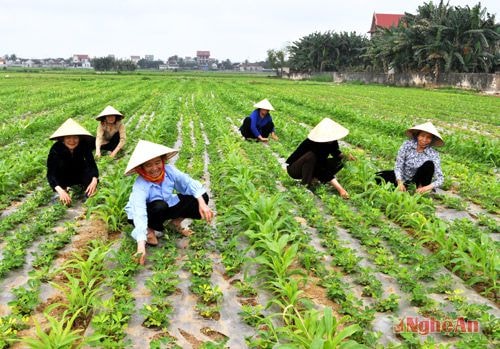 |
| Farmers in Dien Thinh commune (Dien Chau district) tending to peanuts. Photo: Quynh Lan |
According to Mr. Le The Hieu, Head of the Agriculture and Rural Development Department of Dien Chau district, to ensure a smooth winter crop season this year, the district has proactively dredged over 100 km of drainage canals and provided technical guidance to farmers on raising the planting beds to prevent flooding. The district has also provided very practical guidance to farmers on preparing crop seeds for the winter season. Accordingly, the district recommends that farmers plant corn varieties that are resistant to flooding and cold while still ensuring yield and quality, such as DK6919, PAC999, P4199, 30Y87… For nearly 2,700 hectares of corn planted on double-cropped rice land, the district will subsidize 30% of the seed cost. Additionally, the district will provide loans of 5 million VND to households needing to purchase tillage machinery for this winter season. Currently, some cultivated areas are experiencing an outbreak of rats and young locusts, which is considered a major obstacle to the development of winter crops. Therefore, the district has directed farmers to implement a plan to eradicate rats and locusts to ensure the growth of crops.
In Yen Thanh district, despite frequently facing difficulties due to natural disasters such as floods, which affect crop yields and production, the locality is determined to improve the efficiency of winter crop cultivation. From the beginning of the season, the district has plans and methods to guide farmers to take advantage of the time and prepare all conditions well for effective production. This year's winter crop season in the entire district covers 3,450 hectares, with corn being the main crop at 1,760 hectares, followed by vegetables at 900 hectares, peanuts at 60 hectares, and fish-rice farming at 300 hectares. Specifically, corn is sown on hillside land, hillside land, and land used for two rice crops, primarily using varieties such as LVN10, LVN14, NK66, NK6654, and CP888. In addition, the locality has partnered with TH Milk Company to cultivate approximately 300 hectares of corn for animal feed. This is considered a new approach to ensure market access for winter crop production and to initially establish a link between farmers and businesses in the province. To date, farmers have completed over 50% of the third fish crop and corn planting, while all vegetable crops have been prepared for planting.
Leveraging the strengths of each region.
In agricultural production, each region has its own natural conditions and practices; therefore, different localities are actively exploiting their strengths in winter crop production. In Thanh Chuong district, in addition to its strengths in vegetable and raw material areas, farmers are also implementing 700 hectares of fish farming in the third crop season. In the last two years, the fish-rice production movement in the district has developed strongly after the completion of land conversion work with a relatively complete system of dikes and canals. In 2014, the entire district implemented 584 hectares with a total production of 396 tons, and an average yield of nearly 7 quintals of fish per hectare.
Taking advantage of wetlands and low-lying areas, people here often practice intercropping, increasing income on the same plot of land. Mr. Phan Dinh Hy from Hamlet 2, Thanh Hung Commune, shared: “Raising fish in rice paddies has many advantages, because the fish eat insects that harm the rice, stir up the mud, and kill weeds; at the same time, when harvested, the fish eat the scattered rice grains and decaying straw. Fish raised in rice paddies, because they use natural food, are delicious and sell at a good price.” Communes that have the potential to exploit this approach include Thanh Lien, Thanh Tien, Thanh Xuan, Thanh Lam… Mr. Nguyen Canh Hanh, Chairman of the People's Committee of Thanh Hung Commune, shared: “According to calculations, rice cultivation combined with fish farming brings economic efficiency 2.5 times higher. Every year, people in the commune mainly implement fish farming in the winter season to avoid the hot weather and have a food source for the market before Tet.”
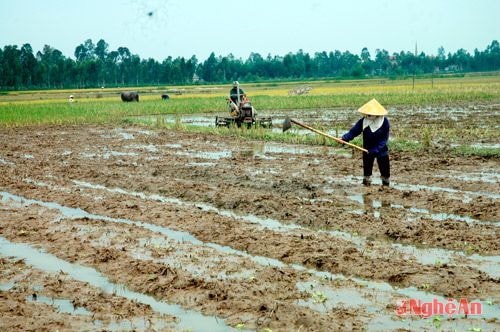 |
| Farmers in Quynh Dien commune (Quynh Luu district) prepare the land for planting winter corn. Photo: TQ |
As for Yen Thanh district, mushroom cultivation has developed strongly in recent years, and this is considered one of the ways to alleviate poverty in the district. Therefore, this year's winter mushroom crop is also receiving attention from the district government as well as the local people. Mr. Nguyen Van Hue, an agricultural extension officer in Yen Thanh district, said: “In order to provide mushroom spawn for farmers during the winter season, the district's mushroom spawn station is currently focusing on producing oyster mushrooms, button mushrooms, wood ear mushrooms, and straw mushrooms. Thanks to concentrated investment in building infrastructure, equipment, machinery, and specialized materials for tissue culture and mushroom propagation, the mushroom spawn products are of good quality. To date, the station has supplied 1 ton of oyster mushroom spawn, nearly 100,000 wood ear mushroom spawn sticks, and over 60,000 reishi mushroom spawn sticks to mushroom producers in Xuan Thanh, Nam Thanh, and Son Thanh communes. According to the plan, from now until the end of the year, the station will continue to produce about 10 tons of oyster mushroom and button mushroom spawn; 650,000 wood ear mushroom and reishi mushroom spawn sticks to serve farmers, ensuring a total production of over 500 tons of fresh mushrooms of all types.”
With the active involvement of all levels of government and the continuous creativity and innovation of the people to enhance production value, winter crop production is increasingly affirming its role in increasing farmers' income. This can be clearly seen in the 2014 winter crop production, where the entire province harvested nearly 115,000 tons of corn, nearly 2,600 tons of peanuts, and over 2,800 tons of fish and rice from the third crop. This is considered a remarkable achievement for the province's agriculture. The 2015 winter crop is predicted to face many difficulties due to unpredictable weather patterns; however, with efforts to adhere to the planting schedule to avoid natural disasters and the application of many synchronized measures in cultivation, a successful winter crop is promising.
Thanh Quynh
| RELATED NEWS |
|---|