

Europe is being criticized for 'humanitarianism running ashore'.
Many officials and activists argue that Europe's handling of the immigration crisis has been narrow-minded.
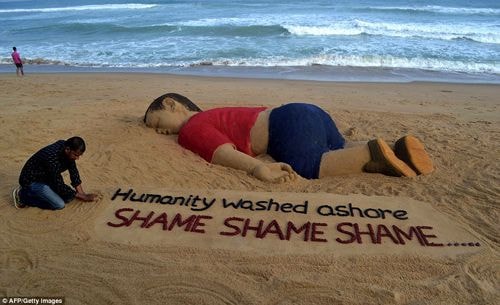 |
| Sand sculptureThe image depicts a Syrian baby washed ashore on the Turkish coast.AFP |
In recent days, the world has been shocked by a photograph of a young boy's body lying face down on the beach at a popular resort in Türkiye. Three-year-old Aylan, along with his older brother Galip and mother Rehan, were three of many migrants who drowned while attempting to reach Europe as refugees.
Numerous activists, artists, and international human rights organizations have spoken out about the current immigration crisis in Europe after that poignant image went viral online. On the Puri coast in eastern India, artist Sudarsan Pattnaik created a sand sculpture depicting Aylan lying face down in the sand, with the words "Humanity washed ashore. Shame, shame, shame" written below.
Narrow
On September 4th, UN officials also criticized European countries for their response to the worsening immigration crisis across the region, as well as the politicians' inability to find fundamental solutions to the problem, CNBC reported.
"The real problem here lies with the European Union (EU) member states, which are not yet ready to recognize the fundamental reality that if they do not find a solution where everyone shares responsibility and shows solidarity, the situation will not improve," said Peter Sutherland, the UN Secretary-General's Special Representative for International Migration.
"If everyone rests behind their borders and lines of defense, the disaster will continue and get worse."
Also on Friday, Antonio Guterres, of the UN High Commissioner for Refugees, stated that a Europe divided on immigration policy only benefits human traffickers, Reuters reported. Guterres called on the EU to do more to help refugees, many of whom have been forced to leave their homes in conflict zones in search of a better life in Europe.
Recently, record numbers of refugees have flocked to Europe's borders hoping to escape the bloody conflicts in the Middle East and North Africa. European border authorities recorded 340,000 illegal border crossings into the EU in the first seven months of this year alone. During the same period, more than 300,000 people risked their lives attempting to cross the Mediterranean to reach Europe, according to the United Nations Refugee Agency, and over 2,500 have died or gone missing on this perilous journey.
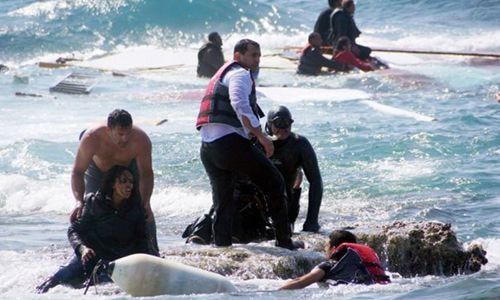 |
| Many peopleThe refugee drowned while attempting to cross the Mediterranean to Europe. Photo:CNN |
However, upon arriving in Europe, they faced the harsh reality that very few places welcomed them. Sutherland strongly criticized EU countries like Slovakia for bluntly stating that they would not accept any non-Catholic refugees.
"I can't believe that many Central and Eastern European countries are declaring they won't accept non-Catholic refugees because it doesn't align with the values we all share. That's unacceptable," he emphasized.
Another EU member, Hungary, has also been heavily criticized for building a 4-meter-high barbed wire fence along its border and blocking the main train station in Budapest, preventing refugees from reaching the rest of Europe.
Meanwhile, European countries bordering the Mediterranean Sea, such as Italy and Greece, are also struggling to cope with the massive influx of migrants arriving by sea. This is a particularly difficult challenge for Greece, a country already grappling with its own economic and political crisis. According to the United Nations Refugee Agency, two-thirds of refugees crossing the Mediterranean to reach Europe this year have landed in Greece. The situation is so dire that Greek Finance Minister Yanis Varoufakis has declared it a "humanitarian crisis."
David Miliband, former British Foreign Secretary and current chairman of the International Rescue Committee, has described Europe's response to the current refugee crisis as "short-sighted and narrow-minded," Time magazine reported. To date, EU leaders have been unable to agree on who will bear the greatest burden of this refugee crisis.
"Most European countries are pretending this is someone else's problem. The Hungarian Prime Minister even claims that this immigration issue is Germany's problem… Europe's handling of this issue has been quite weak, and I think EU leaders now need to make an effort to make up for lost time," Miliband stated.
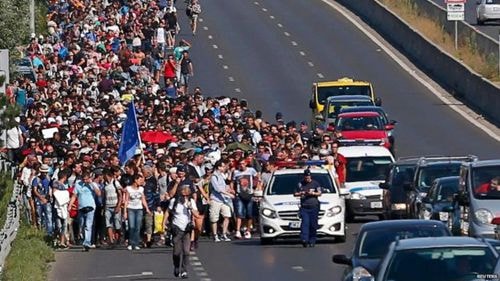 |
| RefugeesWalking along a Hungarian highway to find my way to Austria. Photo:BBC |
A 'drop in the ocean' solution.
According to Mr. Miliband, the EU now needs a more comprehensive policy on immigration, focusing on three key points. First, they must find ways to share the burden of receiving immigrants. Second, the EU needs a more appropriate system for registering and classifying immigrants, clearly distinguishing between war refugees and economic migrants seeking a better life who are not eligible for asylum. Third, Europe needs to be more proactive in supporting countries surrounding the Syrian conflict zone, such as Lebanon, Jordan, Türkiye, and Iraq, which are struggling to cope with the influx of 4.5 million refugees from Syria over the past four years.
Mr. Miliband argued that Europe's approach to the refugee issue is "short-sighted and narrow-minded," because they believe they are bearing too much of the burden. He pointed out the fact that 86% of the world's refugees are concentrated in poor, developing countries, not in the US or Europe.
For example, Lebanon, a country with 4.5 million inhabitants, is currently hosting 1.6 million refugees. Türkiye is currently home to nearly 2 million refugees, while 700,000 displaced people are concentrated in Jordan, a country with 6.5 million inhabitants. In other words, it is these developing countries that are bearing the brunt of the largest refugee crisis.
Under increasing public pressure, Austria and Germany recently announced they would accept hundreds more refugees stranded at the train station in Budapest, Hungary. However, this effort is merely a drop in the ocean compared to the tens of thousands of other migrants still on their journey to find a "promised land."
According to VNE
| RELATED NEWS |
|---|