
Reasonable...
(Baonghean) - Some have concluded that too much of anything is not good. Too much money easily leads to corruption. Too much poverty easily leads to recklessness...
(Baonghean) - Some have concluded that too much of anything is not good. Too much money easily leads to corruption. Too much poverty easily leads to recklessness...
Some have concluded that anything in excess is bad. Too much money easily leads to corruption. Too much poverty easily leads to recklessness. Being too kind can be detrimental. Overdosing on medication can harm one's health. Trying too hard can lead to death... In short, in life, there is only one thing in excess that seems good: "too much luck!" It sounds like a joke, but it's not without reason.
Let's start with a specific, real event in Hanoi. When people think of or talk about this sacred and elegant land, they immediately think of the scent of milk flower. This flower, and its fragrance, has entered poetry and remains an unforgettable memory for those who have lived in Hanoi. There are those who have spent long nights cycling leisurely through the streets just to savor the gentle, pure, yet intensely fragrant scent of the flowers in the cool breeze of early winter.
Those who only know the scent of milk flower through books always yearn to visit the capital to experience it firsthand. People love, like, cherish, and treasure that fragrance. But that treasure was only possible when long streets like Quang Trung and Nguyen Du had only a few milk flower trees. When only a few places in Hanoi had them, and the scent gently wafted through the lingering night mist. Now, the once pure scent of milk flowers has become a very frightening and dangerous smell, threatening human health.
Ultimately, it all boils down to one word: "too much." That is, in the new streets and neighborhoods, too many milkwood trees have been planted. The density is extremely high, reaching thousands of trees along the streets. For example, Le Duc Tho Street, about 3.5 km long, has approximately 200 milkwood trees, all quite tall with wide canopies. Le Quang Dao Street, though shorter, has nearly 400 milkwood trees crowded together. Currently, they are in bloom and simultaneously releasing their fragrant scent.
But the fragrance is so overwhelming, so pungent, that it turns life under the canopy of these "flowers of poetry and music" into an endless torment for the residents. They can't eat or sleep because the scent of the milkwood flowers is too strong. Those living there have to cover their noses and endure it, while passersby try to avoid those roads during the season when the milkwood flowers bloom uncontrollably. Of course, the fault isn't with the milkwood flowers themselves. The fault lies primarily with the people who planted them.
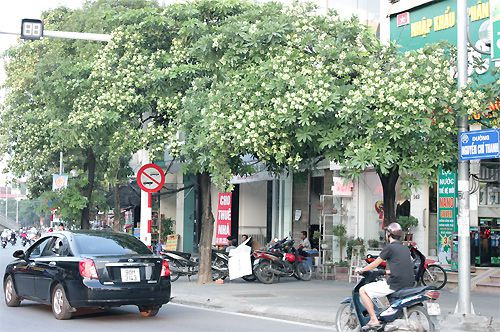 |
| If the milkwood trees are planted too densely, the flowering season will become a nightmare for the surrounding residents (photo: Internet). |
They blindly and recklessly cultivated it with the crude mindset that since it was something many people loved and cherished, the more they provided, the better, without considering that everything has its limits. Excessive indulgence is counterproductive. Clearly, due to careless and unthinking actions, a beloved flower and fragrance, once a symbol of romanticism and elegance from a land of thousand-year-old culture, renowned for its refinement, has been transformed into a terrifying, shunned scent. Someone rightly said that enthusiasm combined with ignorance leads to destruction.
Conversely, also in Hanoi, a recent event has sparked a strong public reaction. Newspapers have just reported, "Internal audit reveals no corruption in Hanoi," citing the Hanoi People's Committee's 2015 anti-corruption report. At a time when the public is averse to and deeply concerned about corruption and eagerly awaits strong action from authorities to clean up public institutions, this information should ideally be encouraging, fulfilling the nationwide expectation of a clean and strong society.
However, no one felt happy, excited, or confident about the results. On the contrary, people were disappointed and skeptical of the report. Because in Hanoi, in just two years, 2014 and 2015, there were quite a few major incidents, such as the campaign to cut down and replace 6,700 trees, the abandoned stadium and theater project worth hundreds of billions of dong, the "gently curving road," and the illegally constructed 8B Le Truc building threatening a sacred place… This immediately led people to believe that there must have been many shady dealings for personal gain to cause such shocking and bizarre events, like "an elephant squeezing through a needle's eye."
Yet, this local inspection agency "has not found any cases showing signs of corruption." This is yet another counterproductive thing: excessive cleanliness. So clean that it's unbelievable and fuels suspicion that widespread cover-up and protection are necessary to achieve such "one hand covering the sky."
If the excessive and uncontrolled planting of milkwood trees was due to an uninformed enthusiasm, then the excess in the latter could be due to a disregard for public opinion and a defiance of reality. However, either way, it shows a common point: going too far, exceeding limits, leading to negative results.
Therefore, in life, it's not always good to fulfill everyone's desires, likes, or wishes in abundance. What's more important is moderation. If you overdo it, good things can turn bad, as in the two examples above. Therefore, in life, don't overdo anything; strive to maintain a reasonable balance for lasting success and reliability. Everything should adhere to the principle of moderation.
Buddha Mountain
| RELATED NEWS |
|---|