

Life and career of Comrade Tran Quoc Hoan
(Baonghean.vn) - Comrade Tran Quoc Hoan, whose real name was Nguyen Trong Canh, was born on January 23rd, 1916 (the year of the Dragon), into a poor peasant family in Dinh hamlet, Duong Lieu village, Nam Kim commune (now Nam Trung commune, Nam Dan district, Nghe An province), a land rich in cultural and revolutionary traditions.
Born and raised in a country still under colonial rule, witnessing the miserable lives of the people under the oppressive and exploitative colonial and feudal regimes, Tran Quoc Hoan was nurtured with patriotic ideals and a revolutionary spirit from a very early age.
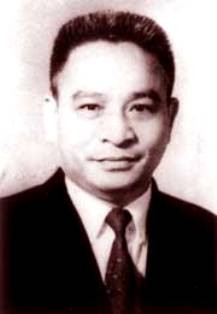 |
| Comrade Tran Quoc Hoan |
Even while still a student, Tran Quoc Hoan actively responded to the call of the Viet Restoration Society, participating in the struggles of students and people of Nghe An demanding that the French colonialists abolish the death sentence of Phan Boi Chau (in 1925), attending the memorial service for Phan Chu Trinh (in 1926), and protesting against the French colonialists' boycott of teacher Ha Huy Tap.
In 1930, Tran Quoc Hoan joined the anti-imperialist student organization of the Indochinese Communist Party. He was entrusted by the Duong Lieu village branch with the task of distributing leaflets, acting as a liaison, and enthusiastically participating in rallies and demonstrations with thousands of farmers from various districts, marching to surround and destroy the Nam Dan district office, the liquor office, and the prison to free political prisoners.
After participating in revolutionary activities in his hometown, Tran Quoc Hoan decided to leave his family and work as a laborer in the Boneng lead mine (Thakhet, Laos), partly to earn a living and partly to have the opportunity to interact with the working class and improve himself.
Here, Tran Quoc Hoan was assigned by the Party organization to propagate and mobilize workers, and he quickly matured from a patriot into a communist. In March 1934, Tran Quoc Hoan was admitted to the Indochinese Communist Party.
In late 1934, he was arrested by French secret police and sentenced to 8 months in prison and 5 years of exile. After serving his sentence, he was placed under house arrest in Ha Tinh. In 1936, Tran Quoc Hoan escaped to Hanoi and participated in the Democratic Front movement, working for several public Party newspapers in Hanoi at that time.
From 1937 to 1939, following the Party's directive, Tran Quoc Hoan went underground, participating in the Standing Committee of the Hanoi City Party Committee as Deputy Secretary and then Secretary of the Hanoi City Party Committee. Being relentlessly pursued by the enemy, in May 1940, he was allowed to leave Hanoi and took up a job at the "Giai Phong" (Liberation) newspaper printing house, directly writing in reverse on stone for lithographic printing.
At a new operational location, he continued to direct the printing and distribution of the newspaper "Liberation," which had been founded earlier by comrades Tran Huy Lieu, Vo Nguyen Giap, and Dao Duy Ky. To suit the Party's propaganda work in the new period, the Party renamed the "Liberation Flag" newspaper. After working at the press agency for a time, Comrade Tran Quoc Hoan was transferred to take charge of the Northern Regional Party Committee's transportation station, concurrently serving as the Head of the Revolutionary Movement Steering Committee for the two provinces of Bac Ninh and Bac Giang.
In early 1941, he was arrested for the second time by the French colonial authorities and sentenced to 6 years in prison and 20 years of house arrest at Hoa Lo Prison (Hanoi), before being exiled to Son La Prison.
Here, he participated in the activities of the prison Party cell and in 1944, was elected Secretary of the prison Party cell. After the Japanese coup against the French (March 9, 1945), Tran Quoc Hoan skillfully persuaded the prison guards to release 200 political prisoners, allowing them to safely withdraw to the Party's operational areas, contributing to the recruitment of cadres for the August Revolution of 1945.
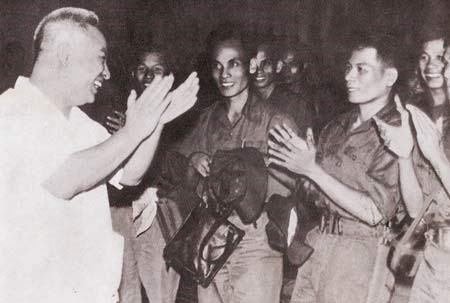 |
| Minister Tran Quoc Hoan visits a police unit before departing for combat and work in the Southern battlefield. |
Upon his release from prison, he was appointed Secretary of the Northern Regional Party Committee by the Central Committee. In December 1946, he was appointed Central Committee envoy in Hanoi. In 1947, he became Secretary of the Inter-regional Party Committee II. In March 1948, he became Secretary of the Inter-regional Party Committee X. In 1949, he became Secretary of the Hanoi Special Zone Party Committee. In 1951, at the Second National Congress of the Party, he was elected to the Central Committee. On August 19, 1952, he was assigned by the Central Committee to be in charge of the Public Security sector. On September 6, 1952, President Ho Chi Minh signed a decree appointing him Director of the Vietnam Public Security Department. In February 1953, he served as Deputy Minister of Public Security and then as Minister of Public Security (later renamed the Ministry of Interior until 1980).
From 1954, he also served as Secretary of the Hanoi City Party Committee, directly organizing the successful takeover of the capital and the relocation of the Government and the Central Committee of our Party from the Viet Bac war zone to Hanoi.
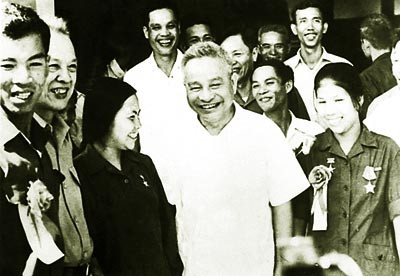 |
| Comrade Tran Quoc Hoan and lawyer Nguyen Huu Tho had a cordial meeting with delegates attending the Conference to honor Heroes of the Southern Security Forces. |
In 1960, at the Third National Congress of the Party, he was elected to the Central Committee and subsequently elected by the Central Committee as an alternate member of the Politburo. In 1972, he became a full member of the Politburo. In 1976, at the Fourth National Congress of the Party, he was re-elected to the Central Committee and subsequently re-elected by the Central Committee to the Politburo. He was also a member of the National Defense Council.
From 1961 to 1984, he served on the Central Military Commission. At the end of 1980, he was appointed by the Central Committee to the Party Central Secretariat. In 1982, at the 5th National Congress of the Party, he was re-elected to the Central Committee and appointed Head of the Central Committee's Mass Mobilization Department.
Comrade [Name] was a member of the National Assembly from the 2nd to the 7th term. Due to his immense contributions to the revolution, he was awarded many medals and decorations, including the Gold Star Medal - the highest honor of our Party and State. Due to old age and declining health, he passed away in Hanoi in early September 1986, at the age of 70.
N.Khoa (compiled)