

The Syrian conflict: A fierce race to the finish line.
(Baonghean) - The British online newspaper Express reported on October 4, 2015, that Russian President Vladimir Putin may be preparing to send approximately 150,000 ground troops to Syria to participate in the fighting. Meanwhile, the US and its allies are also actively preparing for a large-scale offensive against Raqqa, considered a stronghold of the self-proclaimed Islamic State (IS) in Syria. The fight against IS in Syria is entering new phases, and the competition between Russia and the US and its allies on this front is becoming more intense.
Intensify military actions.
According to the British news site Express, Russian President Vladimir Putin has signed a decree summoning nearly 150,000 additional troops, suggesting that these troops are being prepared for deployment to Syria to eliminate ISIS. However, Russian sources have not yet provided any evidence to confirm the Express's assessment.
Russian President Putin's spokesman, Dmitry Peskov, told Sputnik News that the decree signed by the Russian leader had nothing to do with the conflict in Syria and was just a normal document the President signs twice a year.
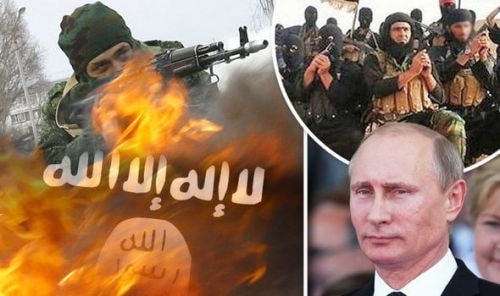 |
| The image, accompanied by information from the online news site Express.co.uk, claims that Putin is preparing to send more troops to Syria. |
However, in a separate development, a photograph that emerged on October 1st showed heavy military equipment disguised for desert combat being shipped from Novorossiysk Port to Syria. The image suggests that Russia may be involved in ground operations in Syria.
Furthermore, Putin's ardent ally, President Ramzan Kadyrov of the Chechen Republic of the Russian Federation, has called on the Russian president to deploy the notorious Islamist army to Syria to defeat ISIS.
According to the Russian news agency Sputnik, Vladimir Komoyedov, Chairman of the Defense Committee of the State Duma (the lower house of the Russian parliament), stated on October 5th that Russia is considering sending more warships from the Black Sea Fleet to Syria to support its airstrike campaign against ISIS terrorists. In addition to transporting weapons, the Russian warships will also be tasked with blockading the Syrian coast.
Western sources indicate that signs of Russia's continued and deeper military intervention in Syria are increasing, and that Putin is planning to expand the campaign in Syria to support President Assad.
Meanwhile, the New York Times reported on October 4th, citing sources from US military and government officials, that US President Barack Obama had taken two important steps to approve the plan to open this front in the near future. For the first time in history, Obama ordered the Pentagon to directly supply ammunition and possibly weapons to opposition forces in Syria.
President Obama also agreed to a proposal to intensify airstrikes against ISIS militants from an air base in Türkiye, although key details have not yet been released. Notably, in the upcoming operation, the US will add a new element to the Kurdish militia: Arab fighters. The US will support Kurdish and Arab fighters, helping them approach ISIS's stronghold of Raqqa, isolating Raqqa and cutting off all supply and logistics routes in the northeast and northwest of the city. US officials said the Arab forces participating in the operation are expected to be called the Syrian Arab Coalition, comprising 10-15 armed groups with a total strength of 3,000-5,000 people. The Kurdish militia will have a larger force, with approximately 25,000 people.
Fierce competition
The decision to intervene in Syria with a relatively large-scale military campaign demonstrates Russia's determination to protect its ally, the government of Syrian President Bashar Al Assad. On the diplomatic front, Russia's actions are a response to calls from the Al Assad regime. Russia also received support from Iran, Egypt, and even Iraq for its military intervention in Syria against ISIS. With the participation of Iran, Syria, and Hezbollah, Russia is effectively leading a new anti-ISIS coalition. On the military front, Russian airstrikes are proving effective, consistently destroying ISIS training facilities and weapons depots.
Amidst Russia's increased military activity in Syria, the US and its allies are also actively reinforcing their anti-ISIS forces. The US does not want its international coalition to be at a disadvantage compared to the Russians. Concerned that Russia might advance and control Raqqa and all the surrounding oil and gas fields near Palmyra, the US has actively supported Arab ground forces approaching Raqqa ahead of the Russian coalition in order to gain an early advantage.
The US and the West are truly "shocked" by Russia's determination in this military intervention in Syria. The intense airstrikes by Russian aircraft against ISIS in the past few days are proving more effective than months of airstrikes by the US and its allies. Therefore, the US and its allies understand that, sooner or later, Russia will expand its military operations throughout Syria. This not only overshadows the US and its allies on the anti-ISIS front in Syria but also threatens the very survival of Syrian opposition forces supported by the US and the West.
Some argue that these new moves by both Russia and the US could lead to a dangerous "race to the Raqqa hotspot." If Russia decides to send ground troops to Syria, the fight against ISIS could take a new turn, with ISIS expected to quickly collapse when facing Russia's formidable forces.
In reality, IS fighters are adept at terrorist attacks, but their professional combat skills are not highly regarded. The reason IS has been able to continue operating is because these militants have not yet faced any well-trained infantry. And the US can certainly worry about the scenario where, once IS is completely eradicated from Raqqa and the rest of Syria, Russia will support the Syrian President Al Assad's regime in consolidating its power.
And therefore, all the effort and money spent supporting the Syrian opposition forces is at risk of being wasted. Consequently, while the US is increasing its support for opposition fighters against the Assad regime and the Arab army to launch more aggressive attacks against ISIS, the US is also asserting that its new anti-ISIS plan will not involve coordination with Russia. Meanwhile, the Arab League countries, allies of the US, have also bluntly stated on the sidelines of the recent UN General Assembly meeting that they will not cooperate with Russia.
Clearly, these developments show that, although Russia and the US have agreed to coordinate to avoid conflict, going their separate ways in their strategies to attack ISIS will create a new and fierce competition. Analysts believe that if Russia actually deploys ground troops to Syria, this move will further deepen the already strained relationship between Russia and the West. Therefore, international public opinion fears the risk of a larger, more intense confrontation in the Middle East in the future.
Nguyen Cao Bien