
Festival in the deep forest
(Baonghean) - The field worship ceremony is an indispensable ritual for rice farmers in the highlands. For the Khơ mú community in Kỳ Sơn and Tương Dương, the field worship ceremony takes place before the harvest season begins.
(Baonghean) - The field worship ceremony is an indispensable ritual for rice farmers in the highlands. For the Khơ mú community in Kỳ Sơn and Tương Dương, the field worship ceremony takes place before the harvest season begins.
I once heard the elders in Bao Thang commune (Ky Son district) tell stories about the custom of worshipping the fields. It's a strange and fascinating ritual, with the festive atmosphere taking place right in the fields. This is a day dedicated to the deities, a day for people to show their reverence and pray for blessings, health, and prosperity.
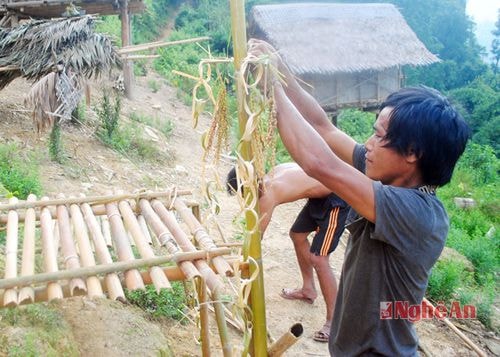 |
| Prepare the altar. |
Stories of local customs compelled me to return to the village during the rice harvest season. Passing through Minh Thanh village, Luong Minh commune (Tuong Duong district), I met a friend named Lo Van Na who told me that in the forest on Pu Mat mountain, bordering Luong Minh commune and three communes of Ky Son district—Bao Thang, Chieu Luu, and Muong Long—there would be a field worship ceremony the following day. The master of ceremonies would be shaman Cut Van Huong from Cham Puong village, Luong Minh commune. This 70-year-old man would perform the ceremony for five families who cultivate fields in Pu Mat. They live in Luong Minh and Bao Thang communes. These areas are in two different districts but share the same farming region.
To reach the location of the field-worshiping ceremony, we had to ask for help from the officials of Bao Thang commune. Vice Chairman Moong Van Loi and Mr. Lo Van Xoai, the commune's cultural officer, enthusiastically agreed. At 6:30 a.m., we set off together.
Reaching the fields in Pu Mat mountain was a truly arduous feat. The mountain slopes seemed to rise endlessly. The path led us through dozens of slopes, bamboo forests, reed forests, and rice paddies… After nearly two hours of climbing and descending the mountain passes, I had to rely on my walking stick to continue the journey.
As we trekked through the forest, Mr. Moong Van Loi explained to me the names of each hill and patch of forest. The hilly area covered with cogon grass where we stopped to rest was called Cau Ta. In the old days, during the war, the villagers worked together on a large plot of land. This plot of land required 9 quintals of rice seeds, hence the name Cau Ta (9 quintals). Beyond Cau Ta hill, we encountered another new plot of land, where the rice was almost ripe, waiting to be harvested.
From the watchtower in the fields, the sound of dogs barking echoed. I secretly rejoiced, thinking we had arrived and were about to rest. However, the village cultural officer told me we had to cross another hill to get there. Now, the forests in Bao Thang have been planned with headwater forests and protected forests to safeguard water sources. People are only allowed to clear land for farming in designated areas. That's why people have to travel far to cultivate their fields. Mr. Loi shared: "Those whose fields are far away have to store the harvested rice in warehouses in the forest; some even don't carry it home. Because the fields are so far away, the rice is only used to feed livestock or for when they have to stay on the fields for extended periods."
When our legs felt like they were about to give way, we arrived at the hut where the field offering ceremony was taking place. The homeowner was Mr. Moong Van Binh from Cha Ca 1 village, Bao Thang commune. It was almost 9 a.m. While waiting for the shaman, who was on his way to the fields, they prepared two ceremonial platforms, one tall and one shorter. Both were made of bamboo and reeds. On each platform, twelve rings woven from reed stalks were tied, and the plumpest rice stalks hung down as offerings. Four chickens were tied to the base of the platforms. Cloths, clothes, skirts, and headscarves were laid out on the platforms. One person in the group explained that they were not allowed to slaughter the chickens yet, as they had to wait for the spirits' permission.
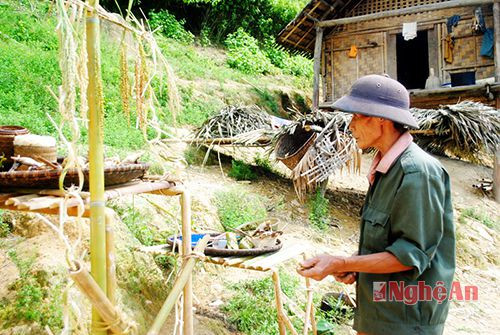 |
| The shaman performs a ritual inviting the spirits to partake in the meal. |
The shaman arrived and the ceremony began. Shaman Cụt Văn Hường said that all the prayers of the Khơ mú people in Lượng Minh commune, Bảo Thắng district, are in the Thái language. The 70-year-old shaman also doesn't understand why the prayers of the Khơ mú community are in Thái.
The shaman's ritual summons the spirits of banyan trees, large and small trees, bamboo roots, fields, and the souls of those who died in the fields and forests to come and see the offerings presented by the living. After the ritual summoning the spirits, the shaman takes a knife and taps two prepared bamboo sticks. With these bamboo sticks, the shaman can understand the will of the spirits by tapping them until they toss up and fall to the ground, like tossing a lucky coin. Shaman Huong prays: "Since all the spirits have gathered, let both bamboo sticks land either heads or tails." Having said that, he taps the bamboo sticks, causing them to toss up and fall. It takes five taps before both sticks land tails up in a row. This signifies that all the spirits have come to attend the field offering ceremony.
The shaman continued the ritual, recounting the offerings, from the chicken and jar of wine to the skirt and shirt, and inviting the spirits to see if they were satisfied. The men examined the rice wine, the homemade liquor, and the tobacco grown in the fields; the women inspected the skirts, shirts, and embroidered scarves. The fat chickens were carefully raised for a year, reserved specifically for the field offering ceremony. After each section describing an offering, the shaman would tap a bamboo stick to "ask" the spirits if they were pleased. Only when all the offerings were accepted by the spirits were they allowed to slaughter the chicken and prepare sticky rice. The meat of three animals—rat, squirrel, and crab—was used to make the dish "moọc." Once the dishes were ready, they were all arranged on the offering platform. The shaman then offered a prayer inviting the spirits to partake in the meal, enjoying each delicious dish in turn, such as the boiled chicken and the "moọc."
Two bamboo slips were then struck, flung into the air, and then fell face down. This confirmed that the spirits had finished their meal, and the shaman performed the "invitation to drink wine" ritual. Afterward, the spirits were invited to receive offerings such as skirts, scarves, and clothing. Once all the offerings had been received, the shaman performed the final ritual of sending the spirits back to their rightful place. "Wherever you came from, return to that place to protect the land, bless the harvest, and ensure the health of people and livestock," Mr. Huong's prayer read.
Once the spirits had returned to their abode, the real festivities of the farmers began. Offerings were laid out on wild banana leaves. Bamboo tubes were used as drinking cups. The sound of a traditional folk song from the cultural officer's phone suddenly blared out, the volume turned up to maximum. Following the song were the sounds of the lam vong music. When slightly tipsy, without a word, everyone stood up and danced around the feast. The small hut suddenly became a stage, and all the farmers were actors.
Shaman Cụt Văn Hường shared: "During a farming season, there are two main ceremonies: the harvest festival and the field worship ceremony. The field worship ceremony is to thank the spirits who govern the mountains and forests. As for us, those fortunate enough to experience this rare joyous occasion, we have a truly special feeling. It's probably very difficult to find such an atmosphere where the festival takes place right in the middle of the deep forest."
Text and photos:HỮU VI
| RELATED NEWS |
|---|