

Linking processing with sustainable agricultural and forestry development.
(Baonghean) - In recent years, the agricultural and forestry processing industry in Nghe An province has made positive progress, contributing to the transformation of the agricultural and rural economic structure towards industrialization and modernization, creating regular jobs and stable income for workers...
Currently, Nghe An province has nearly 32,000 agricultural, forestry, and fishery processing facilities, employing nearly 58,000 workers. These processing facilities are being built on an increasingly large scale, creating many high-quality products for both domestic and export markets.
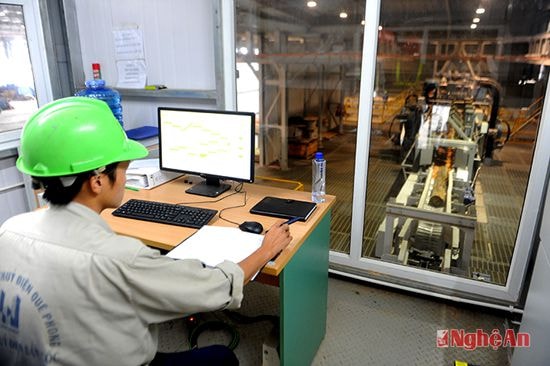 |
| Operating the laminated wood panel processing line at the Nghe An Wood Factory. Photo: Sy Minh |
In the rice procurement and processing sector, there are two enterprises that organize the procurement and processing of rice on an industrial scale: Vinh Hoa Co., Ltd. (Yen Thanh) and Nghe An Agricultural Materials Joint Stock Corporation. These two units purchase and process tens of thousands of tons of rice annually in the province. Vinh Hoa Co., Ltd. alone has invested in a fairly comprehensive processing system including rice milling and drying machines using electric ovens, with a processing capacity of over 30,000 tons per year. The company is aiming to invest heavily in developing purple herbal rice, utilizing rice straw by-products to produce herbal tea, Omega extracts, etc.
Nghe An has 3 animal feed production facilities using corn kernels, beans, etc., with a total capacity of 160,000 tons/year (Goldenstar Animal Feed Company Limited, a 100% foreign-invested enterprise, has a capacity of 80,000 tons/year; Con Heo Vang Animal Feed Factory, belonging to VIC Trading Company Limited in Hai Phong City, has a capacity of 40,000 tons/year; Hope Special Zone, located in Nam Cam Industrial Park, has a capacity of 40,000 tons/year). Animal feed production in 2014 reached 82,000 tons. The sugar cane processing sector is developing quite strongly with 3 factories, processing nearly 15,000 tons of sugar cane/day (NASU Sugar Factory 9,000 tons, Song Con Sugar Factory 5,000 tons/year, Song Lam Sugar Factory 1,000 tons). The production of processed sugar in 2014 reached 153,258 tons.
Regarding tea processing, there are 86 processing facilities with a total designed capacity of 527 tons/day, requiring 120,000 tons of raw materials per year (processing time of 230 days/year). Among them, Nghe An Tea Investment and Development Company Limited has a designed capacity of 243 tons of fresh tea leaves/day; there are 3 cassava starch processing plants that provide a stable supply of raw materials, operating with a total capacity of 900 tons of fresh tubers/day (the plant in Thanh Chuong has a capacity of 500 tons/day and the plant in Yen Thanh has a capacity of 300 tons/day; the Nghia Long - Nghia Dan cassava starch plant has a capacity of 100 tons/day). The province also has 2 dairy processing plants: Vinamilk's plant in Cua Lo town with a capacity of 30 million liters of fresh milk and yogurt/year, and TH True Milk's plant in Nghia Dan district with a capacity of 200 million liters/year.
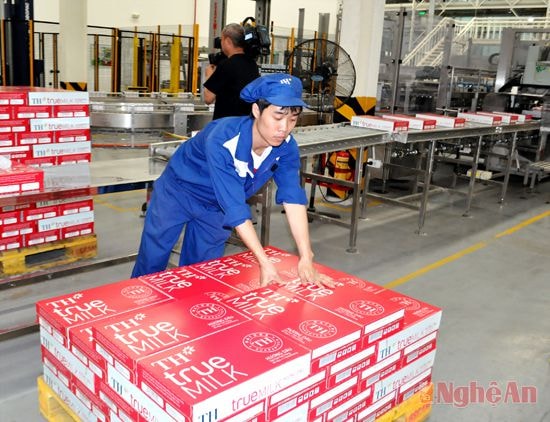 |
| Produced at TH Dairy Factory. Photo: Chau Lan |
Wood processing and wood product manufacturing are developing quite strongly. The province has 45 wood processing enterprises, 98 enterprises producing non-timber forest products, and in addition, there are 10,410 individual and family-scale production and business establishments dealing with wood and non-timber forest products; processing wood chips for export, reaching 300-400 thousand tons/year, with annual export revenue exceeding 100 million USD...
Mr. Tran Huu Tien, Deputy Director of the Department of Agriculture and Rural Development, said: Businesses involved in processing agricultural and forestry products are increasingly innovating technology, applying quality management systems, and registering for industrial property rights protection... in order to enhance the competitiveness of their products. Processed agricultural products have been exported to many countries such as the UK, India, Iran, Japan, Taiwan, Hong Kong, China, Indonesia...
From now until 2020, the province aims to promote the sustainable development of agricultural and forestry processing industries, forming a large-scale commodity production sector with a rational structure and production organization; high productivity, quality, efficiency, and the building of reputable brands with high competitiveness. Simultaneously, it will rationally utilize and exploit land resources to develop concentrated industrial crop cultivation areas linked to product preservation, processing, and consumption to improve product quality and added value. It will also promote joint ventures and linkages between raw material producers and processing and consumption enterprises. This will create stable jobs and increase income for approximately 40,000 workers, contributing to the transformation of the rural labor structure and reducing the poverty rate. The projected average growth rate is 12.2-12.5% per year; export turnover is expected to reach US$500 million, with an average increase of 17.02% per year.
Based on this, the province will select a number of key processing plants to support investment and expand production scale to meet export demands. Simultaneously, it will establish a system of satellite facilities responsible for preliminary processing of raw materials and the production of finished or semi-finished products on an appropriate scale; expand the network of facilities responsible for collecting, preserving, and preliminary processing of raw materials in agricultural, forestry, and fisheries production areas; innovate technology, increase the proportion of deeply processed products, ensure food safety, and offer competitive prices to meet the requirements of demanding markets. Policies will be implemented to support machinery, equipment, and preliminary processing techniques for agricultural, forestry, and fisheries products for small-scale and family-owned businesses.
One of the key solutions is to implement a policy that leverages and harmoniously combines the extraction and supply of raw materials with the processing stage. This involves coordinating agricultural and forestry processing plants with scientists and research centers to select and breed plant and animal varieties that meet the requirements of the processing industry. Furthermore, it is necessary to develop more concentrated raw material areas such as fruit-growing areas, clean vegetable areas, forestry raw material areas (acacia, bamboo, timber, etc.), and livestock and poultry farming areas. Coordination with neighboring provinces such as Thanh Hoa, Ha Tinh, and Laos is also crucial to establish several raw material zones for the processing of agricultural and forestry products within the province.
The processing industry will shift its product structure towards increasing the proportion of high value-added products, improving product quality and food safety. For products consumed domestically, it will ensure safety and hygiene standards, and improve quality and design. For export products, it will ensure national and international standards, and continue to implement solutions to support agricultural production, including agricultural extension policies, policies applying scientific and technological advancements to production, providing market information, and developing infrastructure serving agricultural production.
Van Truong