

The Fire Keepers
(Baonghean) - Living in different rural areas and coming from diverse family backgrounds, they share a common trait: enthusiasm and responsibility towards the community. They are respected and influential figures in their communities, and are well-liked by their fellow villagers.
Ms. Quy is "4 in 1"
"Everyone admires her strength and dedication to the community, but few know that her life has been full of hardships," shared Mr. Nguyen Ngoc Quyen, Secretary of the Party Committee of Hung Chau commune (Hung Nguyen district), when speaking about Ms. Nguyen Thi Quy, a woman whom the locals jokingly call "4 in 1".
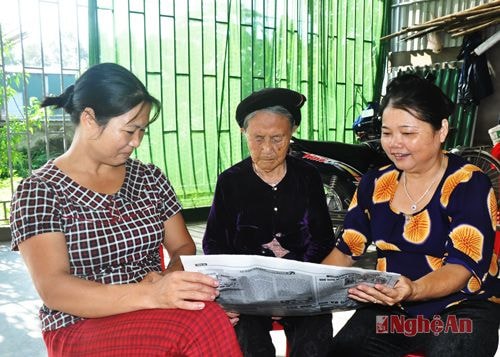 |
| Ms. Nguyen Thi Quy (far right) discusses the economic development movement and best practices published in newspapers. |
When you meet her, seeing her cheerful demeanor, no one would guess that she had endured years of extreme grief. Her husband died in 1995 while working in the fields. With two young children, the older one seven and the younger one just one year old, the overwhelming difficulties made her feel like she couldn't recover. More than ever, the two children needed their mother's hands and shoulders to bear the burden of their deceased father. She decided to rise again. Respected and trusted by the villagers, she joined the Women's Association of the hamlet, and later had the honor of joining the Party (in 2001), being appointed Head of the Front Committee. In 2004, Ms. Nguyen Thi Quy was appointed Deputy Secretary of the hamlet's Party branch, followed by a population officer and a representative of the commune's People's Council.
Hamlet 8, where Ms. Nguyen Thi Quy lives, is considered a model hamlet for socio-economic development in Hung Chau. The hamlet has 98 households (356 people), including 43 Catholic households, and was recognized as a Cultural Village in 2002. Besides agricultural production, the people of Hamlet 8 also engage in several supplementary occupations and have been recognized as a traditional craft village specializing in rice crackers and peanut candy. The movement for national unity in building a cultural life in the residential area has been truly effective, strengthening solidarity between Catholics and non-Catholics, helping each other develop economically, and for five consecutive years, no one in the hamlet has had a third child. Currently, there are only 6 poor households, and the arts and sports movement remains vibrant, with various organizations fulfilling their roles. This is largely due to the active and enthusiastic contributions of Ms. Nguyen Thi Quy.
Old Man Phit in Tan Tien
The old man's full name is Ngan Van Phit, from Tan Tien village, Tan Thang commune (Quynh Luu district). Old man Phit is a former teacher who dedicated 38 years to the education of children at the primary school in Quynh Thang commune. Upon retiring and returning to his village, he realized that his community still lagged behind in many aspects, which deeply troubled him.
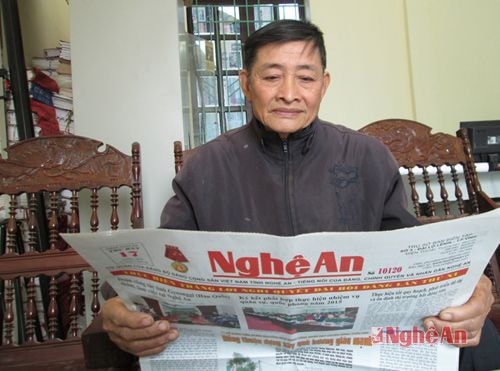 |
| Old man Ngan Van Phit reads the party newspaper. |
The village has 78 households, 100% of whom are of the Thai ethnic group, whose lives mainly depend on slash-and-burn agriculture, growing sugarcane and pineapples. As the head of the Elderly Association and the Farmers' Association, Elder Phit has proactively embraced scientific and technological advancements and encouraged the people to apply them to economic development. “If you only hope to escape poverty through hard work, it’s very difficult. In this day and age, you have to know how to apply technological progress to your business. You have to be dynamic, you have to dare to think, dare to be creative,” Elder Phit believes and advises the villagers accordingly.
The people of Tan Tien village say that thanks to Elder Phit, their village no longer experiences problems like drunkenness causing disorder, illegal migration, or forest fires. He also helps many villagers in need with crops, livestock, and scientific and technical knowledge to help them overcome poverty. Currently, over 70% of families in Tan Tien have been recognized as culturally exemplary, and all children of school age attend school. In particular, in recent years, the village has consistently implemented the Family Planning policy well, and the number of third births has been significantly reduced. Regarding economic development, Tan Tien village has seen many positive changes, with total annual income exceeding 6 billion VND.
In implementing the National Target Program on building new rural areas, village elder Ngan Van Phit set a leading example and propagated and mobilized villagers to voluntarily cut down 800 trees of various types such as oranges, longan, cinnamon, and flowering trees, and donated 2,000 square meters of land.2 Land was used to build rural roads. The road leading to the village is now wide, facilitating the entry and exit of vehicles for transporting agricultural products in the area.
The pioneers of Khe Lang
Upon arriving in the mountainous district of Con Cuong, when we expressed our desire to learn about an exemplary young Fatherland Front official, without much hesitation, Mr. Nguyen Le Loi, Chairman of the District Fatherland Front, said: "You can go to Ms. Giao; she is one of the outstanding Fatherland Front officials in the entire district."
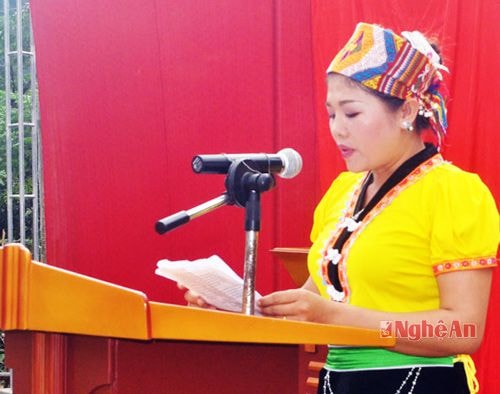 |
| Ms. Vi Thi Giao - Vice Chairperson of the Fatherland Front Committee of Lang Khe Commune |
The person Mr. Loi just mentioned is Ms. Vi Thi Giao (born in 1985), Vice Chairman of the Fatherland Front Committee of Lang Khe commune, an area where the Thai ethnic group is the majority. Ms. Giao is a former village-level official who rose through the ranks as the head of the Women's Association branch, and later took charge of the commune's agriculture sector. In 2010, she was elected Vice Chairman of the Fatherland Front Committee of Lang Khe commune. Ms. Giao recounted: "When I first took on the job, I was very worried because I was young, lacked experience, and had a heavy family burden (an accident caused my mother to lose both legs and become unable to walk)."
With youthful enthusiasm and a generous heart towards the people, Ms. Giao gradually became a respected official among the villagers. She herself has been a role model for successful economic development, becoming wealthy through livestock farming and sugarcane cultivation.
She persistently encouraged villagers to boldly develop sugarcane cultivation. Persuasion at village meetings wasn't enough; she went door-to-door to convince them. Recently, as part of the new rural development movement, Lang Khe commune decided to expand rural roads. However, implementation faced many obstacles, as villagers refused to give up land and cut down trees for the road widening. Once again, Ms. Vi Thi Giao stepped in, going to each house and meeting each person to explain the benefits of the road expansion. Initially, one or two people listened, then many more followed, and finally, the villagers agreed to cut down the obstructing trees and donate over 2,300 square meters of land for the road widening.
Every evening, neighbors would come to the couple's house to ask about policies for the poor, bank loans, regulations on electricity bills, national unity policies, and the movement for building a cultured life in the residential area. She answered their questions attentively and clearly, instilling confidence in the villagers.
Kien-Hung-Vi
| RELATED NEWS |
|---|