

With the explosion of spam messages, who pockets the money?
According to statistics from Bkav Group's monitoring system, up to 13.9 million spam messages are disseminated daily. During the Tet holiday promotional season, the volume of spam messages continues to increase sharply each day.
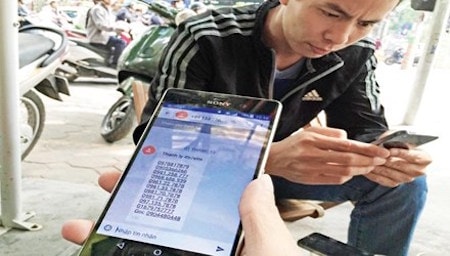 |
| Nearly 14 million spam messages are bombarding mobile phone users every day. PHOTO: Nhu Y. |
Floating prepaid subscriptions
One major cause of the current proliferation of spam messages is the lax management of prepaid subscriptions by mobile network operators. Nguyen Van Hung, from Viet Tri City, Phu Tho province – who has been selling SIM cards for many years – says that SIM card dealers often import SIM cards in bulk directly from within the network or buy and sell them among other SIM card dealers. The imported SIM cards may be unactivated or pre-activated. Although the sale of pre-activated SIM cards is prohibited, a large number of activated SIM cards are offered for sale daily.
According to regulations, one identity card can only register 3 phone numbers, but if just one digit is different, it can be used to register 3 more numbers. These overly formal regulations have made registering a prepaid phone number incredibly simple and unchecked. Regarding spam messages advertising premium phone numbers, these are usually sent randomly, with spam lists purchased directly from network employees. Therefore, postpaid subscribers or those with premium numbers are more susceptible to spam messages.
In Hanoi, there are many places selling SIM cards. SIM cards from various network providers are sold at everything from roadside tea stalls and convenience stores to authorized dealers. Promotional SIM cards are very cheap, costing only 30,000-40,000 VND, and most of these are pre-activated.
A sales and billing employee for a mobile network in Hanoi said that, under current regulations, one person can use many mobile phone numbers. Although regulations require a photocopy of an ID card when registering for a prepaid subscription, it's not easy to trace the subscriber's name because it's linked to the subscriber code. "If you want to use it freely, just buy a disposable SIM card from the street; it's cheaper, and nobody cares who you are," the female sales employee said.
Buying and selling phone numbers is as easy as buying vegetables.
Contributing to the explosion of spam messages is the existence and growth of a market for buying and selling personal information and customer phone numbers on numerous websites and social media platforms. At http://dskhachhang..., they openly advertise the sale of customer lists containing complete data such as: full name, phone number, email, job title, business sector... sorted and categorized by industry and income level.
The social media site "Customer Data" sells customer lists for prices ranging from 100,000 VND to 300,000 VND per list, with discounts for bulk purchases. The lists are further categorized: customers earning over 20 million VND per month; customers of businesses; lists of Directors and Chairmen of the Board of Directors of large companies in Ho Chi Minh City, etc.
Speaking with a reporter from Tien Phong newspaper, a representative from a provincial Department of Information and Communications affirmed that, with the current state of spam messages, the primary beneficiaries are the telecommunications companies, followed by businesses and individuals who use them to advertise their products and goods.
"Mobile phone text messages constitute a significant portion of revenue for mobile network operators. Some operators even use text messages as a form of promotion, offering free in-network messaging, which leads to a massive increase in the number of messages and makes control even more difficult," said a representative from a Department of Information and Communications.
According to Gia Dinh.net