

Posting economic information in the digital age.
"In the social media landscape, the reader is also the creator of information. Producing information for society is no longer the primary function of newsrooms; information is now created by anyone with an internet connection."
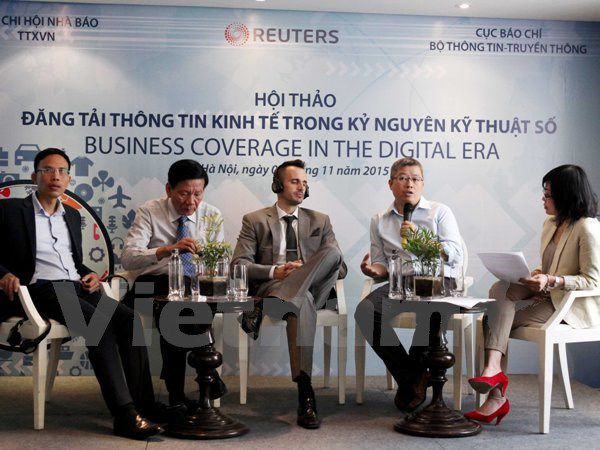 |
| Speakers exchange views at the workshop. (Photo: Doan Duc/Vietnam+) |
Mr. Nguyen Anh Tuan, Editor-in-Chief of Vietnam Investment Review (VIR), a veteran manager in the journalism industry, expressed his impatience when assessing the methods of information dissemination and modern journalistic trends at the seminar "Publishing Economic Information in the Digital Age," jointly organized by the Press Department (Ministry of Information and Communications), the Vietnam News Agency Journalists' Association, and Reuters on November 6th.
Mr. Tuan emphasized that digital technology and the internet have rendered traditional news reporting methods obsolete. The consequence of this process is that many print newspapers, some over a century old, have had to close down or change their operating models, such as the New York Times and Newsweek magazine. Furthermore, the changing way readers access information affects not only countries with highly developed information technology but also Vietnam, creating significant challenges for any newsroom.
These challenges require journalists in general, and economic journalists in particular, to adopt new working methods to meet the increasingly high demands of readers.
Martin Petty, Reuters correspondent in Vietnam, shared that the Vietnamese economy is developing rapidly while also facing various challenges. Furthermore, Vietnam is currently a signatory to numerous free trade agreements and is attracting an increasing number of foreign investors.
The challenge is how to write news articles that are comprehensive, accurate, and timely. The key is that investors always want their information to reach the public quickly but with accuracy; this is an extremely important factor.
"If reporters provide inaccurate information, it will clearly cause trouble for many investors, the market, and society. I think this is not just the responsibility of reporters alone, but also of policymakers, business executives, and others who must provide the fastest and most accurate information so that reporters can deliver it to readers quickly," Martin Petty stated.
Another topic of particular interest to the speakers was how to bring economic information to young people.
Mr. Trinh Ba Duong, Director of Lifetivi Channel, pointed out that currently, the majority of young people and entrepreneurs are not satisfied with the economic content from mainstream media. According to Mr. Duong, domestic media currently does not produce many articles with an international focus and mainly consists of translations. In addition, domestic economic news is exploited quite passively; sources are often provided rather than reporters independently accessing, researching, and gathering information.
Regarding the way economic information is conveyed, delegates generally agreed that, in addition to the requirement for speed, each article now needs to be concise and to the point, and presented in various formats.
"In addition, journalists need both writing skills and the ability to use technological tools to reach the right audience, achieve the desired reach, and engage readers," Mr. Duong said.
According to splendorplus
| RELATED NEWS |
|---|