

A historic milestone in ASEAN integration and cohesion.
(Baonghean) - The 27th ASEAN Summit in Kuala Lumpur, Malaysia, has become one of the most memorable conferences in the history of ASEAN's development. Yesterday (November 22), the leaders signed the Kuala Lumpur Declaration 2015 on "Establishing the ASEAN Community". Thus, the ASEAN Community will officially come into existence on December 31, 2015, marking an important milestone in the process of ASEAN integration and cohesion.
Realizing a dream after nearly half a century.
Forming a common community of peace, stability, and prosperity is the goal that ASEAN has continuously strived to achieve for nearly half a century. Thus, from a loosely organized association, an entity without significant influence in Southeast Asia, ASEAN has risen strongly to become a united and deeply integrated community, playing an important role regionally and internationally.
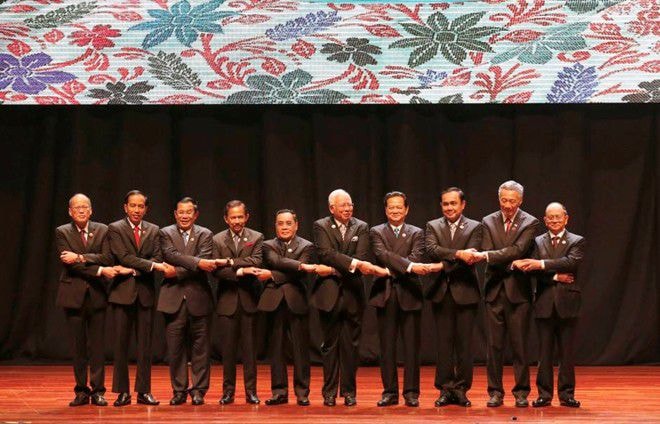 |
ASEAN leaders pictured at the 27th ASEAN Summit in Kuala Lumpur, Malaysia. Photo: TheStar |
Ahead of this historic moment marking a fundamental transformation of ASEAN, the 10 ASEAN member states recalled the spirit when the ASEAN Founders gathered in Bangkok in 1967 – at that time, ASEAN had only five founding members: Indonesia, Malaysia, the Philippines, Singapore, and Thailand.
Thirty years later, with 10 members, ASEAN leaders adopted the important document "ASEAN Vision 2020," with the overarching goal of transforming the Association into "a harmonious group of Southeast Asian nations, bound together in a community of caring societies."
In October 2003, ASEAN leaders signed the ASEAN Concord II with the goal of forming the ASEAN Community by 2020 based on three pillars: the Security Community (later renamed the Political-Security Community), the Economic Community, and the Socio-Cultural Community. In January 2007, to adapt to global development trends, ASEAN decided to promote the goal of forming the ASEAN Community by 2015.
With the signing of the Kuala Lumpur Declaration on the Establishment of the ASEAN Community by its leaders on December 31, 2015, the 10 ASEAN countries have brought the dream of a unified, peaceful, stable, and prosperous ASEAN to fruition. The leaders believe that the formation of the ASEAN Community has marked a milestone in ASEAN's integration and cohesion, with its dynamic, competitive, and deeply interconnected economies.
Firmly built on three pillars.
Over 625 million people have a peaceful and stable region to develop and prosper – that is the greatest goal of forming the ASEAN Community. To achieve this, ASEAN countries must demonstrate shared interests, understanding, and vision, as well as the will and determination to strengthen linkages at a higher level to promptly respond to and adapt to the opportunities and challenges facing the region in terms of security, politics, economics, and socio-cultural aspects. These are also the three pillars that ASEAN must always firmly consolidate throughout its development and integration journey.
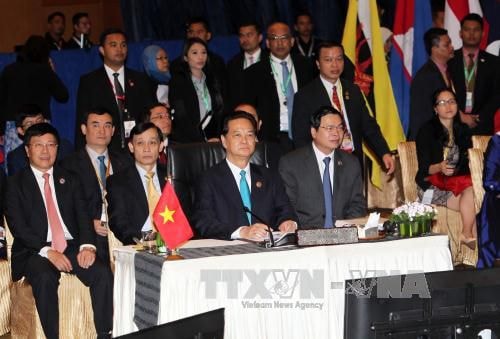 |
| Prime Minister Nguyen Tan Dung attends the plenary session of the 27th ASEAN Summit. Photo: Duc Tam - VNA. |
In terms of politics and security, ASEAN strives to create a peaceful and secure environment for development in Southeast Asia by elevating ASEAN political and security cooperation to a new level, with the participation and constructive contributions of external partners. However, ASEAN affirms that it does not aim to form a military alliance in the region, or a common defense bloc; member states have the freedom to pursue their own foreign policies as well as deploy their own defenses.
Economically, the ASEAN Community will form a common market and a unified production base, a highly competitive region with balanced development and full integration into the global economy. ASEAN is actively implementing a series of solutions such as removing tariffs and non-tariff barriers; facilitating trade, harmonizing product standards and regulations, expediting customs and import/export procedures, perfecting rules of origin, and facilitating services and investment. ASEAN's GDP is projected to reach US$4.7 trillion by 2020 and has the potential to become the world's fourth-largest economy by 2030. If realized, this will be the clearest evidence of the strength of the ASEAN economic community.
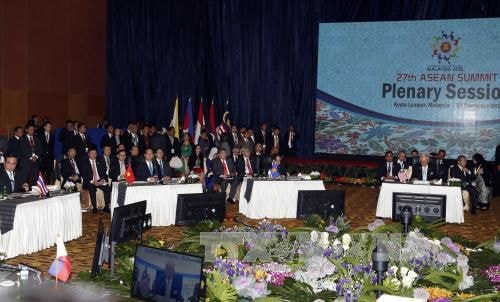 |
Plenary session of the 27th ASEAN Summit. Photo: Duc Tam - VNA |
In terms of socio-cultural aspects, the 10 ASEAN member states will be closely bound together in a community that develops evenly and harmoniously, yet without losing its own unique identity. The ASEAN community will be people-centered; socially responsible, aiming to build lasting solidarity and unity among ASEAN nations and peoples by moving towards a common identity; building a shared, caring, harmonious, and open society where the lives, living standards, and well-being of the people are improved.
Today's success lays the foundation for tomorrow.
ASEAN Secretary-General Le Luong Minh once stated that efforts to promote integration and build a sense of community among governments and 625 million people are difficult to achieve simultaneously. Therefore, as the culmination of nearly half a century of cooperation and development, the establishment of the ASEAN Community is also the starting point for ASEAN's next phase of development. To plan the development path for the next 10 years following the establishment of the common community, at the Kuala Lumpur Summit, leaders adopted the ASEAN Community Vision 2025 and implementation plans for each pillar. Accordingly, in the period 2016-2025, ASEAN will continue its efforts to ensure Southeast Asia is a region of peace, stability, and prosperity; to better connect countries in the region and between the region and the world; and to strengthen ASEAN as a shared and united community in diversity. The ASEAN Community will be strengthened and enhanced to become a rules-based community, united on the basis of shared principles and values; a community that is truly people-oriented and people-centered.
With people at the center of ASEAN's integration and cohesion policy, one of the priorities of the ASEAN Vision for the next 10 years is to raise public awareness of ASEAN. In addition, over the next 10 years, ASEAN will also focus on engaging all citizens of member states through effective reform and improvement plans, as concretized in the ASEAN Connectivity Master Plan (MPAC).
Thuy Ngoc
| RELATED NEWS |
|---|