

8 solutions to cope with the 2016 spring drought.
((Baonghean) - In Nghe An, the spring crop is the main production season of the year, with approximately 88,000 hectares of rice, 23,000 hectares of peanuts, 17,000 hectares of corn, 24,000 hectares of sugarcane, and several other crops. However, this spring crop is threatened by drought.
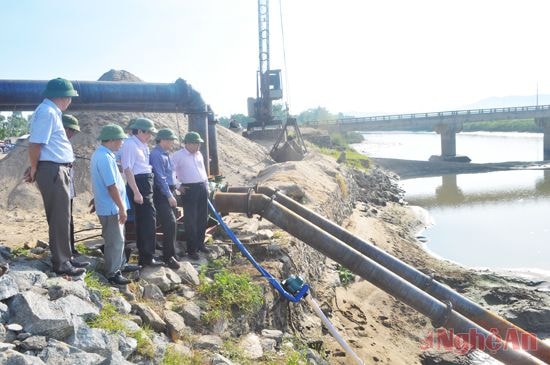 |
| Provincial leaders inspect drought conditions in Hung Nguyen. Photo by Hoang Vinh. |
The main cause of the above situation is climate change. In Nghe An province alone, from January to October this year, the average air temperature reached 24.45°C.oC is higher than the average for the first 10 months of the year (TBNN), which is 1.2.oC is higher than the first 10 months of 2014, which was 0.63.oC. It is projected that for the remaining months of November and December 2015, and throughout the spring crop season of 2016, air temperatures will be 0.5 - 1.5 degrees higher than the average.oC.
According to the Nghe An Provincial Department of Water Management and Irrigation Works, currently, throughout the province, there are 14 reservoirs with water reserves exceeding 70%, 5 reservoirs with reserves between 50-70%, 28 reservoirs with reserves below 50% of their designed capacity, and the remaining reservoirs have negligible water reserves.
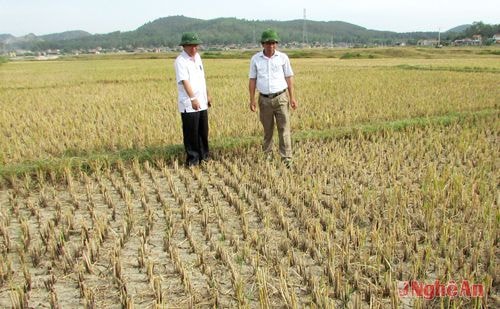 |
| Drought in Quynh Luu during the recent summer-autumn crop season. Photo by Viet Hung. |
Here is a good solution to consider for proactively responding to drought:
Firstly, local authorities and individual production facilities should now conduct a thorough review of all rice cultivation areas. Rice should be planted wherever and how much of the land has sufficient water. Areas where irrigation water is not readily available should be converted to growing corn, peanuts, or beans, and this should be done as early as possible to mitigate the impact of severe drought at the end of the season.
Secondly, water management involves using water as sparingly as possible by: clearing and opening the irrigation canal system from the source to each field, completing this before the planting season begins.
Localities that use irrigation water from reservoirs and dams but do not need to irrigate at this time should close the sluice gates to retain and store water, preventing unnecessary water waste.
Localities that use electric pumping systems for irrigation need to carry out deep and thorough dredging of canals, maintain machinery at pumping stations, and review and upgrade the power transmission lines to ensure that no malfunctions occur when the water pumps are in operation.
For this year's spring rice crop, production facilities should instruct farmers to apply the shallow irrigation method (exposed to the sun and then exposed to the sun) or maintain a consistently shallow water level of 3-5 cm in the fields.
Thirdly, with nearly two months remaining until the rice planting season, local authorities should instruct farmers to plow and dry the soil (a long-standing practice of intensive rice cultivation in Thai Binh province) to improve soil quality and eliminate fungi and bacteria that can cause diseases in rice plants later on.
Fourth, only short-duration rice varieties should be planted, with a growth period not exceeding 135 days. Planting short-duration varieties will save on irrigation, reduce production costs, and prevent severe droughts at the end of the season that can reduce rice yield.
Fifth, direct sowing (seeding by broadcasting) is absolutely prohibited as it wastes a huge amount of water (because water has to be used for plowing and tilling, then drained for sowing, and then water has to be re-filled after 5-7 days). In areas irrigated by electric pumps or water from reservoirs, direct sowing of rice should be strictly prohibited this spring.
Sixth, do not rush to sow rice seedlings or transplant rice before the prescribed planting schedule. This spring season is warm, which will shorten the rice plant's growth period. Therefore, sowing and transplanting early before the prescribed schedule will cause the rice to flower prematurely before April 25th, making it very susceptible to the cold weather during the Qingming Festival, which will reduce rice yield, or even result in a complete crop failure.
Seventh, warm spring years are years when rice yields are not high. Therefore, measures must be applied: transplanting young seedlings, applying a heavy amount of base fertilizer, and applying it before transplanting to encourage early tillering and concentrated tillering. The base fertilizer should be high-quality NPK such as NPK 16-16-8, at an average of 13-15 kg/sao. 12-13 days after transplanting, apply a top dressing of NPK 15-5-20, at an average of 8-10 kg/sao, and finally, apply a final top dressing of 5-7 kg/sao, also using the same NPK 15-5-20 fertilizer.
Furthermore, the spring of 2016 is forecast to be warm, humid, with frequent morning fog and intense heat in the afternoon. This weather creates favorable conditions for various plant pests and diseases such as blast disease, brown spot disease, brown planthopper, leaf roller, and stem borer. Therefore, production facilities and farmers need to regularly inspect their fields to detect pests and diseases early and control them immediately according to the instructions of the Plant Protection Stations in the districts, cities, and towns. Experience in controlling plant pests and diseases over the past few years has shown that it is essential to adhere to the "four correct" principles: the right pesticide, the right pest/disease, the right dosage, and timely application for effective and thorough eradication.
Doan Tri Tue