

Yen Thanh is determined to bring clean water to 70% of its population.
(Baonghean) - The Resolution of the 26th Congress of the Yen Thanh District Party Committee, term 2015-2020, sets a target of having 27-29 communes using piped water.
However, currently, the percentage of people with access to clean water remains low, and the implementation of clean water projects is still facing difficulties. Nghe An Newspaper had a dialogue with Comrade Hoang Nghia Hieu - Secretary of the Yen Thanh District Party Committee - regarding this issue.
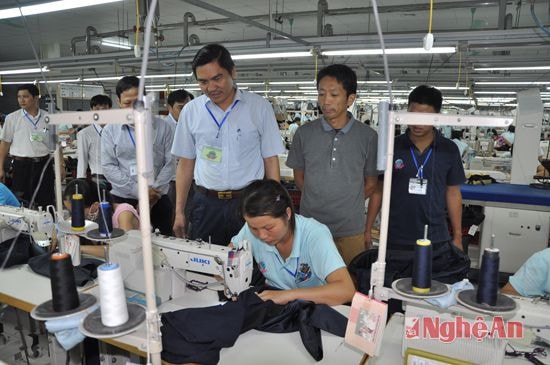 |
| Comrade Hoang Nghia Hieu - Secretary of the Yen Thanh District Party Committee, visits the Yen Thanh Industrial Garment Factory. Photo: Huu Nghia |
Reporter:The target for Yen Thanh district by 2020 is for 27-29 communes to have access to piped water, equivalent to 210,000 people, or 70% of households in the entire district. This is a difficult target, because currently only over 23% of households in the district have access to piped water. So, how do you assess the current situation and the feasibility of achieving this target?
Comrade Hoang Nghia Hieu:Yen Thanh District has over 290,000 inhabitants, distributed across 39 communes and towns, including 18 mountainous communes. The district's water supply comes from four sources: a system of over 200 reservoirs and dams (for highland and lowland communes); the main canal system (for lowland and lowland communes); in some areas, people have to build reservoirs to utilize rainwater; and clean water from water treatment plants.
To improve the quality of drinking water for the people, the Resolution of the 26th Congress of the Yen Thanh District Party Committee, term 2015-2020, only set a target of 95% of households using hygienic water throughout the district (an increase of only 5% compared to the current time), but set a higher target for the percentage of households using clean water, increasing it from the current 13 communes and towns (equivalent to 23% of households) to 27-29 communes, equivalent to 210,000 people, accounting for 70% of households in the entire district by 2020. This is indeed a difficult target, however, the district is determined to direct its implementation.
Currently, there are 10 water treatment plants operating in the district, providing a relatively stable water supply to the people of 13 communes and towns. After the 26th Party Congress, the district continues to direct the plants that have the capacity to increase their capacity and expand their market share to serve the people.
The immediate plan is to increase the capacity of the town's water treatment plant from 2,000 m3/day to 5,000 m3/day. The water treatment plant in Hong Thanh commune will also be upgraded from 2,000 m3/day to 4,000 m3/day. Furthermore, the district is accelerating the construction of several new water treatment plants in Cong Thanh, My Thanh communes, and some highland communes. This is coupled with promoting the implementation of Party Congress resolutions at all levels, raising public awareness about the importance of clean water use, and encouraging a shift from rainwater to piped water. In parallel with the above work, the district is also focusing on reviewing the system of reservoirs and dams to propose upgrades, ensuring water for production while also providing input water for the clean water treatment plants in the district.
ReporterTo our knowledge, several clean water plants are currently under construction in the communes of Do Thanh, Phu Thanh, Long Thanh, etc., but the construction progress is very slow. Perhaps the district hasn't paid enough attention to speeding up the progress?
Comrade Hoang Nghia Hieu:Currently, there are six unfinished water treatment plants under construction in the district, some of which have been temporarily halted. The main reason is the difficulty in securing funding for these clean water plants. For example, the clean water project in Phu Thanh commune has a total estimated investment of over 23 billion VND, with 60% from the higher-level budget and 40% from the commune budget and local people. Construction began in 2013, and while 50% of the work has been completed, only over 7 billion VND has been disbursed, with over 3 billion VND contributed by the local people. Currently, construction is suspended due to a lack of funding. However, the district will continue to provide guidance and support in the future.
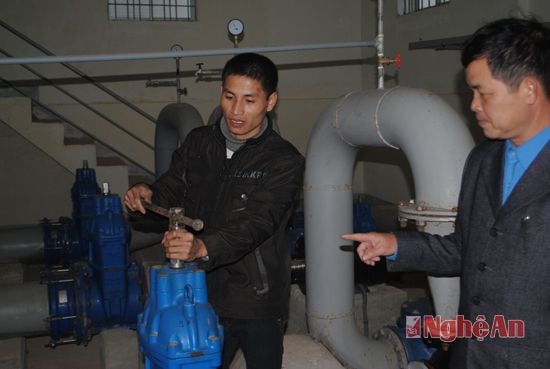 |
| Operating the Yen Thanh town water treatment plant. Photo: Van Truong. |
Reporter:Clean water is one of the important criteria, as it relates to people's health, and is also one of the criteria for achieving the status of a new rural district. So, what solutions does Yen Thanh need to implement to effectively achieve this goal?
Comrade Hoang Nghia Hieu:Currently, the district is focusing on upgrading and maximizing the efficiency of the 10 existing clean water plants to better meet the needs of people in each commune and surrounding areas. At the same time, it is focusing on resolving difficulties and obstacles to accelerate the completion and operation of the 6 water plants that are currently under construction.
In the long term, the district will continue to strengthen efforts to attract investment in the construction of large-scale, centralized clean water supply plants in each region (instead of building small water supply facilities in individual communes as is currently the case). It will actively direct the upgrading of reservoirs and dams to ensure the supply of water for domestic use and production, especially in highland areas. For low-lying areas, it will focus on improving irrigation to drain water during the rainy season and prevent flooding that could lead to the contamination of drinking water sources.
In addition, it is important to regularly conduct effective communication and propaganda to raise awareness among all citizens about the benefits of using clean water and maintaining rural sanitation, thereby leveraging social mobilization in the field of clean water...
Along with local efforts, the central and provincial governments also need to have mechanisms to support people in disadvantaged areas in installing water filtration and settling equipment to ensure hygienic domestic water supply according to standards. At the same time, budget allocation should be balanced, and funding should be provided promptly through appropriate mechanisms to complete unfinished water treatment plants in the district that are currently under construction due to lack of capital...
Reporter:Thank you very much, comrade!
MAI HOA
(Perform)
| RELATED NEWS |
|---|