
Developing mountain farms: easy and difficult.
(Baonghean) - Developing farm and household-based economies is considered a suitable direction for mountainous areas to exploit the advantages of land and abundant labor resources. It also serves as a stepping stone for people to expand the scale of agricultural production, improve productivity, efficiency, and competitiveness in the market economy. However, many issues still arise in the process of developing farm economies...
(Baonghean) - Developing farm and household-based economies is considered a suitable direction for mountainous areas to exploit the advantages of land and abundant labor resources. It also serves as a stepping stone for people to expand the scale of agricultural production, improve productivity, efficiency, and competitiveness in the market economy. However, many issues still arise in the process of developing farm economies...
Green farm on red rock
Chau Binh (Quy Chau), a land once ravaged by the red gemstone rush, has now been revived with vast green farms. Mr. Nguyen Van Thien (from village 3/2, Chau Binh) led us through the winding forest paths to his nearly 10-hectare farm. Mr. Thien shared: “Since 1990, after completing my military service and returning home, my wife and I started digging ponds to raise fish and planting corn and sugarcane. We gradually built up our farm, and by 2007 it was complete, comprising 5 hectares of sugarcane, 3 hectares of cinnamon, a 7,000 square meter fish pond, and the remaining more than 1 hectare for growing seasonal vegetables.”
The fish pond provides food for the whole family, and after deducting the costs of fish fry and feed, they earn a profit of about 35-40 million VND per year. Thanks to annual incentive and support projects from the farmers' association, the family receives a 50% subsidy on fish fry, significantly reducing investment costs. The main source of income from the farm is sugarcane, with an average annual harvest of about 400 tons: 300 tons sold to the Quy Hop sugar factory and 100 tons sold as sugarcane seedlings. After deducting expenses, they earn over 200 million VND. Thanks to the income from the farm, the couple's life is now stable and prosperous.
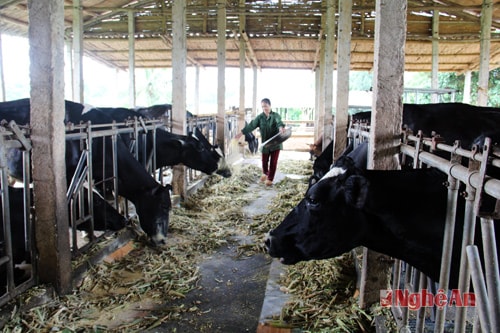 |
| Family dairy farmMr. Ho Sy Dieu (Hamlet 5, Nghia Tien Commune, Thai Hoa Town). |
In Chau Binh commune, there are also farms owned by Mr. Lo Xuan Quang (Binh 1 village), Mr. Nguyen Huu Toan (Binh 2 village), Mr. Ha Van Chung (Can village), and Ms. Nguyen Thi Ngoc (Binh 3 village)... all earning over 200 million VND in profit each year. A common characteristic of these farms is the combination of livestock farming with forestry and raw material cultivation. The entire commune currently has 3,000 hectares of forest, 700 hectares of sugarcane, 3,000 buffaloes and cows, nearly 3,000 pigs, and 20,000 poultry.
It can be observed that in recent years, with the support of livestock development programs and projects, the number of farms in mountainous areas has increased in both quantity and quality. By the end of 2014, the entire province had more than 296,000 buffaloes, nearly 400,000 cows, and more than 971,000 pigs… with a significant distribution in mountainous areas. Typical examples of strongly developing livestock herds include Tan Ky with 83,580 animals; Nghia Dan with 91,139 animals, and Anh Son with over 90,000 animals…
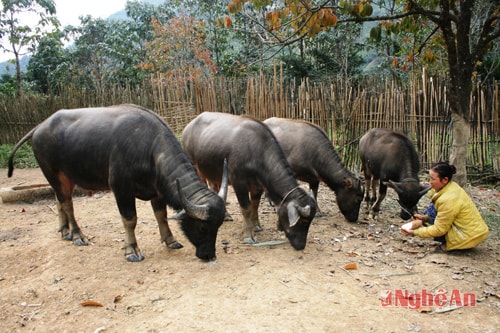 |
| The herd of buffaloesThe family of Mr. Hờ Gà Vừ (Huồi Tụ, Kỳ Sơn). |
The reality is "making things difficult" for farm economics.
These achievements are thanks to the synchronized development of family farms and large-scale farms in various localities. However, difficulties in production and business conditions such as: inadequate infrastructure investment, limited production support services and product distribution, and restricted seed supply... have resulted in slow development of farm economics in mountainous areas, failing to live up to their potential and inherent advantages.
Due to the complex terrain, fragmented by numerous rivers, streams, and rugged mountains, with many roads leading to the centers of the communes only passable during the dry season, transportation and consumption are extremely difficult.
For example, the village of Kèo Lực (Phà Đánh, Kỳ Sơn) is perched precariously on the slopes of Pù Húc mountain. Due to the steep terrain and barren soil, for generations, the Pù Húc valley has been the only flat land in Kèo Lực suitable for cultivation. However, because the distance from the village to the foot of the valley is quite far and there are no roads, only a few households have settled there to run farms. The farm of Mr. Vi Văn Thoong and Ms. Lô Thị Hoa covers more than 3.5 hectares, with over 1 hectare of corn, nearly 2 hectares of mangoes and sugarcane. On average, each harvest yields nearly 10 tons of corn, around 2 tons of mangoes and sugarcane, not to mention the large number of fish raised on the farm, so the amount of produce needing to be transported during harvest season is considerable.
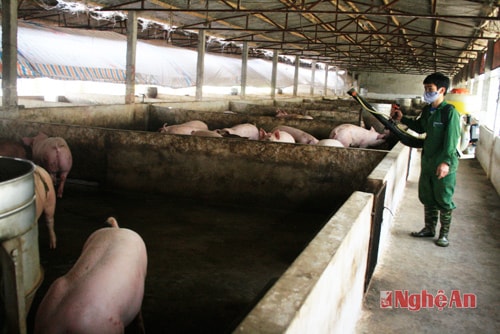 |
| Large-scale farmof the family of Mr. Truong Dinh Thong (Nghia Long, Nghia Dan). |
Yet, the valley roads leading to the inter-communal route are just small trails, making travel difficult for people, let alone transportation.
Besides transportation issues, the shortage of breeding stock is also a major headache for many concentrated pig farmers in mountainous districts. According to information gathered from the farm of Mr. Nguyen Van Loi (Phuong Dinh hamlet, Dong Van commune, Thanh Chuong district), his farm currently has a herd of 75 pigs, supplying 52 tons of meat to the market annually. It is known that for Mr. Loi and other pig farmers in the area, the most challenging problem remains the availability of breeding stock, as most of the breeding stock must be imported from provinces in the North and South.
For sow breeders, importing sows mainly from Dong Nai province incurs high costs. Each import involves a breeding fee of 2 million VND and transportation fees exceeding 4 million VND per ton. On average, each sow purchased costs between 7 and 8 million VND in total. This leaves very little profit. Furthermore, investing in breeding stock production requires a solid understanding of science and technology; however, breeding farms still rely primarily on self-taught methods in mating and breeding, resulting in inconsistent quality and quantity.
Mr. Tran Quoc Hien – Vice Chairman of the Provincial Farm Economic Association, stated: “Currently, the province has 3,185 farms meeting both old and new criteria. Of these, 420 farms meet the criteria according to Circular 27/2011/TT-BNN. The number of farms in the livestock, aquaculture, and mixed sectors has increased rapidly and achieved high economic efficiency. However, many difficulties still need to be overcome in the future. Considering the entire province, sales through contract agreements with livestock farms account for less than 25%, and nearly 60% for aquaculture and poultry farms; for breeding stock, most still have to be imported from other provinces, with the province supplying less than 10%, and even lower in mountainous areas. In addition, people in mountainous areas face many difficulties due to specific conditions such as transportation and weather, which significantly affect production efficiency. However, these issues do not…” "This cannot be resolved overnight; it requires effort from many sides over a certain period of time."
Thanh Quynh
| RELATED NEWS |
|---|