

Vietnam uses robots for laparoscopic surgery on patients.
Following the successful application of robotic laparoscopic surgery techniques on children, this equipment will soon be used in adults.
Robotic endoscopy is a new advancement in endoscopic surgery. Instead of directly holding a scalpel, the surgeon sits and controls the robot to perform the procedures. The robots currently used in Vietnam belong to the 4th generation (these robots have now developed to the 5th generation) with four flexible arms.
According to Dr. Le Thanh Hai, Director of the National Children's Hospital (Hanoi), to optimally utilize robots, the Ministry of Health has a policy of expanding the use of robotic endoscopic surgery on adults. The hospital will coordinate with other hospitals such as Bach Mai, Viet Duc, and 108... to implement this so that people can benefit from modern techniques. The issue here is the coordination mechanism between hospitals, patient transportation, etc.
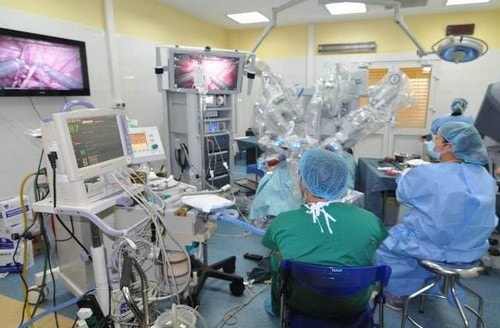 |
| The surgeon controls the robotic arms of the laparoscopic surgeon. Photo: Provided by the hospital. |
After more than a year of application, the National Children's Hospital (Hanoi) has successfully used robotic laparoscopic surgery on 82 children with promising results. Regarding choledochal cysts in children, Dr. Pham Duy Hien, Director of the Pediatric Endoscopy Center at the National Children's Hospital, reported that they have surgically removed the cysts and performed a common hepatic duct-jejunal anastomosis on 30 children. The surgery time was approximately 150 minutes, slightly longer than laparoscopic surgery; the average hospital stay was 4-10 days. During follow-up, two children experienced simple abdominal pain, and two had fever; no cases required re-operation.
Initially, choledochal cysts in children were treated with open surgery. Since 1995, laparoscopic surgery has become the standard procedure. While conventional laparoscopic surgery is safe, anastomosis remains a challenge for surgeons. The use of robotic laparoscopic surgery has helped alleviate this difficulty.
"In particular, the use of robots eliminates hand tremors, allowing technicians to operate very comfortably, and the 3D imaging and 12x magnification camera make complex endoscopic surgery simpler," Dr. Hien explained.
According to Dr. Hien, most medical conditions can be treated using this robot. For example, when removing cancerous lymph nodes, the use of a robot with 12x magnification and 3D imaging helps doctors easily remove all lymph nodes without open surgery. In addition, many countries also use robots to remove prostate glands, bladders, liver, gallbladder, pancreas, and fibroids in women…
This technique is safe and feasible, but the cost is still high. Dr. Hien hopes to implement its application on adults as soon as possible, prioritizing complex conditions requiring dissection and suturing. The cost of a robotic laparoscopic surgery on adults in many countries is approximately $15,000-$30,000.
Dr. Tran Hieu Nhu Hoc, Head of the Surgery Department at Bach Mai Hospital (Hanoi), also stated that robotic laparoscopic surgery has many advantages, being able to perform actions that cannot be done in conventional laparoscopic surgery. If it can be applied to adult surgery, it will bring many benefits and be applicable to a wide range of diseases. Most countries mainly perform this technique on adults.
Vietnam is the first country in Southeast Asia to have this high-tech application center.
According to VnExpress
| RELATED NEWS |
|---|