

Things you might not know about 5G networks
Five years after 4G-enabled smartphones became ubiquitous on the market, major telecommunications companies are racing against time for 5G. The four major US carriers, smartphone chip manufacturers, and network equipment suppliers are actively developing 5G technology. Users should understand 5G thoroughly before seeing the 5G logo appear on their smartphone screens.
5G networks were created to prepare for the Internet of Things (IoT) and meet the demand for ultra-high-definition video streaming.
What is 5G?
The meaning of the letter "G" in 3G, 4G, and 5G is "generation." Therefore, 5G will be the fifth "child" of the wireless network industry.
According to Bill Smith, AT&T's network CEO, the definition of 5G will be finalized in 2018. In 2019, 5G standards will be established according to the standards of the International Telecommunication Union, a United Nations organization.
How fast is 5G?
5G offers speeds up to 40 times faster than 4G. Users can stream 8K video in 3D or download a 3D movie in 6 seconds, whereas 4G takes up to 6 minutes.
However, in reality, this speed is likely to be much lower than in theory.
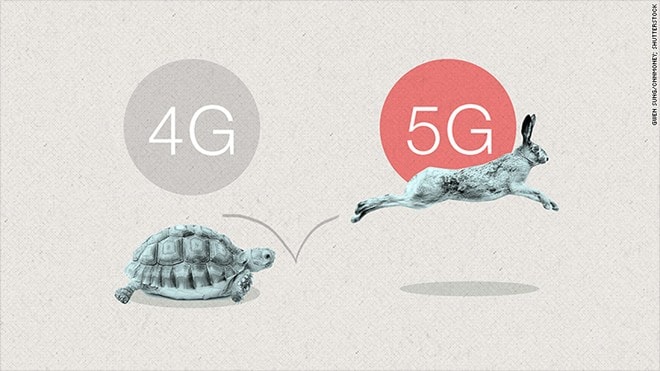 |
| Comparison of speeds between 5G and 4G |
Nokia is currently testing this technology in Finland. The company believes that even when the network is overloaded, 5G technology can still operate at 100 Megabits per second, four times faster than 4G when operating at its highest speed.
Another feature of 5G networks is that they shorten the response time to user requests, improving the speed of web browsing, apps, videos, and messaging.
How does 5G work?
Most 5G experiments are conducted in high frequency bands, around 73,000 MHz. Meanwhile, current mobile networks broadcast signals in the range of 700 MHz to 3,500 MHz.
The advantage of high-frequency signals is that they can provide significantly faster data transmission speeds. However, another drawback is that they can only transmit over short distances and have difficulty penetrating walls. Will thousands, even millions, of tiny transmission towers be needed on lampposts, in every building, in every house, and even in every room for 5G to function effectively in the future?
However, Akshay Sharma, a wireless network infrastructure analyst at Gartner, argues that there is still no effective solution to this problem.
Therefore, 5G will likely be a supplementary option, not a replacement for 4G. 5G speeds will be very high in buildings and public spaces. However, in tunnels, 4G will temporarily remain the only option.
When will 5G arrive?
There is still no official answer at this time. Major players in the network industry have agreed to test 5G at the 2018 Winter Olympics in South Korea, and roll it out widely in 2020.
Verizon claims it is still researching 5G technology with the goal of bringing it to market as soon as possible, around 2017.
Sadly, it seems Verizon won't be able to widely deploy 5G technology anytime soon, as there are still many questions and issues surrounding it. For example, smartphone manufacturers need to develop chips capable of sending and receiving 5G signals without driving up the price too much.
According to Newszing.vn