
The journey of passion
(Baonghean) - When I was a child, as soon as I could think for myself, I told my mother: "When I grow up, I want to join the army. To be a soldier in Truong Sa." My mother sighed: "Why, my child? People dream of becoming engineers, doctors, or teachers, why do you want to go to a place full of bullets and bombs?"
(Baonghean) - When I was a child, as soon as I could think for myself, I told my mother: "When I grow up, I want to join the army. To be a soldier in Truong Sa." My mother sighed: "Why, my child? People dream of becoming engineers, doctors, or teachers, why do you want to go to a place full of bullets and bombs?"
Time passed, I grew up and missed out on my childhood dream. I made a living as a journalist, and luckily, my work environment gave me the opportunity to travel to many places and learn many things. I got to visit Truong Sa (Spratly Islands), and I set my own "record" in my journalistic career.
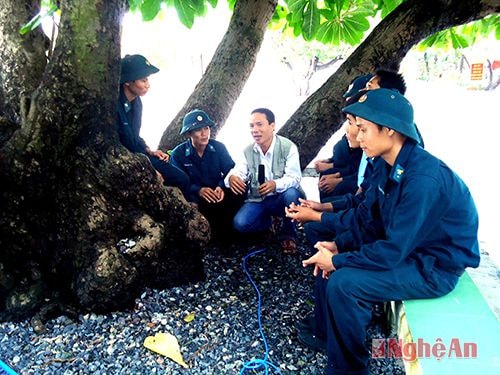 |
| Reporters from Nghe An Newspaper are working on a project at Nam Yet Island in the Truong Sa archipelago. |
With Truong Sa
I first visited the Spratly Islands in December 2011. It's impossible to describe the emotions I felt standing on the pier at Cam Ranh Naval Port, watching the ships before their departure. The space was packed with the green uniforms of the soldiers. Young faces, radiant smiles, tight hugs, and even couples and fathers and sons shedding tears before parting ways. Meanwhile, countless goods were being unloaded onto the decks and at the piers.
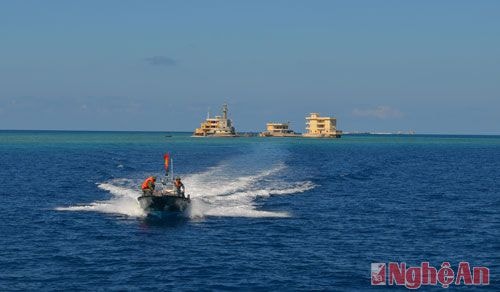 |
| Point B, Da Tay Island (Spratly Islands) seen from a distance. Photo: N. Khoa. |
Besides essential supplies, there were also many plants and animals, such as lemons, oranges, pomelos... pigs, chickens, ducks... I even saw some dry branches and wondered what the soldiers were doing bringing them to the island. Later I learned that the soldiers in Truong Sa used them for decoration and to create peach blossom branches for Tet (Lunar New Year). While sailing on the sea, I also noticed many young soldiers carrying roosters in their luggage. "We bring roosters to the island so we can always hear them crowing and ease our homesickness," explained Captain Nguyen Van Vinh on the submerged Da Lon island, an explanation I still remember.
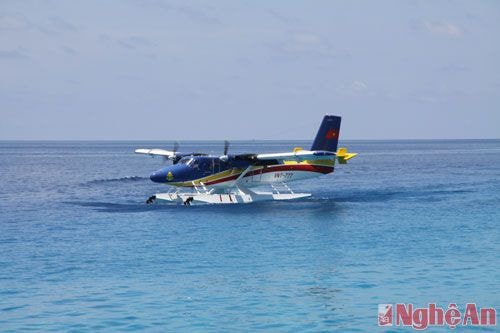 |
| A seaplane of the Vietnam People's Navy lands at Truong Sa Lon (Great Spratly Islands). Photo: N. Khoa. |
That time, the ship that took us to the island for the first time was numbered HQ 936. Every year, in December, along with many other transport ships, HQ 936 carries the leaders of the 4th Naval Region, soldiers, and reporters and journalists representing media agencies nationwide to visit, give gifts, and wish a Happy New Year to the officers and soldiers working on the island.
The first island we visited was Song Tu Tay. But getting the ship to dock wasn't easy. In 2011, Song Tu Tay already had a harbor built to anchor ships and provide shelter from storms. However, at that time, the Truong Sa archipelago was hit by a tropical depression and a typhoon, Typhoon No. 9. The wind was strong, the waves were big, and the harbor entrance was too small for the transfer ship to reach the shore. We had to wait more than one nautical mile from Song Tu Tay. Four days later, we finally reached Song Tu Tay – the largest island in the Truong Sa archipelago. Those who visit for the first time are amazed by the island's beauty. The trees remain green all year round, despite the large waves carrying the salty sea air that seemed to engulf the small island. On the island, the soldiers raise cattle, pigs, chickens, grow vegetables, and many kinds of fruit trees. We took notes, asked questions, and interviewed many people. It was also on Song Tu Tay Island that I sent the first images and articles back to the mainland. At that time, the island had telecommunication coverage and Viettel's 2G network. However, sending even a single photo or a 1kb video clip was incredibly difficult. Reporters had to "monitor the signal" all night, their hands never leaving their laptop keyboards, constantly trying to reconnect whenever the connection was cut off. As if understanding the difficulties journalists faced, many nights the officers and soldiers prepared fish porridge, coffee, and tea to serve them.
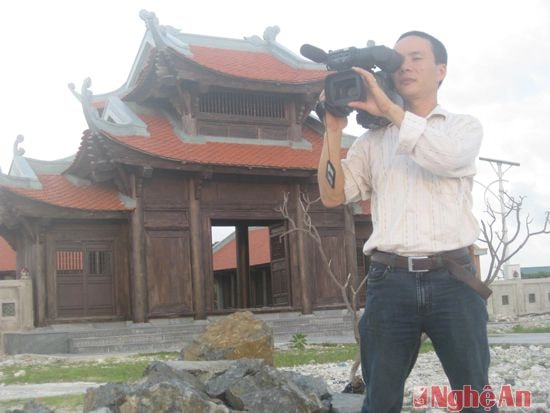 |
| The author is working on Song Tu Tay Island, Truong Sa Archipelago. |
Among the times I've celebrated New Year's away from home, I've spent the first day of the year on the Truong Sa archipelago twice. The first time was on Sinh Ton Island in 2011-2012, and the second was celebrating the Lunar New Year of 2014 right on board the ship HQ 571 in the middle of the ocean. The feeling of waiting for the New Year's Eve moment to embrace each other in the sea and islands of my homeland is difficult to put into words. Somewhere among the trees on the island, there were tears of homesickness from young men in their late teens and early twenties.
My most memorable experience was on Son Ca Island. This small island was surrounded by lush greenery, most notably the Phong Ba tree, the Bao Tap tree, and the sea morning glory. The island's abundance of greenery is thanks to the island's Youth Union, which launched a tree-planting campaign. Each year, from the platoons to individual members, registered to plant trees. It was on this small island that we produced a television documentary about exemplary individuals who studied and followed President Ho Chi Minh's moral example, which aired on VTV1. Remarkably, we were able to see our work on the island itself, amidst the pride and emotion of numerous officers, soldiers, and colleagues.
It's impossible to recount all those days. The arduous journeys through rough seas to reach An Bang Island – nicknamed the "century's lime kiln" by the Trường Sa soldiers; the unforgettable moments on the makeshift transfer boats where soldiers had to drop supplies into the sea to save lives; and the poignant moments before the makeshift altars hastily erected in the corners of rooms by officers and soldiers to mourn their parents, unable to return home for the funerals. All of these experiences have become invaluable sources of information for reporters to portray life in Trường Sa in the most truthful and intimate way possible.
Sea voyages and overseas assignments
Besides the joy of visiting the Spratly Islands twice, I was also fortunate to have two trips with local fishermen to the joint fishing grounds in the Gulf of Tonkin. We "went out to sea" at times when the situation in the South China Sea was very complex. Only by going to the joint fishing grounds, from 190 degrees north latitude northward, did I truly understand the courage of Vietnamese fishermen. Comparing the fishing grounds, we saw a series of massive, high-powered iron-hulled fishing vessels belonging to our neighboring country, China, while Vietnamese fishing boats were made of wood and basically still relied on manual fishing methods, mainly using human power.
It's heartbreaking to see those people with their tanned bodies, their hair bleached yellow by the harsh sun and sea breeze. Yet, out at sea, the purse seine boats, trawlers, and fishing vessels of our fishermen still work tirelessly day and night, determined not to lose their fishing grounds. There have been cases of Vietnamese fishing boats being rammed and damaged by Chinese vessels, and many others where nets have been cut and fishing gear destroyed. When we asked the fishermen about this, we all gave the same firm answer: "What's there to be afraid of? This is our ancestors' sea, and we will exploit it."
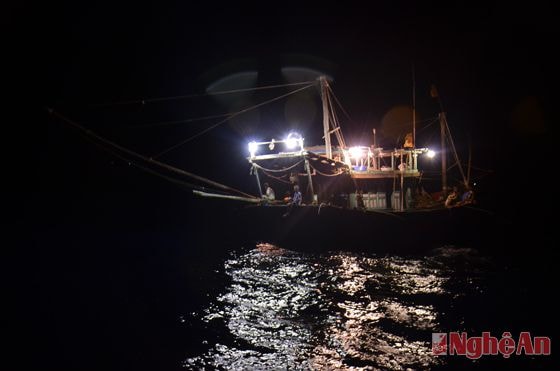 |
| Fishermen from Quynh Nghia commune, Quynh Luu district, catch squid in the common fishing grounds of the Gulf of Tonkin. |
"The lives of our people have been there for generations. If we are afraid and abandon it, we will not only lose our seafood resources but also many other things that are more important." Indeed, wherever there are Vietnamese fishermen and fishing boats, there is the image of our country. I couldn't help but feel proud and moved when I witnessed the crew members climbing onto the roof of the boat to replace the national flag. The boat always keeps two or three red flags with yellow stars on hand. At such times, perhaps not only I, but any reporter would immediately sit on the deck, open their notebooks, and turn on their laptops to write. For a journalist, those are very genuine emotions that bring immense value.
The life of a journalist has taken us to many places, meeting many people, both domestically and internationally. With the remarkable development of information technology, digital technology, and telecommunications systems on an international scale, the work of reporters has become very convenient. From abroad, we can update information, post articles, photos, and videos to online news systems as soon as events are happening. For reporters at Nghe An Newspaper, this is paramount. I remember the time I went on a long work trip to Laos with a female colleague. The purpose of the trip was to learn about the lives of Vietnamese workers in the Land of a Million Elephants.
Among the essential tasks was meeting the Ambassador Extraordinary and Plenipotentiary of Vietnam in Vientiane. The Ambassador scheduled the meeting for 8 a.m., but due to traffic congestion, the driver couldn't pick us up as planned. Not knowing what else to do, the two reporters had to flag down a tuk-tuk (similar to a three-wheeled motorized rickshaw in Vietnam). When the three-wheeled vehicle roared to a halt right at the embassy gate, the uniformed officers rushed over. Only after the Ambassador's secretary confirmed our presence were we allowed in. It was truly a memorable experience on assignment.
With the ever-increasing demands of society and the public, it would not be enough for journalists to live solely on courage. Therefore, in all cases, reporters at Nghe An Newspaper must be versatile and flexible. They must be able to write articles for print newspapers, work on online news, take and process photos proficiently; they can also shoot video clips and do post-production to turn them into a complete product. Once you are a journalist, no difficulty can stop you when you are burning with passion.
Quoc Son
| RELATED NEWS |
|---|