

Fees and charges cannot be considered a disguised form of income tax.
Members of Parliament demanded that fees and charges be commensurate with public services, avoiding overlapping taxes and fees aimed at maximizing revenue from the people.
During the National Assembly discussion on several contentious issues in the draft Law on Fees and Charges, Representative Huynh Van Tin (from the Tien Giang Provincial National Assembly Delegation) stated that the list of fees and charges is extremely important. The collection of fees and charges must be commensurate with public services; if not clear and transparent, fees and charges can easily become a source of excessive exploitation of the people. Therefore, the draft Law needs to clearly explain the nature of fees, charges, and service prices, ensuring the principle that fees and charges do not overlap with taxes.
Representative Huynh Van Tin also argued that the draft Law on Fees and Charges lacks clarity regarding the definition of each type of fee and charge. It needs to be clarified whether fees and charges include public services, and consideration should be given to fees for public services such as those for accessing state-managed documents. Furthermore, the annual revenue from fees and charges must be made public.
To further clarify this point, Representative Truong Trong Nghia (Ho Chi Minh City National Assembly Delegation) stated that the principle is that fees and charges are paid to a specific group that needs to use the service. For services that are public and used by the entire population, citizens are already responsible for paying taxes.
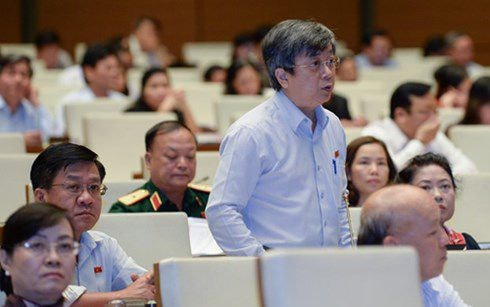 |
| Representative Truong Trong Nghia (Ho Chi Minh City National Assembly Delegation) does not want citizens to have to pay for public services. |
Another principle, according to Representative Nghia, is that fees and charges must be reasonable and cannot be a disguised income tax that reduces people's legitimate income. While people have already paid taxes, they cannot be forced to pay more for public services. Fees and charges cannot be collected to compensate for corruption, waste, and inefficiency in the state's management of taxpayers' money.
“It is unacceptable for a poorly managed investment sector to increase costs, lacking sufficient investment funds, and then mobilizing various fees to cover the costs. BOT projects require citizens to pay extra. Infrastructure fees are a disguised income tax when the state borrows ODA funds for investment. In many countries, infrastructure and road fees are only collected when it can be proven that they bring added value. Or, for some roads, it is clearly stated that they were built with citizens' contributions, and citizens only pay extra for road improvements; citizens have the right to file complaints,” Representative Truong Trong Nghia pointed out.
According to Representative Truong Trong Nghia, it is unnecessary to stipulate that fees constitute a fundamental part of the cost, because for some services, the state only collects a portion of the cost, not the entire amount, when the state only partially subsidizes the service. The maximum fee should also not exceed reasonable costs, as there are cases where collecting the maximum amount is not necessary, and fees should not exceed reasonable costs.
Representative Truong Trong Nghia also proposed removing the phrase "encouraging socialization" from the Draft Law because this phrase is vague and easily exploited. While many services are essentially privatized, the State should tax the income of private individuals and simultaneously reduce taxes for citizens accordingly.
"The people have already paid taxes to benefit from that service, and now they are transferring that service to the private sector and having to pay additional fees, which is unreasonable. If privatization is cheaper, then we should privatize it and let the private sector do it, but we must also avoid creating a natural advantage for the private sector. Granting licenses to the private sector gives them a significant advantage, so in such cases, the state should handle it itself," Representative Nghia said.
Although agreeing with the draft law's provision that fees will not be applied to service revenues provided by businesses, organizations, and individuals outside the state sector—which these organizations and individuals will account for as revenue and fulfill their tax obligations to the state budget—Representative Do Van Ve (National Assembly Delegation of Thai Binh province) still argued that service revenues collected by public service units are essentially service prices, which have long been commonly referred to as fees in society, and therefore need to be boldly transitioned to a pricing mechanism, similar to the prices of medical examination and treatment services and training services.
"Only in this way can we promote investment attraction and accelerate the socialization of areas where the non-state sector can participate and bring high quality to society," said Representative Do Van Ve.
Commenting on the list of fees and charges, National Assembly Delegate Nguyen Thi Quyet Tam (Ho Chi Minh City National Assembly Delegation) reflected that in practice, people are frustrated by the phenomenon of overlapping fees, overlapping taxes, and excessive fee collection in the detailed lists of taxes and fees. This is easily seen in road transport fees, animal and plant quarantine fees, etc., where the detailed lists issued by the government have overlapping and duplication.
"I propose that the Government annually report detailed lists of taxes and fees for the National Assembly to review and monitor," Representative Nguyen Thi Quyet Tam suggested.
According to VOV