

Tips for stopping your car when the brakes fail.
To avoid dangerous situations, drivers must know how to stop their vehicle when the brakes fail while driving on the road, especially on a highway.
Imagine you're driving down a highway or down a hill when you discover your car's brakes have failed or malfunctioned. How do you stop safely?
If the brakes fail, shift to a lower gear.
According to automotive experts, brake failure is not limited to older vehicles. Newer cars can also experience brake failure. In such unexpected situations, drivers are often caught off guard and panic, leading to serious consequences.
Brake failure is most common in vehicles traveling long distances, on hilly or mountainous roads, and in challenging terrain. This is because drivers on these types of roads tend to use the brakes excessively. Since most vehicles have hydraulic braking systems with vacuum assist, excessive use can generate heat, causing brake pads to become dull, brakes to malfunction, and brake cylinder seals to become loose. Each time the brake pedal is pressed, brake fluid leaks out, leading to brake failure.
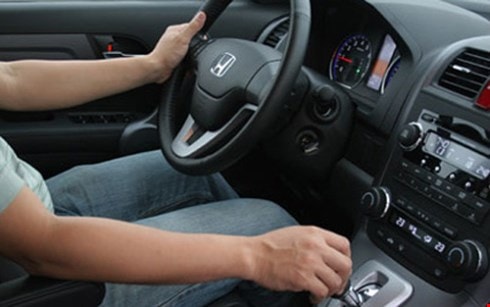 |
| When brake failure is detected, the first thing to do is remain calm; panicking will only make the situation worse and more difficult to salvage. |
If the brakes fail, calmly pull the parking brake, then try shifting the gear lever back to first gear to slow the vehicle down to the slowest possible speed. Note that you shouldn't keep it in neutral (N) for too long, because when going downhill, pressing the clutch to shift to neutral will cause the car to accelerate faster and it will be very difficult to shift back into gear because the engine speed and the wheel rotation speed are no longer synchronized.
For example, if your car is descending a hill in third gear and suddenly loses its brakes, to shift to first gear, depress the clutch and shift to neutral; release the clutch and aggressively press the accelerator to match the engine speed with the wheel rotation; then depress the clutch again and shift to second gear. At this point, the car will suddenly lurch and jerk. Shift the gear lever back to first gear. The car will then slow down considerably, and you can bring it to a complete stop by releasing the handbrake lever and quickly pulling it down to bring the car to a complete stop.
When the brakes fail, you should repeatedly pump the brake pedal to temporarily restore hydraulic pressure in the leaking lines… Then, bring the vehicle to a complete stop by leaning it against guardrails, steel railings, walls, curbs, cliffs…
If the brakes are not working, immediately release the accelerator.
As soon as you notice signs that the brakes are not working, immediately release the accelerator pedal. If the vehicle has a cruise control system, you must turn off the control button on the steering wheel (if this mode is activated).
Continue pressing the brake pedal and try to determine the cause. If the brake pedal feels soft and goes all the way to the floor, there may be a loss of brake fluid due to a damaged line. Try pressing the pedal repeatedly to see if pressure can be restored. However, if the brake pedal is stiff, the braking system may have a blockage in the hydraulic lines, or the brakes may be seized. Sometimes, it could also be due to something obstructing the brake pads underneath (such as a water bottle stuck in the gap, a floor mat, etc.).
Press and release the brake pedal repeatedly. Repeatedly pressing and releasing the brake pedal in an attempt to hopefully reactivate the system, especially with vehicles equipped with ABS, can help activate the ABS.
Shift to a lower gear (automatic transmissions use gears 1, 2, or S, L...). Lower gears help slow the vehicle down thanks to the engine's braking force. With manual transmissions, shifting to lower gears must be done gradually, not abruptly to gears 1 or 2. If you are in a higher gear, you must downshift slowly depending on the operating speed. Shifting to a very low gear at high speeds can damage the drivetrain and the inertia can cause loss of control. Remember, never turn off the engine because this will cause the power steering to lose assistance, making it very heavy and difficult to control. Furthermore, at high speeds, a sudden engine stop will cause the vehicle to lose control due to inertia.
Use the parking brake.
This brake is also known as the parking brake (when the vehicle is stopped). However, because this brake only acts on the rear wheels, it should only be applied gradually to provide sufficient braking force. Sudden application can cause the vehicle to lose control and skid due to the rear wheels locking up. Keep the release button on the parking brake lever to release it when you feel the vehicle is losing control.
Keep your eyes open to avoid obstacles or other vehicles, giving yourself extra time to safely handle a brake failure.
Quickly turn on your hazard lights (triangle symbol) to warn other vehicles. You can also flash your headlights and honk repeatedly to attract attention. If there is a passenger, ask them to open the window and verbally signal (in areas with heavy traffic).
Swerve if possible. If there's space, swerving left and then right repeatedly can help reduce the vehicle's speed. Note that you shouldn't do this at high speeds as it could cause the car to flip over if you're not a skilled driver.
Use obstacles to slow down. This is one of the methods to limit because your vehicle will have to rely on other vehicles or obstacles to slow down. You can utilize roadside vegetation or muddy areas to guide your vehicle. You can even use the median strip or sidewalk to create friction.
According to VOV.VN
| RELATED NEWS |
|---|