

Food safety and hygiene issues are difficult to prevent!
(Baonghean) - The use of banned substances in livestock farming, pesticide residues on vegetables and tubers; and the lack of food safety and hygiene from the production, business, consumption, and processing stages of food are currently "hot" issues that voters are concerned about, have reflected on, and have made numerous recommendations on during meetings with National Assembly and People's Council representatives.
General situation
According to health statistics, 92% of food poisoning cases are due to excessive levels of microorganisms in food. This includes green vegetables and ripe fruits that have been sprayed with growth stimulants and pesticides close to market, and the use of prohibited chemicals to preserve meat, fish, and fruits.
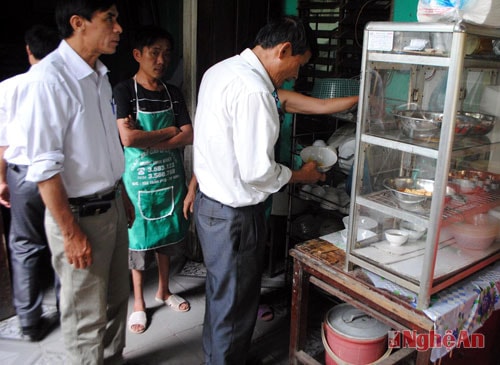 |
| Inspect food safety and hygiene for street food. |
Mr. Nguyen Van Thang, Deputy Head of the Market Management Department under the Department of Industry and Trade, stated: "From the end of 2014 to the present, the department has inspected 518 cases and handled 414 violations, mainly related to food. The department has seized 5,612 kg of animal products, 3,500 kg of animal fat, 12,240 poultry, 355 kg of various dried nuts, and 80 kg of processed food with unclear origin."
In reality, food products are infiltrating the market daily through various channels, and seizures by authorities are like a drop in the ocean due to limited resources and a lack of coordinated efforts among relevant agencies and local authorities.
Regarding this issue, Dr. Dao Trong Dung, Head of the Nghe An Food Safety and Hygiene Department, shared: Currently, the inspection and detection of violations in the production, business, processing, and consumption of food are facing many shortcomings. Authorities cannot inspect everything, and businesses have many ways to circumvent the law. Consumers are both victims and inadvertently accomplices to violations, as most of them lack knowledge about consumption.
Currently, detecting food contaminated with viruses, chemical residues, and other food safety and hygiene issues through colorimetric methods is very difficult and costly. For example, in the case of abnormally red meat found in a household in Ha Huy Tap ward (Vinh city) during the 2015 Lunar New Year, the Food Safety and Hygiene Department had to send samples to South Korea for bacterial identification testing… Another shortcoming is that local authorities have not yet actively participated in ensuring food safety and hygiene in their areas.
Currently, market inspections and checks of food production and business establishments are still considered only addressing the symptoms and are not thorough. Meanwhile, food reaches consumers through many stages, and the most important thing is ensuring quality and safety starting from the production stage. So, in the production and business stages, what factors contribute to food safety and hygiene violations?
From pesticide residues in vegetables...
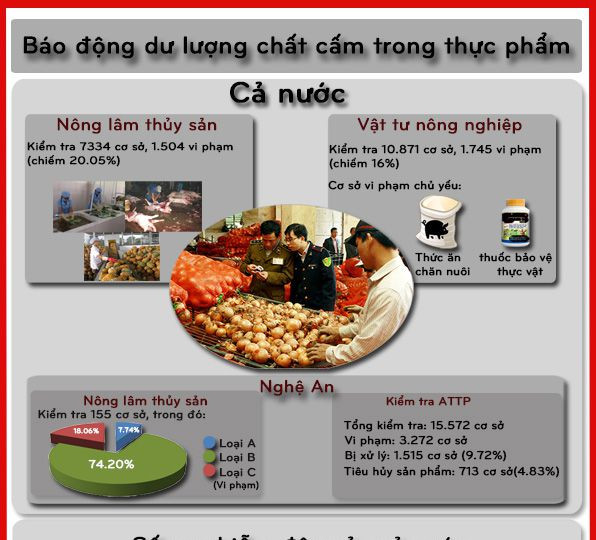
In reality, one of the major risk factors for food poisoning and harm to human health is pesticide residue on fruits and vegetables exceeding permissible limits. According to information from various levels and sectors, the control of pesticide residues is currently limited, only implemented on a probabilistic basis. When samples of vegetables are found to have pesticide levels exceeding the limit, the penalties are only at the level of recommendations or administrative fines, leading to the possibility of repeat offenses.
 |
As someone directly involved in the sampling and testing process, Mr. Nguyen Xuan Binh, Head of the Inspection Department of the Plant Protection Sub-Department, stated: “The first difficulty is that when taking samples in the fields, farmers may have only sprayed pesticides 4 days ago, so there are still residues. It takes 7 days for the residues to dissipate, and we cannot conclude whether the farmers harvested the vegetables and sold them at the market after the 4th day. Secondly, when taking samples, farmers often obstruct the process, refusing to allow them to be taken, refusing to sell, and giving inaccurate answers when asked about the date of the last pesticide application.”
In reality, vegetable production is largely spontaneous, fragmented, and small-scale, lacking overall planning. There are still instances where households use chemical fertilizers and pesticides to boost growth, resulting in greener, healthier vegetables, leading others to imitate and calculate how to achieve even higher yields. People are primarily concerned with quantity and attractive appearance, while food safety is not given sufficient importance.
Regarding banned substances in animal feed.
Mr. Ho Viet Nam, from Nam Dan town, the owner of a pig farm with 130 fattening pigs and 30 breeding sows, said: "For animal feed, we mix various types from factories with distributors in the area; we just try whichever type makes the pigs grow faster and look fatter... As for banned substances in livestock farming, honestly, I'm not sure; if they're on the market, they must have undergone thorough testing and quality assurance."
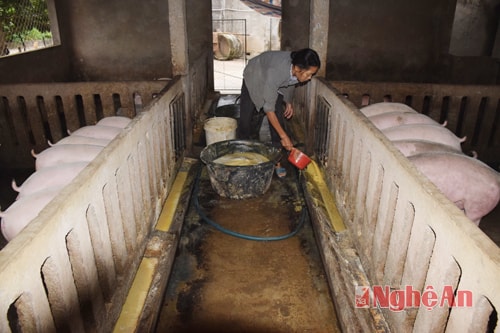 |
| Illustration. |
Mr. Ho Van Cuong, a farm owner in Hamlet 1, Hung Tan Commune, shared: "My farm raises 100-120 pigs per batch, and the cost of feed is about 250 million VND. Each bag of feed, if purchased through a distributor, costs 25,000-30,000 VND, so each batch of pigs costs 18-20 million VND, significantly reducing profits. However, if the price of live pigs falls below 40,000 VND/kg, small-scale farmers will suffer losses. Therefore, finding the best feed source to minimize the breeding cycle and maximize profits is a top priority for Mr. Cuong and other farm owners in Hung Tan Commune."
In reality, the control of animal feed sources is quite strict, implemented by the Animal Husbandry Department of the Department of Agriculture and Rural Development, from the feed procurement process to the inspection of feed lists in the areas where samples are taken. Recently, the inspection team has checked and monitored banned substances in animal feed in 6 districts and towns, taking 82 samples and testing 132 banned indicators in animal husbandry.
The analysis results showed one sample positive for Salbutamol (the main ingredient in asthma medication; exceeding the permitted limit multiple times can pose a cardiovascular risk to users). The team also inspected production and business conditions, checked labels, packaging, and quantities, and took 66 samples of industrial food for quality analysis. The results showed that 1 out of 66 companies violated regulations, and 2 out of 40 companies violated labeling regulations.
Mr. Luu Cong Hoa, Head of the Livestock and Veterinary Department of the Department of Agriculture and Rural Development, said: “Although inspections are quite frequent, the team can only conduct checks on suspected cases on a probabilistic basis; but we believe that in Nghe An province, banned substances in livestock farming do not have favorable conditions to circulate because farmers always prioritize the quality of their livestock. However, it is unavoidable that small animal feed companies will offer their products to farmers; in that case, if people provide information to the local authorities and the authorities request samples for testing, the department will conduct inspections immediately.”
Thus, the practice of mixing unlabeled, unregulated feed into livestock feed to accelerate weight gain, enhance color, and increase lean meat production, thereby boosting the price of livestock products, remains a possibility. To effectively control feed in farmyards, the Department of Agriculture and Rural Development leadership affirms the need for a plant protection and quarantine team at the grassroots level. Districts must strengthen inspection efforts and take responsibility for the quality of inspections and monitoring. Furthermore, farmers involved in production and livestock farming need to understand that the value of their products is linked to consumer trust...
Thanh Nga - Thanh Chung
| RELATED NEWS |
|---|