

Shortage of laborers for shipbuilding.
(Baonghean)ButShipbuilding is a very arduous profession requiring high skill and perseverance from the workers; therefore, although the wages for shipbuilders are not low, shipyards still find it difficult to attract workers.
The Hai Chau Shipbuilding Company today developed from the Hung Chau Shipbuilding Cooperative during the period (1959 - 1992). To produce sturdy and durable ships, skilled craftsmen worked tirelessly day and night.
According to Mr. Nguyen Ba Minh, 60 years old and a skilled craftsman at Hai Chau Shipbuilding Company, besides natural talent, a craftsman must also possess perseverance and patience. Even a novice craftsman needs two years of training to become proficient.
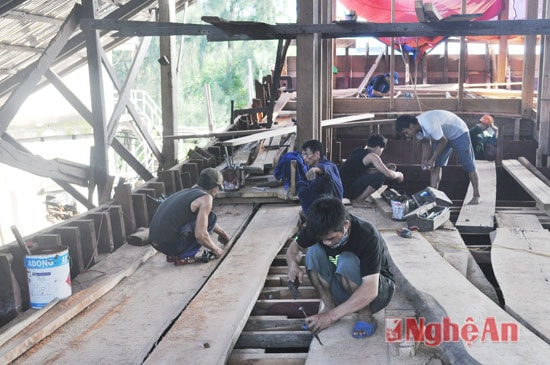 |
| Completion of an 800CV vessel at Hai Chau Shipbuilding Company. |
Currently, Hai Chau Shipbuilding Company builds approximately 30 new fishing vessels annually for customers in provinces ranging from Thai Binh and Nam Dinh to Kien Giang. However, the biggest concern for the company owner is the increasing shortage of skilled workers. Young people are not interested in shipbuilding, even though the income from the profession is not low; experienced workers earn 350,000 VND per day, while newcomers earn over 200,000 VND per day.
Every year, 50-60 workers join the company for apprenticeship, but after a while, they find the work too hard and strenuous, so they gradually quit. Each year, the company only manages to recruit 2-3 people who are motivated and committed to the profession...
The Ho Van Ngo shipbuilding facility in Quynh Nghia commune, Quynh Luu district, currently employs over 30 skilled shipbuilders with decades of experience, including a hull engineer, ready to meet the needs of fishermen for new construction and repair of fishing vessels. Mr. Ngo's shipbuilding facility is also the successor to the former Lien Minh Handicraft Cooperative. Established in 1966, the Lien Minh Handicraft Cooperative was responsible for building ferries and transport boats to serve the people in transporting goods during the war, as well as fishing boats for coastal fishing.
In 1988, following the government's policy of abolishing the subsidy system and transitioning to business accounting, the cooperative was dissolved. Recognizing the unique characteristics of his coastal hometown and the indispensable role of shipbuilding, as his people had relied on the sea for their livelihood for generations, Mr. Ngo resolutely gathered some friends to form a cooperative. They acquired saws, machinery, and workshops to continue building boats to serve the fishing needs of the people in his commune and neighboring communes.
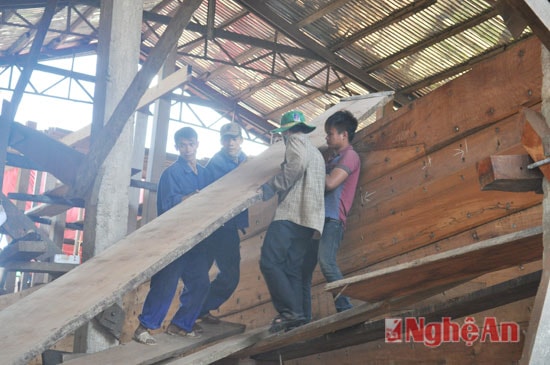 |
| Mr. Ngo's shipbuilding facility is growing steadily, building many large vessels to serve the offshore fishing needs of local fishermen, constructing around 10 new fishing boats each year. |
Mr. Ho Van Ngo shared: "For decades, despite facing the ups and downs of history, there were times when I thought I couldn't continue to maintain the traditional craft passed down from my ancestors. But overcoming all obstacles, I wholeheartedly built up the craft and created jobs for many local workers. In peak years, the workshop always had dozens of shipbuilders, but currently, the workforce at the workshop has decreased by half."
The reason is that workers are unwilling to do this strenuous job because it involves toiling all day in a dusty and noisy environment. Young men in the village, after finishing high school, either fail to get into university or find other jobs or pursue fishing at sea; very few are willing to take up shipbuilding. Therefore, labor in this profession is becoming increasingly scarce..."
Mr. Ho Anh Dung, a resident of Quynh Nghia commune, said: "Young people like us are now very hesitant to work in boat building because the work is hard and restrictive, the working environment is noisy and dusty. Moreover, not everyone has the talent for boat building, and it also requires perseverance and patience to pursue this profession..."
With a coastline stretching 82 km, Nghe An province has a long tradition of marine exploitation. Since ancient times, fishing boats have been the means of livelihood for generations of people in the coastal region. To this day, the exploitation and processing of seafood remains a strong economic sector of the province. Currently, the province has approximately 60 establishments for building and repairing fishing vessels, and nearly 4,000 fishing boats are operating at sea...
Therefore, the shipbuilding industry always needs to be maintained and developed, and there also needs to be a mechanism to attract workers to stay committed to the profession.
Quynh Lan
| RELATED NEWS |
|---|