

Unemployment among bachelors and masters degree holders is rising: Training skills are far removed from reality.
-The increasing number of unemployed graduates and master's degree holders is due to their work skills and discipline not meeting the requirements of employers...
The latest labor market update from the Ministry of Labour, Invalids and Social Affairs, published at the end of January 2016, shows that currently, more than 1.1 million people of working age nationwide are unemployed. Among them, those with college degrees or higher still have the highest unemployment rate, and this rate is trending upwards.
Another statistic shows that out of every 10 graduates, 6 lack skills and English proficiency; and out of every 10 bachelor's degree holders, 4 lack specialized knowledge. Therefore, out of every 10 companies recruiting, 6 are dissatisfied with the quality of training at the college, university, and postgraduate levels.
According to Deputy Minister of Labour, Invalids and Social Affairs Doan Mau Diep, the knowledge and skills currently taught in training institutions still lag significantly behind the requirements of employers. Therefore, the issue is that education and training systems need to link more closely with businesses and labor market management agencies to narrow the gap between the knowledge and skills acquired in schools and those demanded by the labor market.
Faced with the situation of highly qualified graduates facing unemployment, foreign partners and businesses believe that training institutions should also establish skill standards for each profession, as well as standards for student conduct and discipline. This would allow the training programs designed by schools to better meet the demands of employers.
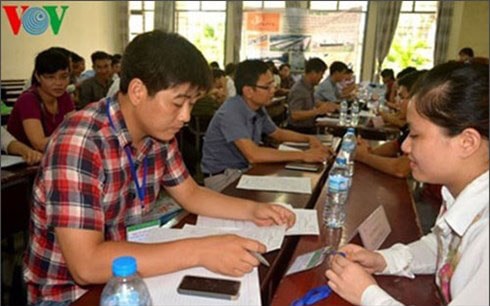 |
| Graduates are applying for jobs. |
Students are not proactive in research and practical work.
Professor, Doctor, and Meritorious Teacher Tran Huu Nghi, Rector of Hai Phong Private University, believes that currently, students' learning at universities and colleges remains passive, lacking initiative in research and practice. Many students have unclear motivations for learning; their studies are merely a formality to cope with family pressure, leaving them without a clear vision of their future careers. This is also the main reason why the majority of graduates are unable to meet the job requirements of employers.
To address this situation, schools need to organize more career guidance activities for students starting from the high school level. In addition, university and college training programs need a strong shift from theory to practice, with more investment in infrastructure, equipment, machinery, and laboratories so that students can practice in their respective fields more fully and practically.
The quality of learning throughout a student's education greatly impacts the quality of their "outcomes." This is a crucial factor in determining whether a student can meet the job requirements of employers.
According to Mr. Phan Huy Phu, Rector of Thang Long University, the phenomenon of students randomly choosing a university just to get accepted during the university entrance exam is one of the reasons for the poor academic performance of students during their university studies.
It can be said that the source of university and college admissions cannot be considered the decisive factor in determining the quality of graduates. Many students with low entrance exam scores may have better job prospects after graduation than those with high entrance scores.
The key to obtaining a high-quality workforce that meets job requirements lies in the students' ability to learn and improve themselves. In addition, training at universities and colleges must foster students' learning potential.
Training must be closely aligned with recruitment needs.
Agreeing with the view that not all students with high entrance exam scores will graduate successfully, Associate Professor, Dr. Do Van Dung, Rector of Ho Chi Minh City University of Technology and Education, stated that currently there is a situation where high school students have very high entrance exam scores for universities and colleges.
However, due to their impoverished family circumstances, many students have to find part-time jobs to help support their families and cover living expenses and tuition fees. This leaves many students with no time for studying, going to the library, or practicing in the lab, which greatly affects their academic results and work skills upon graduation. Not to mention cases where students enter university with high grades but become complacent during their time there, becoming engrossed in pointless activities and excessively playing online games.
Therefore, when directly applying for jobs in their field of study, most students are unable to meet the requirements of businesses, employers, and the labor market.
To ensure students acquire proficient knowledge and skills upon graduation and can meet employment demands, Mr. Do Van Dung suggested that universities and colleges, in addition to providing good theoretical and practical instruction, should guide students on how to study effectively.
Schools need to equip students with the skills to work independently and in teams, to handle problems scientifically and realistically in line with the realities of the labor market; and to cultivate honest and principled work ethics and conduct. Only then can the unemployment rate among graduates and master's degree holders be reduced.
According to VOV
| RELATED NEWS |
|---|