

A series of new laws came into effect on January 1, 2016.
From January 2016, many important laws came into effect, such as the Law on Military Service, the Law on Social Insurance, the Law on Citizen Identification, and the Law on Civil Registration...
Military Service Law 2015
From January 1, 2016, the Law on Military Service will come into effect and replace the 1981 Law on Military Service (which underwent several amendments in 1990, 1998, and 2005).
 |
| According to the 2015 Military Service Law, the period of military service during peacetime is 24 months. Photo: Le Quan. |
The 2015 Military Service Law has many new points compared to previous laws, such as regulations on female citizens participating in military service; prohibited acts; those exempt from military service registration; and those who can temporarily postpone conscription...
According to this Law, the term of service in peacetime is 24 months (previously 18 months). In cases where necessary for reasons of national defense and security, the Minister of National Defense may decide to extend the term of service, but not by more than 6 months.
During war or a national defense emergency, military service will be carried out under a general mobilization or partial mobilization order.
Social Insurance Law 2014
Approved by the National Assembly on November 20, 2014, the Law stipulates the social insurance regime and policies; the rights and responsibilities of employees and employers; agencies, organizations, and individuals related to social insurance, collective labor representative organizations, employer representative organizations; social insurance agencies; social insurance funds; procedures for implementing social insurance and state management of social insurance.
According to the new regulations, social insurance contributions will change from the beginning of 2016. The amount used to calculate social insurance contributions will include salary and allowances, instead of being based on the payroll as is currently the case.
Specifically, from January 1, 2016 to the end of 2017, social insurance contributions were based on the salary and allowances stated in the contract. From January 1, 2018 onwards, employees contribute to social insurance based on their salary, allowances, and various other supplementary payments as stated in their labor contract. Employees will contribute 8% and employers will contribute 18%, totaling 26% of the monthly salary.
Law on Citizen Identification 2014
This law regulates citizen identification, the citizen identification database and the national population database; the management and use of citizen identification cards; and the rights, obligations, and responsibilities of relevant agencies, organizations, and individuals.
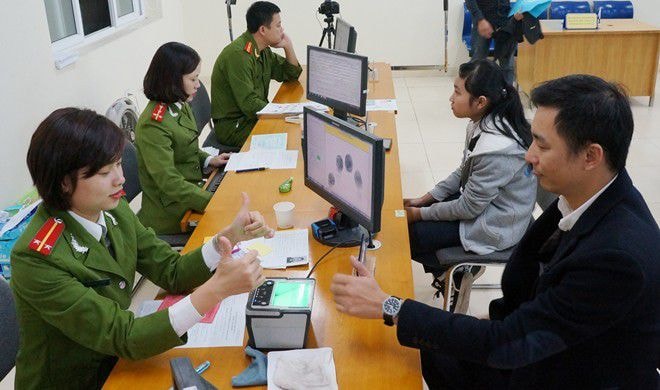 |
| The process for issuing the Citizen Identification Card (CCCD) is quite similar to issuing the 12-digit National Identity Card (CMND). Photo: Viet Duc. |
Also, starting in 2016 with the enactment of the Law, the regular National Identity Card will be replaced by the Citizen Identity Card.
The Ministry of Public Security has issued Circular No. 61/2015/TT-BCA regulating the mẫu (template) for the Citizen Identity Card. Accordingly, the applicable subjects are Vietnamese citizens aged 14 years and older who are applying for, exchanging, or reissuing a Citizen Identity Card.
This Circular takes effect from January 1, 2016 and replaces Circular No. 57/2013/TT-BCA of the Minister of Public Security regulating the mẫu of the Citizen Identity Card.
Law on Civil Status 2014
Enacted by the National Assembly on November 20, 2014, the Law stipulates the following: civil registration; rights, obligations, principles, authority, and procedures for civil registration; civil registration database and state management of civil registration; authority and procedures for resolving matters concerning nationality and adoption, which are implemented according to the provisions of the Vietnamese Nationality Law and the Adoption Law, except where this Law provides otherwise.
Vietnamese citizens and stateless persons residing in Vietnam have the right and obligation to register their civil status. This regulation also applies to foreign citizens residing in Vietnam, except in cases where international treaties to which Vietnam is a party provide otherwise.
In order to strengthen administrative procedure reforms and create more favorable conditions for citizens, the 2014 Law on Civil Status also stipulates that the authority to register civil status with foreign elements will be assigned to the district-level People's Committees instead of being under the authority of the provincial-level People's Committees as it is currently.
Amended Special Consumption Tax Law 2014
On November 26, 2014, the National Assembly passed the Law amending and supplementing a number of articles of the Law on Special Consumption Tax, deciding to increase the special consumption tax rate by 5% for a number of goods and services from January 1, 2016.
Specifically, for cigarettes, cigars, and other tobacco products, the excise tax rate increased from 65% to 70% from January 1, 2016, and to 75% from January 1, 2019; for alcoholic beverages with an alcohol content below 20 degrees, the excise tax rate was 30% from January 1, 2016, and 35% from January 1, 2018.
For spirits with an alcohol content of 20 degrees or higher and beer, the special consumption tax rate also increased by 5% to 55% from January 1, 2016, 60% from January 1, 2017, and 65% from January 1, 2018. Similarly, the special consumption tax rate for casino business services and electronic games with prizes also officially increased to 35% from January 1, 2016, an increase of 5% compared to before.
The amended Special Consumption Tax Law of 2014 was enacted by the National Assembly to amend and supplement several articles of the Special Consumption Tax Law No. 27/2008/QH12. Of particular note are the regulations on tax rates for 17 goods and services.
Law on Government Organization 2015
The 2015 Law on Government Organization, passed by the National Assembly, consists of 7 chapters and 50 articles and came into effect on January 1, 2016. Compared to the current law, the new law has been amended and supplemented relatively fundamentally and comprehensively, for example:
- Emphasize and concretize the executive function of the Government in the context of building a rule-of-law state; perfect the legal framework to promote proactiveness and flexibility in the Government's operations.
- Clearly define the position and further emphasize the role and responsibilities of the Prime Minister within the state administrative system.
- Clearly define the relationship between ministers and heads of ministerial-level agencies with ministries and ministerial-level agencies; innovate the functions of ministries and ministerial-level agencies.
Law on the Organization of Local Government 2015
This law regulates administrative units and the organization and operation of local governments within these administrative units.
The administrative units of the Socialist Republic of Vietnam include: Provinces and centrally-administered cities (hereinafter referred to as provincial level); Districts, counties, towns, cities under provinces, and cities under centrally-administered cities (hereinafter referred to as district level); Communes, wards, and townships (hereinafter referred to as commune level); and Special administrative-economic units.
This law was passed by the 13th National Assembly of the Socialist Republic of Vietnam at its 9th session on June 19, 2015.
Law on the Vietnam Fatherland Front 2015
This law stipulates the rights, responsibilities, organization, and activities of the Vietnam Fatherland Front; the relationship between the Vietnam Fatherland Front and the State, the People, and other organizations; and the conditions for ensuring the operation of the Vietnam Fatherland Front.
The Vietnam Fatherland Front is the political foundation of the people's government; it represents and protects the legitimate rights and interests of the people; it gathers and promotes the strength of national unity, implements democracy, strengthens social consensus; it monitors and provides social feedback; it participates in building the Party and the State, and in people's diplomacy, contributing to the building and protection of the Fatherland.
Law on the Organization of the National Assembly 2014
The 2014 Law on the Organization of the National Assembly stipulates that the term of each National Assembly is 5 years, from the opening date of the first session of that National Assembly to the opening date of the first session of the next National Assembly.
The National Assembly operates on a conference basis and makes decisions by majority vote.
The National Assembly is the highest representative body of the people and the highest state power organ of the Socialist Republic of Vietnam. The National Assembly exercises constitutional and legislative powers, decides on important national issues, and exercises supreme oversight over the activities of the State.
According to Newzing.vn
| RELATED NEWS |
|---|