

Thai and Malaysian goods are accelerating their entry into Vietnam.
The ASEAN Economic Community will be officially established tomorrow, marking a new and challenging turning point as goods from other countries can enter Vietnam more easily.
A significant figure marking this event is the import of over 23,500 Thai cars in the first 11 months of this year, replacing South Korea as the largest exporter of cars to Vietnam. Surveys at several markets and supermarkets in Hanoi show that fruits, confectionery, and household goods from ASEAN countries in general, and Thailand and Malaysia in particular, are increasingly appearing and diverse on the shelves.
At a supermarket on Khuong Dinh Street (Thanh Xuan District), ASEAN confectionery dominates the market, such as Dynamite Choco candy priced at 15,000 VND, Bin Bin rice crackers at 39,500 VND, Hiro egg cakes at 33,500 VND, sliced potato chips are mainly Malaysian brands like Ligo and Kinos, while Thai products dominate the market for plastic containers. Recently, the influx of Thai agricultural products into Vietnam has also been frequently mentioned, not only rice but also various fruits like tamarind, mango, rambutan, and star fruit.
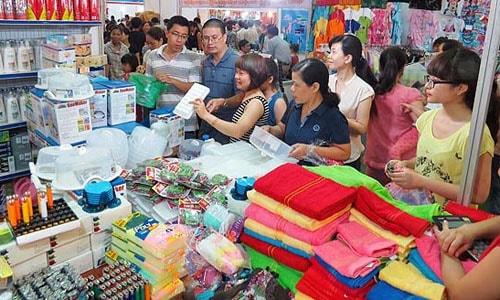 |
| Thai household goods have won the hearts of Vietnamese consumers. |
A supermarket employee shared that ASEAN brands are popular among housewives because they trust the quality and the prices are much cheaper than European or American confectionery. Similarly, with agricultural products, attractive packaging, delicious taste, and unique characteristics are what attract buyers, even if the price is double that of domestic products.
Furthermore, goods from Thailand, Malaysia, and other countries in the region will have even greater opportunities to enter the Vietnamese market as the ASEAN Economic Community (AEC) officially forms tomorrow (December 31st). Accordingly, commitments, initiatives, action programs, and tariff removal plans from member countries will be implemented more aggressively towards establishing a common economic zone with over 640 million people and a total trade turnover exceeding US$2.5 trillion.
Data from the General Department of Customs also shows that Thailand currently leads the bloc in goods exports to Vietnam, with a turnover of US$7.5 billion in the first 11 months of the year, an increase of 17% compared to the same period last year. The trade deficit with this market reached US$4.5 billion, an increase of 40%. Similarly, Malaysia had a trade deficit of US$500 million in the first 11 months of this year, while the deficit was only US$140 million during the same period last year. The main imported goods from these countries include fruits; confectionery; machinery, equipment, tools and spare parts; electronic products and components; household appliances; automobiles; and automobile components and spare parts.
Speaking to VnExpress.net, Ms. Le Thi Minh Thuy, Director of the Trade and Services Statistics Department (General Statistics Office), said that Vietnam is estimated to import $5.5 billion from ASEAN countries this year, a 45% increase compared to last year, ranking third among major import markets, after China and South Korea. Thailand's trade deficit has surged this year despite low levels in previous years, and Malaysia, which previously had a trade surplus, is now experiencing a trade deficit.
"Domestic businesses have low competitiveness, and their ability to take advantage of preferential treatment from trade agreements is still not as good as in foreign countries," Ms. Thuy commented.
Sharing the same view, Mr. Nguyen Bich Lam, Director General of the General Statistics Office, said that besides opportunities, the biggest challenge for Vietnam next year is integration. The impact of implementing trade agreements with a roadmap for zero tariffs will increase imports and intensify domestic competition. If domestic businesses do not improve their capabilities, the trade deficit will face significant pressure, affecting foreign exchange and exchange rates.
The ASEAN Economic Community (AEC) is one of the three pillars of the ASEAN Community (AC), along with the ASEAN Political-Security Community (APSC) and the ASEAN Socio-Cultural Community (ACSC). Over the past 10 years, Vietnam has consistently experienced a trade deficit with ASEAN member countries, increasing from US$3.9 billion in 2005 to US$6 billion in 2010, and this year's preliminary estimate is US$5.5 billion.
According to VNE
| RELATED NEWS |
|---|