

The impetus for restructuring the forestry sector.
(Baonghean) - In reality, planting large timber forests always yields better economic and environmental results compared to small timber forests. However, planting large timber forests currently faces many difficulties.
The benefits of planting large timber forests.
In Tuong Duong, due to difficulties in selling acacia wood, people have switched to planting mahogany. Mr. Lo Van Ly from Tam Bong village, Tam Quang commune, said: In 2006, his family converted 3 hectares of acacia trees to mahogany trees, and to date, they have harvested 140-150 million VND/hectare, while acacia only yielded 30-40 million VND/hectare.
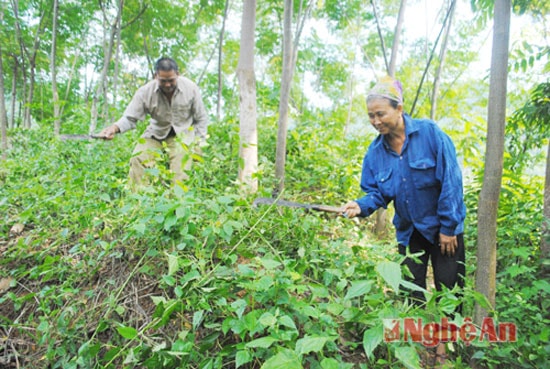 |
| The people of Tam Bong village, Tam Quang commune (Tuong Duong district) are taking care of the large-timbered mahogany forest. |
According to Ms. Kha Thi Hien, Vice Chairman of the People's Committee of Tam Quang commune: The entire commune has about 700 hectares of timber forest, of which mahogany accounts for more than 270 hectares. Previously, people who planted acacia suffered losses due to the extremely low price, while planting mahogany is very effective, easy to sell, and traders come directly to the area to buy it. On average, each cubic meter of mahogany wood is priced from 2 to 2.5 million VND; each hectare of mahogany after 5 years of planting yields an income of about 150 million VND. In 2015, Tam Quang also planted mahogany and teak on 30 hectares. Currently, the commune is planning about 40 hectares of "multi-layered, multi-purpose mixed forest" area, planting mahogany with naturally regenerating Săng Lẻ trees. This Săng Lẻ wood is salt-tolerant and is used for shipbuilding, so it has high value.
Mr. Lo Kham Kha, Head of the Agriculture Department of Tuong Duong District, added: From 2007 to the present, the district has focused on planting large timber trees. Of the 7,200 hectares of raw material forest, mixed-cropping mahogany and teak trees account for 80%. The effectiveness of planting mahogany has been confirmed; it is easy to plant, requires little investment, and yields 3-4 times higher returns than planting acacia. In addition to the State's investment policies on forest planting such as Project 147, Program 30A, etc., the district annually supports people with 2.5 - 2.7 billion VND for forest planting (providing 100% of the seedlings).
According to Mr. Ho Dinh The, Director of Song Hieu Forestry Company Limited, from 2004 to 2005, the company planned and planted 2,700 hectares of large timber trees. To date, 1,000 hectares have been harvested, and the remaining 1,700 hectares are still being harvested. Large timber forests yield 140-160 m³ of wood per hectare per 10-11 year cycle, generating revenue of 180-200 million VND per hectare. Notably, these large timber forests are used for multiple purposes, from laminated timber to wood chips. They not only bring higher economic benefits but also help reduce soil erosion and runoff, contributing to environmental protection and combating climate change. Many large timber forest areas in Nghia Mai and Nghia Minh communes (Nghia Dan district) have proven very effective in preventing soil erosion.
At Con Cuong Forestry Company Limited, from 2000 to 2002, the company intercropped hybrid acacia with native large-timber trees such as Terminalia catappa and Terminalia chebula on over 60 hectares. From 2009 to the present, the company has also intercropped native Terminalia catappa with hybrid acacia on nearly 350 hectares. Terminalia catappa is known to be an easy-to-grow tree, with light wood (classified as group VII), less prone to warping, easy to process, and used for sawing planks, veneer for plywood, matches, pencils, making household furniture, carving clogs, and some office supplies…
Challenges that need to be overcome
Recently, the People's Committee of Nghe An province issued a decision approving the Project for Restructuring the Forestry Sector in Nghe An until 2020, which aims to achieve a forest cover rate of 57% and increase the sector's production value by 4-4.5% per year. The project also aims to protect and develop existing forest areas, gradually meeting the demand for timber, forest products, consumption, and export. It will convert 15,000 hectares of existing planted forests into large-timber production forests, plant 8,000 hectares of new large-timber forests on non-forested land, and replant 30,000 hectares of previously harvested large-timber forests. The main large-timber tree species include: Acacia mangium, eucalyptus, Dalbergia tonkinensis, green lim, Dipterocarpus spp., Dipterocarpus spp., and pine; with Acacia mangium being the main species, accounting for 90% of the planted area.
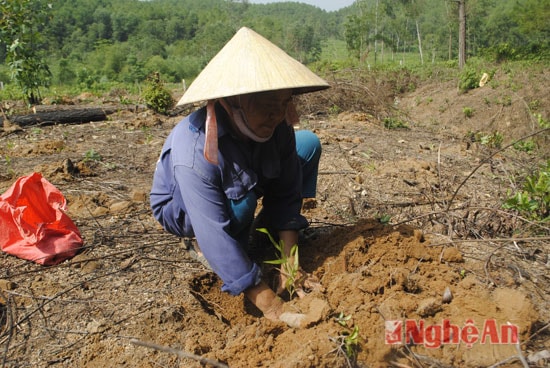 |
People in Tang Thanh commune, Yen Thanh district, are implementing a project to plant large timber forests. |
To date, the province has over 160,000 hectares of timber forests, with approximately 4,000 hectares of large-timber forests concentrated in districts such as Nghia Dan, Con Cuong, and Tuong Duong. However, planting large-timber forests faces numerous challenges. In recent years, the planted forest area and timber production have increased significantly, but mainly supply small timber for paper and wood chips, which have low economic value. We lack technical and policy solutions to develop large-timber plantations to serve the wood processing industry and exports, thereby increasing economic value.
Mr. Dang Xuan Minh, Deputy Head of the Forest Protection Department, shared: The reason for this has been identified as a capital shortage. Planting large timber forests requires a long period of care and protection, at least twice as long as planting small timber forests, leading to a longer time for harvesting and recouping investment capital. Meanwhile, people are still facing difficult circumstances, and their daily needs require money to cover expenses. Furthermore, borrowing capital to invest in planting new large timber forests is not easy. Although the State has regulations and credit policies to develop forestry, in reality, banks are often hesitant to lend in this sector due to high risks and long repayment periods.
The benefits of planting large timber forests are clear, and the province's policy is timely and correct. However, the roadmap for implementing this policy is extremely difficult; without appropriate and effective mechanisms and support, it will certainly be difficult to achieve the desired results.
Van Truong
| RELATED NEWS |
|---|