

Basic driving lessons for new drivers
VOV.VN - When you first start driving, you must learn the basics such as driving a small car, staying in the correct lane, maintaining a safe distance, and parking properly...
For new drivers, the first thing to do is to remain calm and confident when participating in traffic by equipping themselves with minimum knowledge and skills such as knowing the law and traffic signs.
Before driving, drivers should test the engine, brakes, steering wheel, lights, etc., ensuring all components are functioning properly. This inspection helps minimize potential risks such as engine malfunction or brake problems, thereby reducing unnecessary accidents.
Once behind the wheel, it's essential to know the traffic laws. This is especially important if you lack driving experience; knowing the rules, traffic signs, and directions will make it easier and safer to navigate through traffic.
Driving a small car at a slow speed is the top priority for beginners transitioning from two-wheeled to four-wheeled vehicles. Small, low-powered cars help you practice basic driving skills proficiently. Driving techniques are also learned starting from slow speeds and gradually increasing, depending on each person's ability.
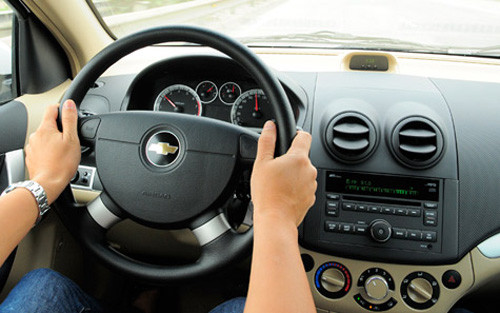 |
| New drivers need to know how to yield the right of way and drive slowly. |
Stay in your lane, however, you should occasionally yield to other vehicles. Especially on highways, new drivers who can't drive fast are easily pressured by cars behind them honking to overtake. Stay calm, observe, steer, and yield to faster vehicles. Don't rush to speed before you've mastered it.
When you're just learning to drive, you shouldn't go on the highway, because on the highway, experienced drivers often go at speeds of 100 to 130 km/h, and you might end up causing an accident.
It's important for new drivers or those who have just gotten their license to practice driving on short, familiar routes; practice driving straight, pulling over to the side, reversing, checking rearview mirrors and side mirrors, using turn signals, and familiarizing yourself with all the car's functions. Another important point is to memorize the accelerator and gear shift pedals, always use turn signals when changing lanes, and clearly understand traffic signs on both sides of the road (refer to your textbook if you don't remember them) for at least 6 months to a year before driving long distances, on highways, or in densely populated areas or alleys.
If driving an automatic car, absolutely do not use both feet; only use your right foot. Remember that (while driving) when releasing the accelerator, press the brake, and when releasing the brake, press the accelerator, to avoid accidentally pressing the accelerator instead of the brake, or vice versa.
Since you're a new driver, you need to know how to yield the right of way; you can't just cut in like experienced drivers.
In addition, maintaining distance is the most difficult thing for drivers, especially when traveling in crowded cities like Hanoi or Ho Chi Minh City.
Cars never park at the distances you read about in parking books, motorbikes constantly cut in front of your car, and both sides of your vehicle will be lined with motorbikes at a distance of only 5-10 cm, especially during rush hour. All drivers, young or old, encounter this situation, but experienced drivers know exactly what distance is sufficient to avoid collisions.
Find a stretch of road with little traffic, ask someone to signal for you, and practice approaching a motorbike or car, stopping just before a collision. Feel and measure the safe distance between the front of your vehicle and the vehicles in front. Remember, each vehicle has a different front end length, so feeling the distance ahead is essential whenever driving an unfamiliar vehicle.
Turning around is a fairly basic driving skill, but it's not easy, especially for new drivers. In heavy traffic, with cars constantly honking, turning around on a busy road requires more calmness than skill.
In areas with signs indicating that crossing the road, making a U-turn, or signaling is permitted early, when approaching the turning point, steer slowly and check your rearview mirrors.
On streets where U-turns are required (which are common in Vietnam), it's necessary to observe and find a location where a U-turn can be made with minimal disruption to traffic.
Parallel parking and reverse parking both require skillful driving. The standard distance for parallel parking is never sufficient in Vietnam, so you need to be more skillful and careful when reversing. Reverse parking (also known as parallel parking or 'reverse parking') is a difficult technique in the driving test and even in real-world situations for beginners, but it will become easier after a few practice sessions.
In addition, you need to buy insurance to ensure safety while driving. Whether you are a beginner driver or an experienced driver, you should buy insurance for your car. Especially for new drivers, collisions are unavoidable no matter how careful you are, so research and buy insurance to save on repair costs.
According to VOV
| RELATED NEWS |
|---|