

Actively vaccinate livestock in mountainous areas.
(Baonghean) - To ensure effective vaccination against hemorrhagic septicemia and foot-and-mouth disease for livestock in the upcoming spring season, many mountainous localities have identified public awareness campaigns as a top priority.
Following Vi Trung Duc, a veterinarian in Do village, Chau Kim commune (Que Phong district), we visited several households in the village to gather information and prepare for the upcoming spring livestock vaccination campaign. The people of Do village mainly engage in small-scale livestock farming, so almost every family has built barns to keep their buffalo and cattle.
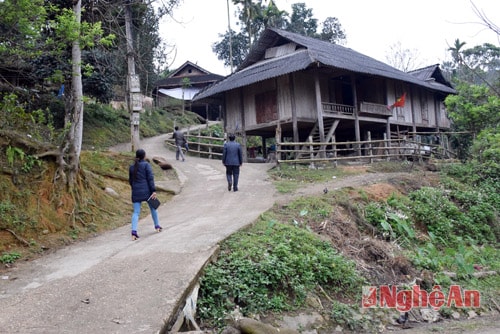 |
| Veterinary officers from Chau Kim commune, Que Phong district, are coordinating with village veterinary officers to promote livestock vaccination for the upcoming spring season. |
Anh Duc said: Recently, he and all the veterinarians in the commune received training and were briefed on livestock vaccination work, preparing to implement the vaccination campaign for the upcoming spring season. To ensure that people are aware of the vaccination schedule in the village, before the vaccination day, the village head informs all families to keep their buffaloes and cows in their barns, shortening the vaccination time and reducing the effort of having to go up the hill to find each buffalo or cow.
Mr. Luong Van Muoi's family, residing in Do village, Chau Kim commune, currently owns two buffaloes and one calf. Mr. Muoi stated that the buffaloes are a significant asset to his family, and therefore, they diligently comply with the annual vaccination schedule announced by the village. Because they receive vaccinations twice a year, their herd thrives and remains free from disease.
Mr. Ha Minh Tuan, Vice Chairman of the Chau Kim Commune People's Committee, said: Chau Kim has 10 villages, and the commune has assigned one veterinarian to each village to monitor disease outbreaks and vaccinate livestock annually. However, because the grassroots veterinarians do not receive a monthly allowance, many are unwilling to work or lack a high level of responsibility. Recently, the commune had to find replacements for two veterinarians in Do and Muong villages. To ensure thorough vaccination for the upcoming spring season, the commune has organized training and briefings for grassroots veterinarians since mid-February. Chau Kim currently has 1,129 buffaloes and 459 cows. The local goal is to achieve an 80% vaccination rate for buffaloes and cows against hemorrhagic septicemia and foot-and-mouth disease this spring.
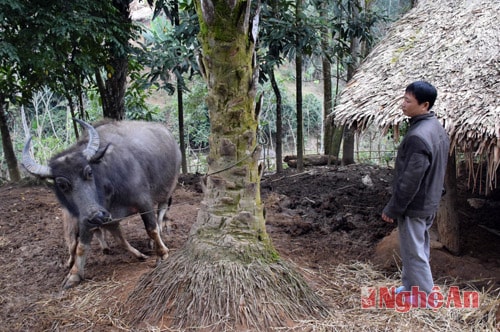 |
| In addition to his regular annual vaccination duties, Vi Trung Duc also frequently treats illnesses in buffaloes and cows for the villagers. |
According to statistics from the Que Phong District Veterinary Station, the annual vaccination rate against hemorrhagic septicemia and foot-and-mouth disease for buffalo and cattle herds reaches 70 to nearly 80% of the total herd during the spring season. To achieve this figure, firstly, livestock farmers have raised their awareness of disease prevention; secondly, the government provides 100% vaccine support from the investment fund under Resolution 30a; and thirdly, the district directs localities to implement vaccination schedules appropriate to the actual conditions of each locality, combined with strengthening propaganda and mobilization efforts to ensure people strictly adhere to the vaccination schedule in each village. According to the plan, Que Phong will implement livestock vaccination from March to June.
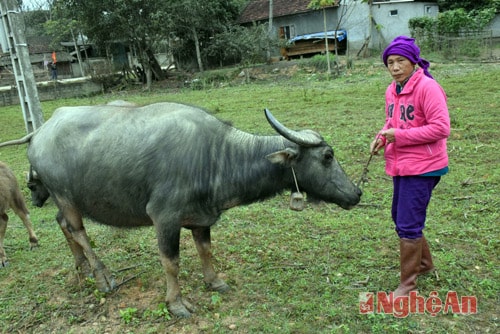 |
| Ms. Lo Thi Mui, from Ke Nam village, Chau Binh commune, Quy Chau district, takes care of her herd of buffaloes. |
Mr. Le My Trang, Head of the District Veterinary Station, said: Quy Chau district has 26,000 buffaloes and cows, of which about 21,000 are eligible for vaccination, therefore requiring 21,000 doses of hemorrhagic septicemia and foot-and-mouth disease vaccines. At this time, the Station is coordinating with local authorities to intensify propaganda through various forms, such as: sending directive documents; distributing leaflets, making announcements on loudspeakers… combined with district veterinary officers directly working with communes, villages, and hamlets to understand the current situation of the buffalo and cow herds…
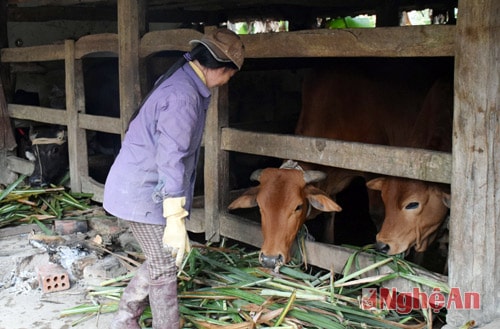 |
| If every family keeps buffalo and cattle in enclosures, the annual vaccination program will be easier to manage. |
To ensure the effectiveness of vaccination efforts, relevant levels and sectors need to strengthen communication and raise public awareness so that people understand and comply. In reality, localities that do a good job of vaccinating their livestock experience fewer disease outbreaks, and vice versa.
Xuan Hoang
| RELATED NEWS |
|---|