
"Launchpad" for economic development
(Baonghean) - Discussions on solutions for developing the country's socio-economic infrastructure in the period 2016-2020 and beyond have become heated in the National Assembly as well as on the sidelines of the 12th Party Congress. In particular, the issue of building transportation infrastructure (KCHTGT) needs fundamental solutions to become a "launching pad" for socio-economic development.
(Baonghean) - Discussions on solutions for developing the country's socio-economic infrastructure in the period 2016-2020 and beyond have become heated in the National Assembly as well as on the sidelines of the 12th Party Congress. In particular, the issue of building transportation infrastructure (KCHTGT) needs fundamental solutions to become a "launching pad" for socio-economic development.
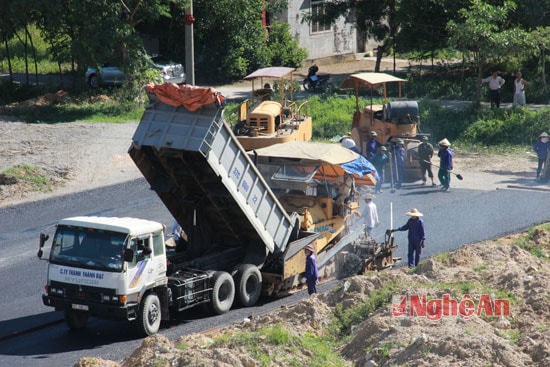 |
| Construction is underway on the 72-meter road section passing through Ha Huy Tap ward, Vinh City. |
3 breakthroughs
"Building a comprehensive economic infrastructure system, especially the transportation system, which is causing congestion, hindering economic growth, and creating public discontent." This is one of the goals set out in the Resolution of the 11th National Congress of the Party. Simultaneously, the socio-economic development strategy for the period 2011-2020 also identified one of its three strategic breakthroughs as "Building a comprehensive infrastructure system, with a number of modern projects, focusing on transportation systems and major urban infrastructure."
Thus, accelerating the development of transportation infrastructure to serve socio-economic development needs has been given special importance and has made remarkable progress. The Minister of Transport, delegate Dinh La Thang, in his presentation before the 12th National Congress, emphasized: "Over the past five years, transportation infrastructure has been focused on a synchronized, modern, and targeted approach, using resources efficiently to improve investment efficiency, and especially, the investment results have created a ripple effect, promoting development in all regions and the entire country."
Firstly, the transportation sector has created a breakthrough in crucial and essential infrastructure, with a ripple effect across regions. Secondly, there has been a breakthrough in policy mechanisms to attract resources for the development of transportation infrastructure. Thirdly, there has been a breakthrough in the effective organizational methods of the political system, from the central to local levels, in implementing socio-economic infrastructure development.
To illustrate the comprehensive progress made in road, air, water, and rail transport, as well as urban and rural infrastructure, creating a new face and acting as a "launching pad" for socio-economic development, Representative Dinh La Thang presented compelling figures: The entire Ho Chi Minh Highway through the Central Highlands was put into operation 1.5 years ahead of schedule; the expansion of National Highway 1 from Thanh Hoa to Can Tho was completed 1 year ahead of schedule. These are two of the most important transport axes, significantly impacting the country's economic development, connecting growth regions, and key international transport hubs.
Over 700 km of expressways have been put into operation (exceeding the target set in Resolution No. 13-NQ/TW by more than 100 km); these are key expressways located on the North-South axis, connecting the two key economic regions of the North and South with gateway seaports and international border gates. Many projects at important airports have been completed and put into operation, such as Noi Bai (Terminal T2, VIP lounge), Tan Son Nhat, Da Nang, Can Tho, Vinh, Phu Quoc, Lien Khuong, Pleiku, Tho Xuan... Urban and rural transportation have received strong investment, creating a strategic breakthrough.
Accordingly, investment resources for the construction of transportation infrastructure during the 2011-2015 period were also strengthened by diverse sources. In addition to resources from the state budget, other resources totaling over 410,000 billion VND were mobilized for investment in transportation infrastructure. The focused investment in the synchronous and targeted development of transportation infrastructure, connecting major economic centers and gateway transportation hubs, has contributed to the rational restructuring of the transportation sector, ensuring harmonious connectivity, maximizing the strengths of each mode of transport; reducing transportation costs, and improving the efficiency and quality of transportation services.
The head of the national transport sector also provided compelling evidence: A report by the World Economic Forum shows that Vietnam's transport infrastructure has risen 36 places in the past five years (from 103rd in 2010 to 67th in 2015). The World Bank also estimates that the average growth rate of the logistics market in Vietnam is 16-20% per year... These are the most accurate and objective measures of the quantitative and qualitative changes in transport infrastructure and investment efficiency, thereby directly contributing to reducing transport costs, increasing the competitiveness of the economy, and improving the quality of life for the people.
4 challenges
Along with significant and groundbreaking achievements, Vietnam's transport infrastructure also presents challenges, limitations, and risks that could hinder economic growth. In a side discussion at the 12th National Congress, Deputy Minister of Transport Nguyen Ngoc Dong did not hesitate to clearly outline four challenges facing the transport sector.
The first challenge is that transportation infrastructure remains congested in some areas, becoming a barrier to socio-economic development because it has not met the ever-increasing demand. The Deputy Minister further analyzed: "This is the most important challenge, because the requirements for developing infrastructure to accelerate socio-economic development have not been met. Our transportation costs are high compared to the region and the world, thus impacting the cost and competitiveness of domestic transportation compared to other countries."
“The lack of synchronized connectivity between different modes of transport, as well as between regions, the poor organization of transport, and the limited application of scientific and technological advancements in the industry are the second challenges,” Deputy Minister Nguyen Ngoc Dong emphasized. The third challenge is the limited human resources in the transportation sector, as some large-scale projects still rely on the support of foreign experts. The fourth challenge is the high number of traffic accidents and fatalities, for which the transportation infrastructure still has shortcomings.
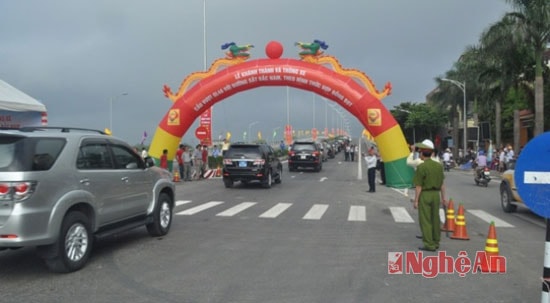 |
| Overpass 46 connecting to the North-South railway line was inaugurated. |
4 groups of solutions
Based on a clear understanding of existing shortcomings and limitations, and with the strategic orientation that infrastructure development should become one of the three strategic breakthroughs for socio-economic development, the leaders of the Ministry of Transport particularly emphasized the following breakthrough solutions:
The first,Utilize resources rationally, invest strategically and prioritize projects with a ripple effect, ensuring connectivity between economic centers, key economic regions, and various modes of transport through reviewing and adjusting industry development strategies and plans to ensure feasibility and suitability to actual conditions. Improve standards, regulations, procedures, and economic-technical norms. Strengthen the application of science and technology in the development of transport infrastructure.
Monday,Continue to actively attract all resources for the development of transport infrastructure, including domestic and foreign resources; paying particular attention to coordination to encourage localities to participate more strongly in mobilizing resources for transport infrastructure development.
Tuesday,Continue to coordinate closely with localities to accelerate land clearance and project construction progress; effectively inspect, supervise, and handle issues related to project progress and quality.
WednesdayStrengthening anti-corruption efforts in investment and construction; enhancing the capacity of entities involved in the investment and construction process. Continuing to promote administrative reform with the goal of ensuring the satisfaction of citizens and businesses.
Clearly, transportation infrastructure must necessarily be the "launching pad" to create momentum for socio-economic development; and what has been achieved so far is only the beginning of a very arduous journey to meet the requirements of the integration period.
Huu Nghia - Nguyen Son