
The female artist from Nghe An province is captivated by the spirit of her homeland.
(Baonghean) - Pink lotus blossoms are spreading their fragrance in the autumn breeze, the roads bordering Hanoi's flower villages, bicycles laden with flowers brightening up a street corner… I asked the petite artist who painted Hanoi with all that gentleness and subtlety: You must be a "Hanoi lady"? Artist Vo Thanh Huong replied with a distant smile: No, I'm a girl from Nghe An.
(Baonghean) - Pink lotus blossoms are spreading their fragrance in the autumn breeze, the roads bordering Hanoi's flower villages, bicycles laden with flowers brightening up a street corner… I asked the petite artist who painted Hanoi with all that gentleness and subtlety: You must be a "Hanoi lady"? Artist Vo Thanh Huong replied with a distant smile: No, I'm a girl from Nghe An.
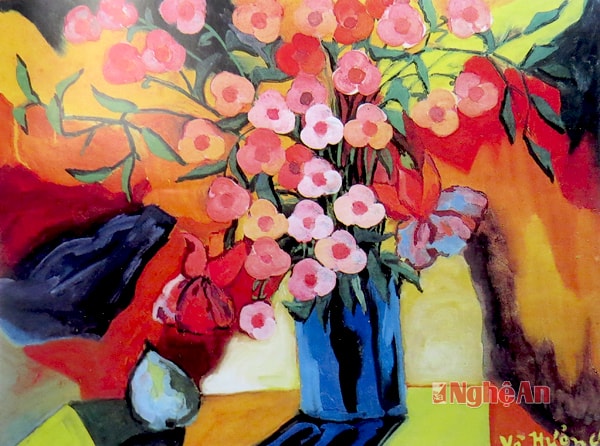 |
| A "Still Life" artwork by artist Vo Thanh Huong. |
Her house is located on a small alley in Tay Ho, Hanoi, where the female artist Vo Thanh Huong (a member of the Vietnam Fine Arts Association and the Hanoi Fine Arts Association) lives and quietly creates her art. She sits by the sunlit window, and her vibrant paintings seem to radiate joy before my eyes. Just looking at them is enough to know that she loves nature immensely.
She said that she always feels a sense of awe when standing before the beauty of nature. And it is this very feeling that compels her to paint and paint. Sometimes she feels as if the colors are flowing spontaneously, overflowing into her canvas. Yet, there are still times when she feels overwhelmed, as if she can't keep up, as if she's powerless.
She gave an example, like her trip back to her hometown six years ago. “I thought the Giang River only existed in dreams. But it was right before my eyes, gentle and soft like a silken ribbon in the mist.” She said that her astonishment was understandable, because although she's from Nghe An, she was born and raised mostly in Hanoi. A part of her soul lingered in her hometown, feeling a sense of loss, a debt, until she finally set foot in Thanh Chuong, her ancestral land. Her hometown is still poor, but so beautiful.
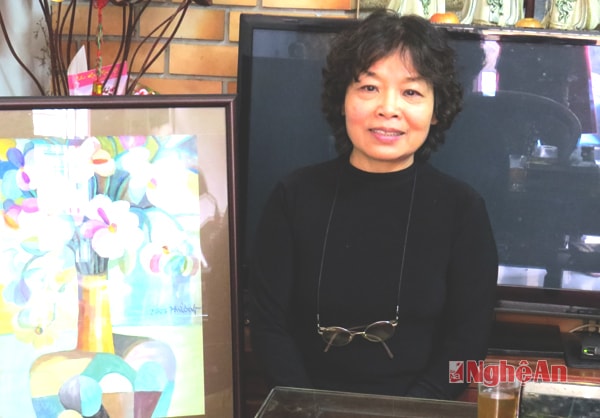 |
| Artist Vo Thanh Huong |
"I should have visited my hometown more often. And indeed, I still long to return..." Vo Thanh Huong said, her eyes welling up with emotion. Throughout her life in exile, the female artist has sought the beauty of new lands, but she knows that in her soul, somewhere hidden, there remains a picture of her homeland, so that sometimes, without the hustle and bustle, she quietly remembers it... She dreams again, a dream of painting the river of her hometown, a dream of painting the small village with its simple, honest poor people. A dream of painting a bowl of tea shimmering like honey, filled with the joyful and sorrowful sounds of her homeland...
Born in 1953 and primarily residing in Hanoi, Vo Thanh Huong loved drawing from a young age. By the age of 15 or 16, her paintings were praised by many, including art students. In 1969, she studied at the Industrial Fine Arts College, specializing in toys, and in 1985, she continued her studies at the University of Industrial Fine Arts, specializing in graphic design. Since 1974, she has worked in the Technical Drawing Department of the Institute of Archaeology. Her work there was quite interesting, as it gave her a unique perspective on painting, closely linked to the approach of archaeology.
Thanh Huong was assigned to draw artifacts, archaeological sites, book covers, magazine covers, etc. While the millimeter-level accuracy of the drawings gave her a realistic view of the subject, the decorative patterns, ancient motifs, and images steeped in the colors of time allowed the artist to look deeply inside, to see the essence, hidden beauty, and historical significance of the subject.
It's no wonder that in the 1990s, the paintings of artist Vo Thanh Huong had a certain archaeological influence. She skillfully incorporated the colors of time and archaeological decorative details into her works, giving them an ancient, profound, simple yet sophisticated feel. These paintings were created using pigments and traditional Vietnamese dó paper, primarily employing black and white or gray tones.
A pastel painting titled "A Farewell," created by her in 1996, has a very unusual composition, which Thanh Huong calls a "divided composition," depicting a farewell between a soldier and a young woman. Many people have commented on this unusual painting, showering it with praise. But for her, it is simply a reflection of life's reality, as simple as life itself, and if there is a hint of unusual color, it is because it was painted from the heart of a woman, a woman who longs for love, yearns for completeness, but is also strong and willing to endure and sacrifice.
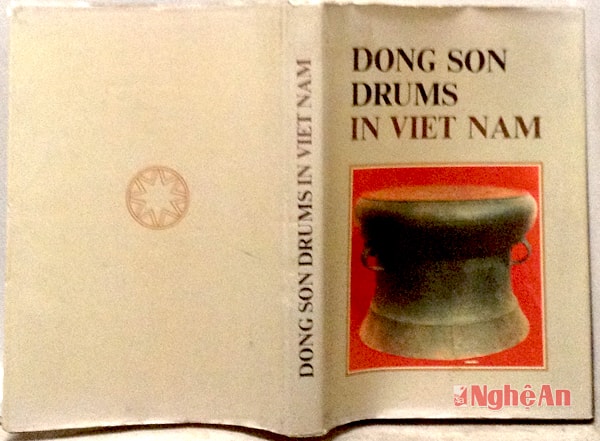 |
| A book on archaeology with a cover designed by artist Thanh Huong. |
Later, she mainly painted with oil and acrylic paints. Many of her paintings of flowers, still lifes, and landscapes were loved by friends and family, such as "Blooming Flowers," "Still Life," "Peaceful Street Corner," "Children's Yard," "Suburbs," etc. However, Thanh Huong didn't paint much. She considered artistic creation a quiet and serious endeavor.
"I paint what I like, but I pay close attention to technique. After finishing a painting, if I don't think it's beautiful enough, I'll revise it until I'm satisfied," the female artist confided. Therefore, she might only paint one picture every one or two months, but each painting must surely reflect something she has felt, something she has longed for, something she has strived to express through the language of color and painting technique.
There were times in her life when she felt sad and hopeless, but it was painting that lifted her up. She buried all her sorrows in her passion for creation, so that each morning she woke up feeling more in love with her work, more in love with the people around her, more sensitive to every breath of life, every leaf trembling in the morning dew, every budding flower under the dawn light, and the myriad colors kindling the joy of living.
Since retiring in 2008, Thanh Huong has devoted more time to painting. When asked about her artistic philosophy, she simply replied: "Everyone likes beauty, and expressing and creating it is even more enjoyable. For me, painting is primarily to satisfy my passion for creativity, and secondly, to decorate the walls of my family and friends' homes. A vibrant, beautiful painting, if hung in the right place, will bring a feeling of comfort and warmth to everyone."
And she quietly became the decorator for those homes. Her living room brightened up with the pink of the flower petals in the paintings, sparkling invitingly, gently inquiring, joyfully welcoming. Some customers liked the paintings and bought them, while a few close friends received them as gifts to hang in their homes. Thus, her joy seemed to be shared and spread. Thanh Huong was pleased by this.
Besides enjoying decorating walls with art, she is also a woman who loves cooking. After hours spent diligently working with her paintbrush, Thanh Huong enjoys going into the kitchen, tinkering with spices and pots and pans, and cooking delicious meals for her family. "Not only do I want them to be delicious, but they also want them to be visually appealing," she says. And once again, she finds herself enthusiastically doing the work of an decorator: cooking and beautifully presenting dishes. She is happy that these simple things are contributing to beautifying life and bringing joy to everyone. As a woman, she says, you should know how to shine through simple things.
Whether it's food arranged on a plate or paintings of flowers and landscapes with soft, bright colors, artist Vo Thanh Huong's work always aims for beauty. For her, beauty must be good; beauty is always good. And she believes that even in the smallest things, people need to do things beautifully, because that means they have done something good for themselves and for those around them.
T.Vinh - Q.An
| RELATED NEWS |
|---|