

Unleashing the potential of remittances
(Baonghenan) - Remittances from overseas Vietnamese transacted through banks in 2015 reached US$180 million. The majority is being used at people's discretion, with a large portion invested in purchasing houses and vehicles, and the remainder in production and business.
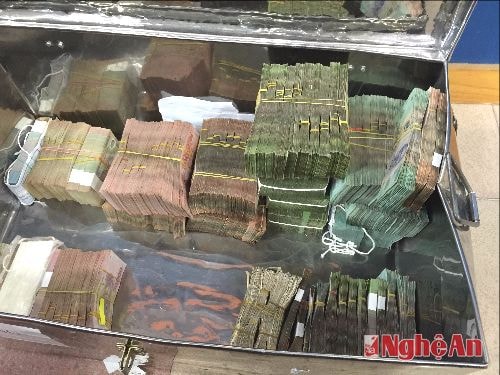 |
| Remittances from overseas Vietnamese mainly come through banks. (Photo taken at VIB Bank) |
Dien Hoa – Dien Chau commune has a large number of successful migrant workers. Currently, 222 workers (mainly construction workers) are employed in Russia and Angola. Each year, this workforce sends home approximately 46-47 billion VND, and many households have contributed to the development of their hometowns. In Dien Hoa, remittances are even sent directly to relatives at home. Most families with migrant workers have built spacious houses; the numerous villas here clearly indicate that someone has worked abroad. However, the amount of money sent back for investment in production and business is quite small. Mr. Cao Xuan from Hamlet 2 has been working in Angola for nearly three years, earning 1,100 USD per month. He has built a house costing over 600 million VND, and the rest is saved in the bank, with no clear investment plan yet. In Nam Cat - Nam Dan, similarly, many families are going abroad for work, and the number of two-story and three-story houses in Nam Cat is increasing. Everyone wants to build a big, beautiful house because of the substantial remittances. On average, each worker earns 15 million VND per month, so the remittances sent to Nam Cat commune annually amount to about 80 billion VND. However, since the main workers have not yet returned, the remittances are mainly held in banks and used for purchasing amenities and building houses. Remittances to Nghe An mainly come through the overseas labor export program of Nghe An people from various countries, including the UK, Russia, Iraq, Saudi Arabia, France, and especially from the UK, South Korea, and Japan.
 |
| Transactions at the bank. |
Over the years, labor export has been one of the quite effective solutions for poverty reduction. According to data from the Department of Labor, Invalids and Social Affairs, in 2015, Nghe An had 12,800 workers going to work in South Korea, Taiwan, Malaysia, and the Middle East. Although remittances decreased compared to 2014 (2014 reached 250 million USD), this is still a very large amount, and only a few have been reinvested to bring higher value, such as Dung Thuy Company in Son Thanh, Yen Thanh, which invested in a garment factory for over 100 workers with remittances from Russia; or the commercial center in Bao Thanh (Yen Thanh) also built with remittances from Russia; Van Xuan Taxi Company invested with remittances from Russia; and the commercial center in Yen Thanh invested with remittances from Czechoslovakia…
Currently, some districts have a high number of migrant workers, such as Yen Thanh, Dien Chau, and Do Luong. In Do Luong, for example, 1,500 people go abroad for work each year, and there are currently over 6,700 people working overseas on fixed-term contracts. Remittances sent back annually reach approximately 15-20 million USD. Currently, remittances are mainly sent through commercial banks such as the Vietnam Bank for Agriculture and Rural Development, BIDV, and VP Bank.
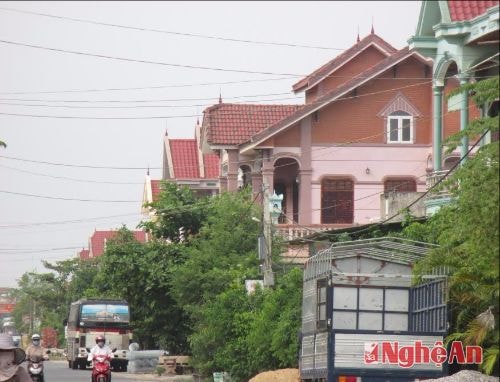 |
| People from Dien Hoa, Dien Chau, who went to work abroad, have returned and built large, beautiful houses. (Photo by Le Hoai Thung) |
Remittances are one of the important resources for socio-economic development, especially in creating jobs, stabilizing people's lives, and contributing to the construction of new rural areas in Nghe An. However, the amount of remittances sent to Nghe An for investment and development is not yet significant; the accumulated capital after building houses, buying cars, and giving to relatives is mainly held in banks. Finding jobs for those returning from overseas labor remains a difficult problem for both those who went abroad for work and the local authorities.
Currently, Nghe An province has attracted several investment projects from people from Nghe An who are living and working abroad, such as the Vicentra Commercial and Office Center project by Mr. Nguyen Canh Son, Chairman of the Board of Directors of Euro Windows Company (formerly in Russia), the Bai Lu Tourist Area project by the Chairman of the Board of Directors of Bai Lu Investment and Business Joint Stock Company (formerly in the US), Van Xuan University of Technology by Mr. Nguyen Lu Thuy (Poland), Minh Anh - Kim Lien Garment Company, Mr. Le Luong Nguyen (South Korea), and the establishment of an elevator manufacturing plant in Nghi Phu…. These projects not only invest in expanding the province's technical infrastructure but also contribute effectively to job creation, social welfare, and local revenue.
Chau Lan
| RELATED NEWS |
|---|