
Regional linkage: Not an addition.
To overcome the fragmentation of the economic space caused by administrative boundaries, and to best allocate and utilize state and economic resources for investment, clear mechanisms are needed to avoid overlaps, in addition to increasing the effectiveness of regional management.
To overcome the fragmentation of the economic space caused by administrative boundaries, and to best allocate and utilize state and economic resources for investment, clear mechanisms are needed to avoid overlaps, in addition to increasing the effectiveness of regional management.
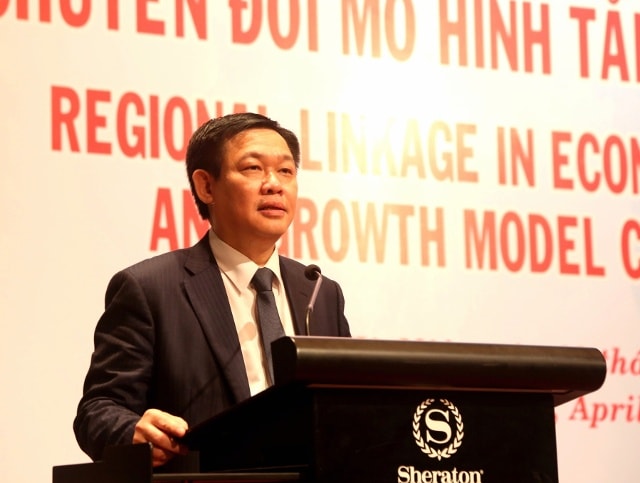 |
| Member of the Politburo and Head of the Central Economic Committee, Vuong Dinh Hue, delivered a speech at the seminar. |
This was the topic discussed at the workshop "Regional Economy in the Process of Restructuring and Transforming the Growth Model in Vietnam," held on April 3rd in Hanoi.
Many opinions at the workshop shared the view that although certain results have been achieved in implementing policies and mechanisms for regional economic development, many limitations still remain.
Specifically, key economic regions have not yet fully played their leading role, having a ripple effect to form intra-regional and inter-regional economic value chains.
Regional master plans and sectoral plans have not yet proven to be truly effective tools in guiding, coordinating, allocating budgets, attracting investment, managing socio-economic space, and especially in fulfilling the role of binding intra-regional linkages.
Nguyen Dinh Cung, Director of the Central Institute for Economic Management (CIEM), commented: "Currently, regional linkages are still mainly voluntary and spontaneous, done only when people feel like it or not, or done in a perfunctory manner."
This reality leads to a situation where many economic development plans of localities in the region overlap and duplicate each other, causing large-scale waste of development resources. It even creates a trend of unhealthy competition among localities, such as lowering land prices and offering excessive incentives.
Meanwhile, many pressing regional issues are emerging that individual localities cannot effectively address, such as climate change and saltwater intrusion in the Mekong Delta; drought and water resource management in the Central Highlands; and forest and ecological management in the northern mountainous region…
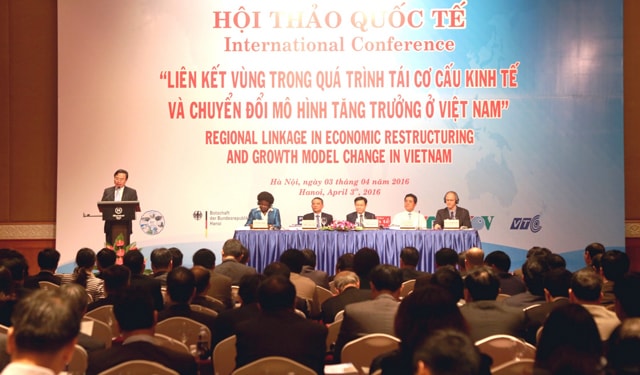 |
| Conference scene |
From the perspective of an international organization, Victoria Kwakwa, Country Director of the World Bank in Vietnam, believes that research on regional development is crucial for promptly and effectively addressing issues beyond the scope of individual localities. Localities need to cooperate more closely based on win-win principles to optimize efficiency and resilience to risks.
Politburo member and Head of the Central Economic Committee, Vuong Dinh Hue, stated that the most important goal for socio-economic development according to regional planning is to leverage the comparative advantages of each locality, overcome the fragmentation of economic space caused by administrative boundaries, and make the best use of resources from the State and economic sectors for investment, especially in transportation and new rural development.
Therefore, alongside the achievements, a new perspective is needed to overcome limitations and ensure that the economic restructuring and transformation of the growth model by region is an integral part of the national economic restructuring and transformation of the growth model.
For example, key economic regions could consider implementing policies oriented towards a knowledge-based economy, developing high-tech industries that create high added value. This linkage would then boost the dynamism of industrial zones in line with the new growth strategy, making them breakthrough areas for economic development, capable of competing with economic centers in ASEAN, Asia, and the world.
For areas with difficult socio-economic conditions, policies are needed to attract investment into industries that exploit comparative advantages, are suitable to natural and social conditions, preserve the ecosystem, and have integrated, comprehensive policies specific to the region, ensuring that these functions are compensated for by revenue from other economic areas.
Furthermore, it is necessary to clarify the relationship between regional economic development, regional linkages, and the decentralization process, in order to propose improvements to the institutional framework for the division of responsibilities and decentralization between the central and local governments. This would ensure both the centralized unity of the economy and the proactive and innovative spirit of local authorities. In addition, research should be conducted on establishing a regional development fund to implement inter-provincial and inter-regional projects in a coordinated manner.
According to Chinhphu.vn
| RELATED NEWS |
|---|