

The "critical" regulations came into effect in February 2016.
New regulations that came into effect in February 2016 include: the Decree on the selection of citizens for police service; the implementation of Circular 01/2016/TT-BCA by traffic police; and support for those paying voluntary social insurance...
Decree on the selection of citizens to perform police service.
Starting from February 1st, Decree No. 129/2015/ND-CP dated December 15, 2015, stipulating the subjects, standards, procedures, and policies for citizens performing compulsory service in the People's Public Security Force; and the responsibilities of agencies, organizations, and individuals in the selection of citizens performing compulsory service in the People's Public Security Force, officially comes into effect.
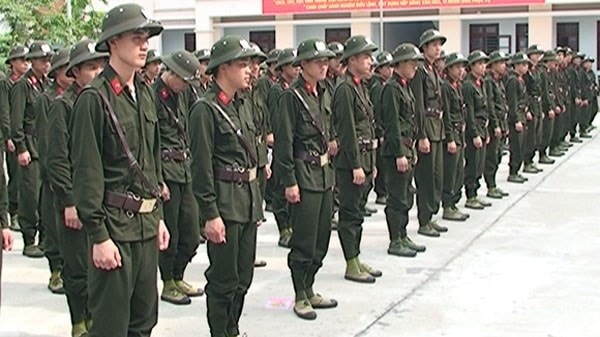 |
| Decree No. 129/2015/ND-CP dated December 15, 2015, stipulating the subjects, standards, procedures, and policies for citizens performing compulsory service in the People's Public Security Force; and the responsibilities of agencies, organizations, and individuals in the selection of citizens performing compulsory service in the People's Public Security Force, officially came into effect on February 1, 2016 (illustrative image, source: Tri Thuc Tre). |
Accordingly, the eligible candidates include: male citizens of conscription age who have registered for military service as prescribed by the Law on Military Service; and female citizens of conscription age who have registered for military service as prescribed by the Law on Military Service, possessing professional qualifications suitable to the requirements of the People's Public Security Force, who, if they volunteer and the People's Public Security Force has a need, will be considered for selection to perform military service in the People's Public Security Force.
According to the Decree, citizens are selected to perform compulsory service in the People's Public Security Force when they meet the following criteria:
- Has a clean record.
- Strictly abide by the guidelines and policies of the Party, and the laws and regulations of the State;
- No prior criminal record, not subject to criminal prosecution, probation, or currently undergoing educational measures at the commune, ward, or town level, or being placed in a treatment facility or compulsory education institution;
- Possessing good character and morals, and enjoying the trust of the people in their place of residence, study, or work.
Ensuring the political standards of officers and soldiers of the People's Public Security Force are in accordance with the regulations of the Minister of Public Security. High school diploma required. In mountainous areas, islands, ethnic minority regions, and areas with particularly difficult socio-economic conditions, citizens with junior high school diplomas may be recruited. Priority will be given to citizens with college or university degrees or higher, possessing expertise necessary for the work and combat of the People's Public Security Force.
Physically fit, without deformities or abnormalities, and meeting the health standards for fulfilling the obligation to serve in the People's Public Security Force as prescribed by the Minister of Public Security.
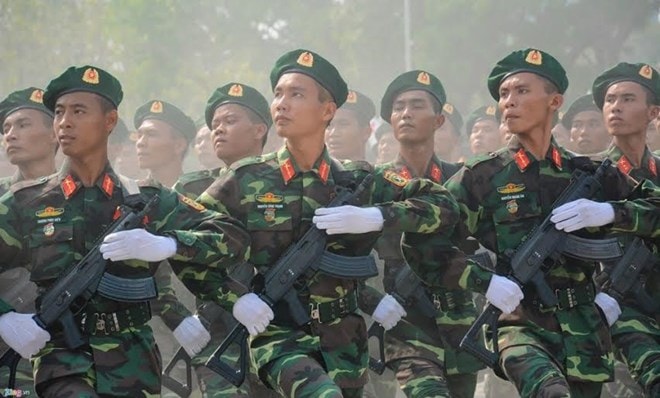 |
| Vietnam People's Army. |
The decree stipulates that the period of service in the People's Public Security Force is three years.
Citizens performing their duty in the People's Public Security Force are promoted to the ranks of Private, First Class, Corporal, Sergeant, and Staff Sergeant. The time frame for promotion from Private to First Class is 6 months; from Private to Corporal is 6 months; from Corporal to Staff Sergeant is 1 year; and from Staff Sergeant to Staff Sergeant is 1 year.
In addition, the Decree stipulates that non-commissioned officers and conscripted soldiers who have served for 24 months to less than 36 months, have achieved the title of "Soldier who has completed his duties" or higher, and meet the standards and conditions for professional service in the People's Public Security Force, are eligible to be considered for and take entrance exams to the People's Public Security academies and schools according to the regulations on recruitment of the Ministry of Public Security. Upon graduation, they will be promoted to the rank of professional officer or non-commissioned officer.
Non-commissioned officers and conscripted soldiers who do not fall under the above categories, upon completion of their active service term and meeting the standards required for employment by the People's Public Security, may be considered for transfer to professional service if they volunteer and the People's Public Security has a need for them. The criteria, standards, and percentage for transfer to professional service for non-commissioned officers upon completion of active service shall be prescribed by the Minister of Public Security.
The decree also stipulates that, during their military service, non-commissioned officers and conscripted soldiers are entitled to the benefits and policies prescribed for non-commissioned officers and soldiers serving in the armed forces; upon completion of their service, they receive vocational training allowances or job creation allowances and are given priority in entrance examinations to People's Public Security schools, and are entitled to other benefits and policies as prescribed by the Government.
Traffic police are implementing Circular 01/2016/TT-BCA.
This Circular takes effect from February 15, 2016 and replaces Circular No. 65/2012/TT-BCA dated October 30, 2012 of the Minister of Public Security regulating the duties, powers, forms and content of patrol and control by road traffic police.
The circular clearly stipulates that there are 5 cases in which traffic police are allowed to stop vehicles in transit, as follows: Firstly, when traffic police directly detect or, through technical equipment and devices, detect and record violations of traffic laws.
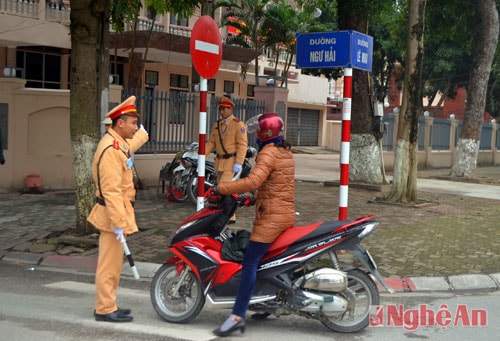 |
| Traffic police officers in Vinh City remind people to follow traffic regulations. |
Secondly, when implementing the plan, the overall inspection order must be issued by the Director of the Traffic Police Department or the Director of the Provincial Public Security Department or higher.
Thirdly, implement the plan for organizing patrols, inspections, and handling violations to ensure traffic order and safety, as directed by the Head of the Highway Traffic Patrol and Inspection Department under the Traffic Police Department, the Head of the Traffic Police Department, or the Head of the District Police or higher.
Fourth, in cases where there is a written request from the Head or Deputy Head of the investigating agency; or a written request from a relevant functional agency to stop vehicles for inspection to ensure security and order, prevent and combat crime and other violations of the law. The written request must specify the time, route, vehicles to be stopped for inspection and processing, and the participating forces.
Fifth, reports and denunciations regarding violations of traffic laws by individuals and vehicles.
The circular also clearly stipulates that stopping vehicles must ensure: safety and compliance with legal regulations; not obstructing traffic; and once a vehicle is stopped, inspection must be carried out, and any violations detected must be handled in accordance with the law. In particular, this circular also emphasizes that road traffic patrol and control officers have the following powers:
Authorized to stop vehicles participating in road traffic; inspect vehicles and vehicle documents; inspect the driver and their documents, personal identification documents of passengers in the inspected vehicle, and ensure compliance with regulations on road transport operations as prescribed by law.
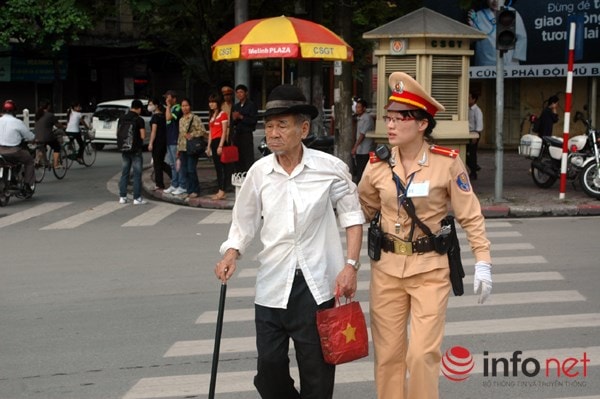 |
| Female traffic police officer helps elderly person cross the road. |
Handling administrative violations in the fields of road traffic, security, order, social safety, and other administrative violations in other areas of state management as prescribed by law.
Measures to prevent and ensure the handling of administrative violations in accordance with the law may be applied; driver's licenses, vehicle registration certificates, and other documents related to the vehicle, the driver, or passengers in the vehicle may be temporarily seized when there is a violation of the law, as well as documents related to transportation activities, to ensure the enforcement of administrative penalty decisions in accordance with the law.
Requesting agencies, units, organizations, and individuals to cooperate and assist in resolving traffic accidents; traffic congestion or obstruction; or other cases causing disruption to traffic order and safety.
They are permitted to use weapons, support tools, and technical equipment and devices in accordance with the law.
The requisition of various types of transportation vehicles; communication equipment; and other technical means and equipment belonging to agencies, organizations, and individuals, as well as the operators and users of such vehicles and equipment, is permitted in accordance with the law.
Temporarily suspend the movement of people and vehicles on certain road sections, reroute traffic, reassign routes, and designate temporary stopping and parking areas when traffic congestion occurs or when other necessary requirements exist to ensure security, public order, and safety.
Support for those paying voluntary social insurance.
Effective from February 15, 2016, Government Decree No. 134/2015/ND-CP dated December 29, 2015, provides detailed regulations on a number of articles of the Law on Social Insurance regarding voluntary social insurance.
The decree specifies regulations on retirement benefits; death benefits; social insurance fund; payment methods; voluntary social insurance contribution rates; changes to payment methods and monthly income levels for voluntary social insurance contributions; financial support for voluntary social insurance participants;...
Militia and self-defense forces coordinate to protect borders, seas, and islands.
From February 15th, Government Decree 133/2015/ND-CP, which regulates the coordination of militia and self-defense forces with other forces in border, sea, and island protection activities, officially came into effect.
Accordingly, the commander of the provincial military command with a land border may deploy militia and self-defense forces within the province according to the coordination regulations when agreed upon by the Chairman of the Provincial People's Committee and the Commander of the military region.
The Commander of the Navy deploys the Maritime Militia according to the regulations on coordinated activities after consultation with the Commander of the military region, the Chairman of the Provincial People's Committee, and the head of the agency or organization that has the Maritime Militia.
According to Infonet
| RELATED NEWS |
|---|