

Where did 6,000 migrant children disappear to?
(Baonghean.vn) - Approximately 6,000 migrant children have gone missing in Germany. Most of them may have continued their journey, but what about the rest? Child protection organizations need to increase support for these vulnerable children.
 |
| Illustrative image. Source: dpa. |
The recently released figures have sent shockwaves everywhere: Last year alone, 5,835 children were reported missing in Germany. The German Interior Ministry released this figure in response to a question from Parliament. Of these, 555 were under the age of 14. The Ministry's statement said: "These unaccompanied children who went missing mainly came from Afghanistan, Syria, Eritrea, Morocco, and Algeria."
But where did these children disappear to? The government has no answer. Barbara Kuppers, a child rights expert at Terre des Hommes, criticized: “It’s scandalous that the Interior Ministry can’t give any explanation. Where are these children?”
Kuppers assumes that most teenagers and children are likely to simply continue their journey to countries like Sweden or Denmark. Even within German territory, some might seek refuge with relatives living in cities, where the children are not eligible for temporary residency registration.
However, many children disappear after becoming victims of crime. Kuppers asserts, "We have seen many cases where child welfare institutions suddenly find themselves confronted by traffickers extorting money from children." As a result, the children distrust everyone and hide to earn money, even becoming involved in street prostitution. Kuppers says it is unclear how many similar cases exist.
In an interview with DW, the German Federal Criminal Office emphasized: "There is currently no credible evidence to suggest that the migrant children who went missing earlier this year have fallen into the hands of criminals."
A spokesperson for the agency confirmed that unaccompanied children often leave reception centers to find acquaintances or relatives. Many of them have also been registered multiple times because they travel without identification or their names have multiple pronunciations.
She said: "Once children or teenagers reach a safe place, German authorities rarely receive the information, so the list is not shortened."
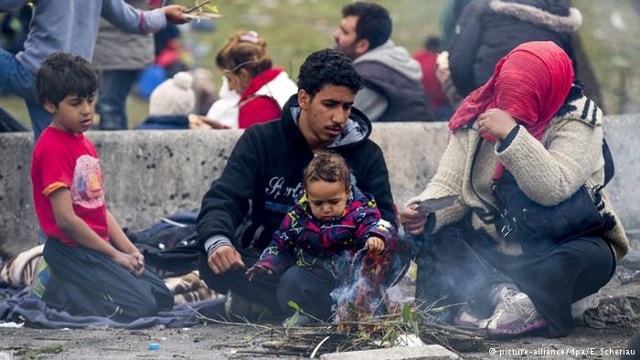 |
| Illustrative image. Source: dpa. |
The Criminal Police Office of North Rhine-Westphalia shares this view. There is currently no reliable information about children becoming victims of criminal gangs or human trafficking. A spokesperson for the agency stated that families often disperse when fleeing to Europe, and the child is then left to find relatives on their own. Searching for a missing child is often difficult, due to the lack of information and clues within Germany.
The sudden disappearance of migrant children is not a problem unique to Germany. Earlier this year, the head of the European police agency Europol, Brian Donald, admitted in the British newspaper Observer that thousands of underage migrants in European countries had been registered but then vanished without a trace. Conservative estimates suggest that 10,000 children have gone missing.
Donald offered a different conclusion from the German police. He warned that some missing children may have become prey to criminals. Europol has evidence suggesting that a number of children and adults have been sexually abused during these journeys. Criminal structures that profit from the migration flow are also growing.
In late March, several members of the European Parliament pointed out that pan-European gangs may be exploiting missing migrant children. These children could be victims of sexual violence, labor exploitation, or organ trafficking. No one knows how many migrant children in Europe have continued their journey, and how many are abused or forced into slavery.
This needs to change, as Barbara Kuppers said: “The politicians haven’t woken up yet.” The easiest way is to accept unaccompanied migrant children at the EU’s external borders and support their safe journey to their destination. Only then, “within thousands of kilometers, will they not be in danger or fall into the hands of traffickers or exploiters.”
Phu Binh
(According to DW)