

China's plot to silence the world on the South China Sea issue.
China appears to have failed in its attempt to intimidate other countries into not discussing its assertive actions in the South China Sea.
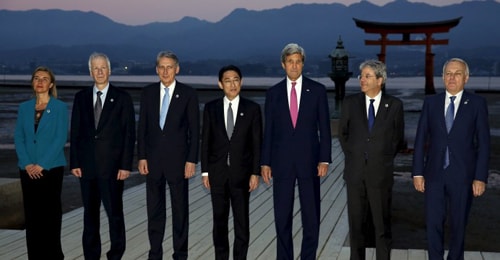 |
G7 foreign ministers at a summit held in Hiroshima, Japan. Photo: Reuters |
When Japan and the United States announced they would put the South China Sea issue on the agenda of the G7 foreign ministers' meeting in Hiroshima last week, China reacted strongly, saying the G7 should focus only on economic issues and calling Japan's move a "provocative act" aimed at "inciting the West to crush China," according to Reuters.
Joint statement following the conference of theThe G7 foreign ministers addressed maritime security, without directly mentioning China, emphasizing "the fundamental importance of managing and peacefully resolving disputes."
Following the G7 foreign ministers' statement strongly opposing any provocative or coercive actions, unilateral threats that alter the status quo and escalate tensions, China expressed its anger, calling these "irresponsible statements and actions."
According to EJInsight commentator Frank Chin, these actions by China are part of an effort to "silence" the international community on the South China Sea issue, particularly voices opposing Beijing's aggressive and illegal actions in the disputed area with its neighbors.
The statement issued by the G7 foreign ministers on April 11th is of significant timing, as the Permanent Court of Arbitration (PCA) is scheduled to issue its ruling on the "nine-dash line" claim filed by the Philippines against China in the South China Sea in just a few weeks.
Beijing defiantly declared that it would ignore the PCA ruling; however, the G7 statement called on nations to abide by international maritime law and implement all binding rulings issued by international courts and arbitration tribunals under the United Nations Convention on the Law of the Sea (UNCLOS).
Despite criticism and appeals from world leaders, China continues its campaign of blockade and deterrence against any country that intends to discuss Beijing's aggressive actions in the South China Sea, according to Chin.
Recently, Australian Prime Minister Malcolm Turnbull experienced this firsthand during his visit to Beijing on April 15-16, followed just days later by New Zealand Prime Minister John Key. Both leaders were warned by China not to discuss the South China Sea issue, or they would face consequences.
According to the Sydney Morning Herald, "in an attempt to preempt Mr. Turnbull ahead of his visit, the China Daily, the mouthpiece of the Chinese Communist Party, warned that Australia would face financial consequences if it opposed Beijing's territorial ambitions in the region."
China Daily quoted several scholars, including Han Feng, vice president of the National Institute of International Strategy under the Chinese Academy of Social Sciences, as saying that territorial disputes in the South China Sea are not Australia's business, and Canberra's response would be "a test of the political wisdom of Australian leaders."
Deterrence failed.
During a two-hour meeting with Chinese Premier Li Keqiang, Mr. Turnbull reiterated his position that anything that threatens peace and stability would be contrary to the interests of all countries in the region. He also stated that South China Sea disputes should be resolved in accordance with international law.
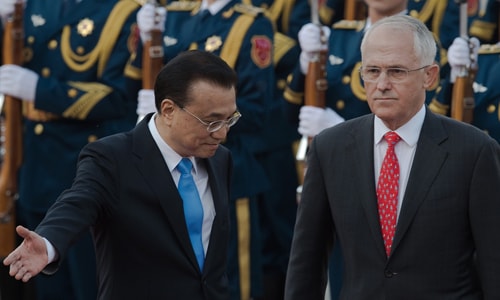 |
Australian Prime Minister Turnbull (right) and his Chinese counterpart Li Keqiang. Photo: HuffingtonPost |
At the subsequent banquet, Chinese President Xi Jinping said that China and Australia need to respect each other's core interests. According to Mr. Chin, for China, that means Australia must turn a blind eye to Beijing's actions in the South China Sea, where it is illegally building seven artificial islands on reefs belonging to Vietnam's Spratly Islands, which are disputed with three other Southeast Asian nations: the Philippines, Malaysia, and Brunei, as well as in the East China Sea, where China is disputing the Senkaku/Diaoyu Islands with Japan.
Chin stated that, as a close ally of the US, Australia would certainly not side with China or even remain silent in the face of Beijing's threats and warnings, especially if China ignored international court rulings.
China's threats against New Zealand were somewhat more subtle than those directed at Australia. On the very day New Zealand Prime Minister John Key arrived in China for a six-day visit, the state-run Xinhua news agency published an editorial warning him that, for the visit to be successful, he needed to avoid discussing disputes in the South China Sea.
"The successive visits by Mr. Turnbull and Mr. Key," Xinhua said, "underscore the importance of China's growing middle class to them." However, relations between China and New Zealand "are not always rosy," Xinhua warned.
The news agency recalled the incident in February, when Mr. Key "made some comments against China regarding the South China Sea issue." Xinhua argued that those statements "went against New Zealand's commitment to impartiality in territorial disputes in the region."
"New Zealand needs to chart its own course in its relationship with China rather than letting its policy be influenced by the ambitions of its military allies. The future of bilateral relations between the two countries, to some extent, depends on Wellington itself," Xinhua wrote.
"Mr. Key should remember that New Zealand is a complete outsider in the South China Sea dispute, not a party involved," Xinhua warned, adding that "any attempt by Wellington to break his promise of impartiality on this issue risks complicating the developing trade relationship between China and New Zealand."
According to commentator Chin, the "silencing" threats that China recently issued to the G7 foreign ministers and the prime ministers of Australia and New Zealand reflect Beijing's strategy of "isolating" the disputing parties. By pushing countries like Australia and New Zealand away from the South China Sea, China hopes to confront the entire international community, isolate the US and smaller countries in the region, and serve its ambition of dominating the South China Sea.
"Because China is the only country that has declared it will ignore the international court's ruling, it is obvious that any party calling for the enforcement of the ruling will be seen by Beijing as criticizing its actions and showing 'bias' in the South China Sea dispute," Chin emphasized.
 |
A Chinese Y-8 military aircraft illegally landed on Vietnam's Chữ Thập (Cross) Reef. Photo: 81.cn |
Observers believe that this strategy by China cannot possibly subdue the international community into remaining silent in the face of its aggressive actions. On April 18, Hugo Swire, the UK Foreign Secretary for East Asia, declared that although relations between London and Beijing have warmed and Britain needs to attract investment from China, the country will not cease its criticism of China's unreasonable territorial ambitions in the South China Sea.
"We have made it clear to China that the two sides can only cooperate openly and transparently within the framework of international law," Swire stated. "Under this system, which the world relies on, we expect the ruling of the international court to be respected by all parties involved, and regardless of which side the ruling favors, we will stand with the international community, including the United States."
According to VNE