

Is the Bermuda Triangle really dangerous?
The Bermuda Triangle is one of the world's most notorious areas, associated with numerous ships and planes that have disappeared without a trace.
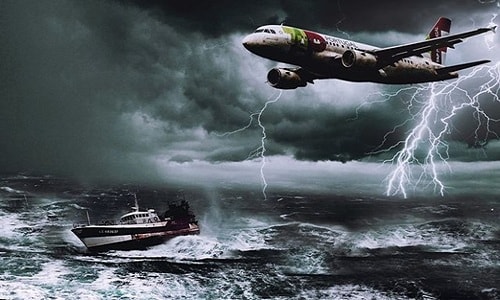 |
Storms at sea can cause accidents for ships and planes in the Bermuda Triangle area. Photo: Moviepilot. |
According to Live Science, the Bermuda Triangle, or "Devil's Triangle," is an area in the northwestern Atlantic Ocean, located between the islands of Bermuda, Puerto Rico, and Melbourne, Florida, USA, where many ships and planes have mysteriously disappeared.
Many speculate that supernatural forces or extraterrestrial beings in the Bermuda Triangle are causing planes and ships to disappear in the area. However, according to the U.S. Coast Guard and Aviation Safety Network (USCG), many disappearances are related to storm activity in the region, vehicle malfunctions, or even human error.
The disappearance in 1945
According to the U.S. National Oceanic and Atmospheric Administration (NOS), seas and oceans cover 70% of the Earth's surface, with an average depth of 3,700 meters and a maximum depth of 11,000 meters. Therefore, airplanes and ships can disappear into the ocean without a trace.
In 1964, journalist Vincent Gaddis used the name "Bermuda Triangle" to title a story published in Argosy magazine about the unexplained disappearance of Flight 19. This was a fleet of five US Navy aircraft and 14 crew members participating in training in the Bermuda Triangle area in 1945.
Another Navy plane with a crew of 13 was dispatched to search for Flight 19 but never returned, Howard L. Rosenberg, a former U.S. Navy veteran, wrote about the Bermuda Triangle on the official U.S. Navy website (NHHC).
Rosenberg said the PBM-Mariner search aircraft is often called a "flying fuel tank" because it is highly flammable. It is highly likely that the rescue team encountered an accident involving fire.
Since then, rumors about the Bermuda Triangle have begun to increase. However, the number of disappearances in this area is not significantly higher than in other sea routes around the world.
"The Bermuda Triangle is one of the world's most traffic-dense areas. The greater the number of ships and aircraft, the higher the likelihood of accidents occurring," Rosenberg said.
Weather factors
According to the U.S. National Oceanic and Atmospheric Administration (NOAA), tropical storms and cyclones are relatively common in the Bermuda Triangle area of the Atlantic Ocean. This may be the cause of many mysterious disappearances in the past, as ships are easily endangered when the weather changes suddenly.
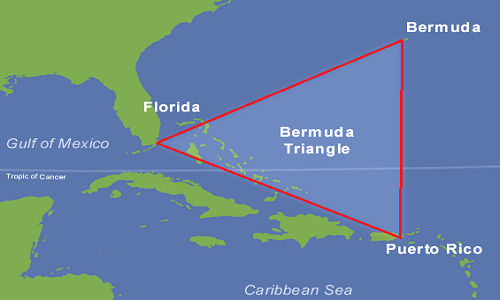 |
The Bermuda Triangle is located in the northwestern Atlantic Ocean. Photo: Wikipedia. |
The presence of numerous islands in the Caribbean Sea creates shallow areas, making navigation difficult for ships. If an accident occurs, sharks and barramundi will tear apart the bodies of victims in the water. The Gulf Stream current quickly washes away any evidence of shipwrecks or aircraft at the accident or explosion site.
"The ocean has always been a mystery to humans. When the weather is bad or deteriorates, it becomes a very dangerous place," NOAA experts warn.
Methane gas (CH4)
In March 2016, scientists conducted a detailed study of craters in the Barents Sea, off the coast of Norway. The results showed that these craters may have formed from ancient methane gas explosions following the end of the last ice age, 11,700 years ago. The explosions occurred when ocean temperatures warmed, releasing methane from the burning ice (a solid mixture of hydrocarbon gases and frozen water), causing pressure to build up at the seabed.
Some media outlets have linked the study to the Bermuda Triangle, suggesting that sudden and violent methane gas explosions create sinkholes or form giant gas bubbles that sink ships.
According to Carolyn Ruppel, a geophysicist and director of the Gas Hydrates Project at the U.S. Geological Survey, the above explanation is most likely incorrect.
"We know that you can see methane escaping from the seabed. It's a relatively common phenomenon," Ruppel said. "Methane leaks usually happen quite slowly in the ocean. Large-scale gas explosions like those that occurred after the end of the ice age haven't been recorded since then."
In fact, most of the methane escaping into the ocean today is converted into carbon dioxide (CO₂) by bacteria.2) before reaching the water's surface. "So I don't think there will be any major disasters in the next few centuries," Ruppel said.
According to VNE
| RELATED NEWS |
|---|