

How much money do Vietnamese people send abroad?
According to a recent report published by the Vietnam Institute for Economic and Policy Research (VEPR), a notable figure is the sharp increase in overseas deposits in the third quarter of 2015, reaching $7.3 billion. This information immediately caused a stir in public opinion. However, the State Bank of Vietnam has provided an explanation regarding the nature of this money flow.
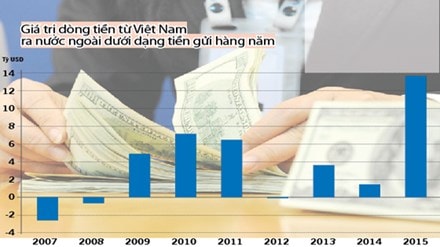 |
| Source: iMf (2007-2011) and State Bank of Vietnam (2012-2015). |
Where did the $7.3 billion come from?
According to a report published by VEPR on April 12th, in the third quarter of 2015, "other investment flows, primarily consisting of overseas deposits, which were insignificant in previous periods, surged to $7.3 billion. Therefore, this shifted the overall balance from equilibrium to a deficit of $6.6 billion."
The following day, VTV broadcast the following information: According to sources from the State Bank of Vietnam, the amount of USD deposits from credit institutions abroad in the third quarter of 2015 only fluctuated between an average of 2 and 3 billion USD. "This is a relatively stable development, nothing unusual like the 6 billion USD figure previously reported by the Institute for Economic and Policy Research," the source said.
On April 15th, Dr. Nguyen Xuan Thanh, Director of the Fulbright Economics Teaching Program, explained the discrepancies in these figures from a research perspective. Dr. Nguyen Xuan Thanh's analysis emphasized that all figures were based on data published by the State Bank of Vietnam.
Firstly, cross-border currency and deposits are funds that domestic organizations/individuals send abroad with no fixed term or with a very short term. By definition, currency and deposits are not money transferred abroad to pay for services (tourism, healthcare, education); not direct foreign investment; not foreign securities investment; and not term loans.
Secondly, in the third quarter of 2015 (from the beginning to the end of the quarter), a total of US$7.968 billion flowed out of Vietnam in the form of deposits. Subtracting other receivables of US$104 million, the remaining flow was US$7.864 billion. Of that amount, US$5.968 billion (almost 6 billion USD) was deposits from Vietnamese credit institutions abroad. “The US$6 billion figure cited by the press is only for credit institutions, only for the third quarter of 2015, and the total figure does not adjust for inflows,” Mr. Thanh noted.
Thirdly, in addition to deposits from credit institutions, there was also a $2 billion outflow of funds from "other sectors" in the third quarter of 2015. Also in the third quarter of 2015, there was a $535 million inflow of funds from foreign organizations/individuals into Vietnam.
Finally, Dr. Nguyen Xuan Thanh did the calculation: Subtracting the $535 million inflow from the $7.64 billion outflow, we get a net outflow in the form of deposits of $7.329 billion. This is the $7.3 billion figure announced by VEPR. This means that in the third quarter of 2015 alone, a net $7.3 billion in deposits (and other receivables) flowed from Vietnam to abroad. This money belonged to both credit institutions and other organizations/individuals.
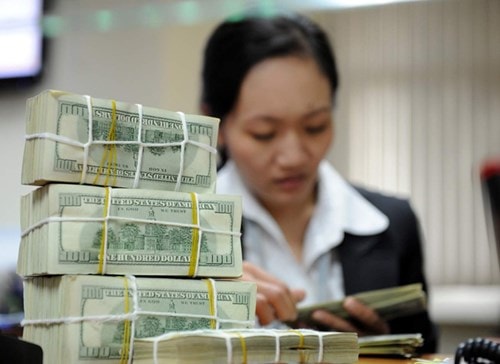 |
| Overseas remittances surged in the third quarter of 2015. Photo: Hong Vinh. |
Does money flow through other "channels"?
Speaking to a reporter from Tien Phong newspaper, an expert with many years of experience in foreign exchange said that in reality, there are still signs of foreign currency being smuggled out of the country through loopholes such as "illegal" money transfers at gold shops (there are two forms: one side gives the money and the other side has someone waiting to receive it; and in cases where the money flows out, those companies will have documents to show the money transfer as an investment channel or for import-export businesses). However, this channel is insignificant.
According to this source, it's more likely that Vietnam currently has several banks with branches in Southeast Asia. While this is difficult in Western countries like the US and Australia where laws are strict, within the same region, it's possible some banks have found ways to circumvent regulations by using investment as a cover to transfer funds abroad. "But in that case, the State Bank of Vietnam would control the flow of documents; not to mention that one of the requirements for overseas investment is to obtain approval from the Ministry of Planning and Investment, and the amount of money transferred abroad would also need confirmation from the State Bank of Vietnam in the respective province or city...", this source explained.
According to banking expert Nguyen Tri Hieu, most banks currently have overseas accounts, so the State Bank of Vietnam can easily track daily transactions, including how much money flows out and how much flows back in (due to daily reports). Is there any overlap with the phenomenon observed in the last two years, where many Vietnamese people are secretly buying and selling real estate in the US and Australia through certain companies? Mr. Hieu predicts: "Regarding real estate specifically, a Vietnamese person cannot officially transfer money abroad through an account unless they collude with certain banks. If they do, I believe it's very likely through a roundabout route via an overseas investment company," Mr. Hieu said.
Speaking to Tien Phong newspaper on April 15th, Deputy Governor of the State Bank of Vietnam, Nguyen Thi Hong, stated that high or low figures are normal because the data reflects the balance of payments. “The surge in foreign currency deposits at commercial banks in the third quarter is correct because people and businesses are psychologically burdened by the devaluation of the Chinese Yuan, leading them to hoard foreign currency. However, saying that the increase in foreign deposits at the end of the third quarter was due to the 0% USD interest rate is incorrect, as the interest rate was implemented two days later, starting in the fourth quarter,” Deputy Governor Nguyen Thi Hong explained.
| More specifically, on April 15th, Dr. Nguyen Xuan Thanh updated the Q4 data (new figures released for the first time by the State Bank of Vietnam), stating that outflows from Vietnam to overseas (from the beginning to the end of the quarter) totaled US$3.32 trillion, of which US$369 million came from credit institutions. Adding up all four quarters, in 2015, US$14.184 billion went out of Vietnam in the form of deposits, with US$4.630 billion from credit institutions and US$9.554 billion from the "other sector". The State Bank of Vietnam leadership stated that they were unaware of this information and would consider responding as soon as possible. |
According to Tien Phong
| RELATED NEWS |
|---|