

Portrait of a female interpreter for Chinese leaders.
Zhang Lu, an interpreter for top Chinese leaders such as Premier Li Keqiang and former Premier Wen Jiabao, has impressed not only with her interpreting skills but also with her captivating appearance and discreet demeanor.
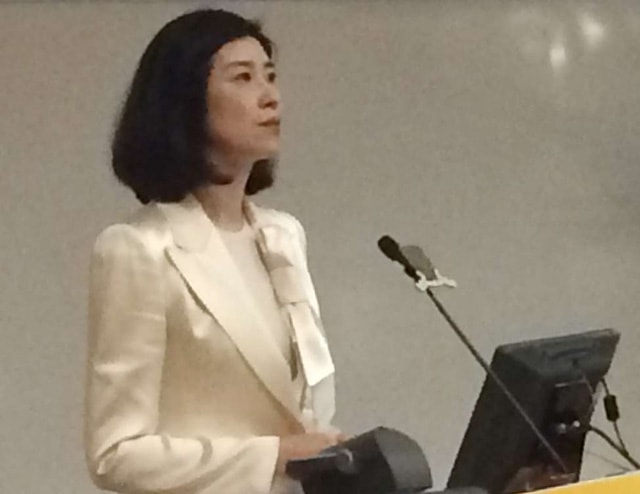 |
| Zhang Lu frequently acts as an interpreter for Chinese leaders during their overseas trips (Photo: SCMP). |
The South China Morning Post reported that Zhang Lu, 39, was greeted like a rock star during her visit to Hong Kong on April 8th. Girls, and even boys, called her their idol.
Hundreds of university students in Hong Kong, who consider Zhang an ideal role model, gathered at the Chinese University of Hong Kong to listen to her talk on April 8th. Some even traveled from Guangdong province to Hong Kong just to hear her speak.
Dressed in an elegant suit, Zhang, with her tall, slender figure, immediately drew everyone's attention as she entered the auditorium.
"We are both diplomats and professional interpreters. It's like we have to combine these two tasks into one," Zhang said, introducing her job as an interpreter at the Chinese Ministry of Foreign Affairs.
Unlike her former boss Fu Ying or her predecessors such as Zhang Hanzhi and Wang Hairong—two translators who worked under leader Mao Zedong—Zhang's name has become widely known on the internet in China.
Zhang became a sensation online in 2010 when he brilliantly translated a classical literary work that former Prime Minister Wen Jiabao mentioned in a speech at a press conference.
Zhang's willingness to share details about her work and professional experience with everyone made her even more beloved.
Zhang initially intended to become a teacher after graduating from the international law department at China Foreign Affairs University in Beijing in 2000. Zhang only changed her career path after being recruited to work in the translation department of the Ministry of Foreign Affairs.
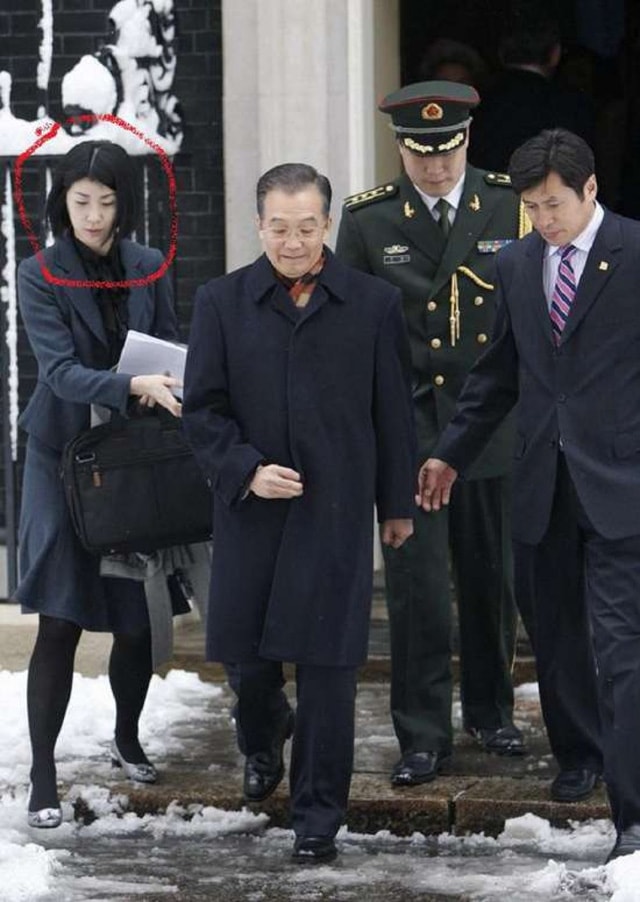 |
| Zhang previously served as an interpreter for former Prime Minister Wen Jiabao (Photo: SCMP) |
She has served as an interpreter for top Chinese leaders on numerous foreign trips and high-level international talks, including the Copenhagen climate talks in 2009 and G20 summits.
Zhang said her work has become increasingly busy amid China's increased diplomatic engagement in recent years. 2015 was Zhang's busiest year, when she made 54 overseas trips with Chinese leaders.
"The truth is, when you work for heads of state... it means that every time you speak, you're translating so that people aren't just listening to your words as an individual, but as the voice of the government," Zhang shared.
She said her most memorable experience was working as an interpreter at the Six-Party Talks, which aimed to find a peaceful solution to Pyongyang's nuclear program, involving China, the United States, Japan, Russia, South Korea, and North Korea, from 2003 to 2008.
"It involved very interesting and challenging diplomatic negotiations," Zhang shared.
Due to the sensitive nature of the issue, the language used by each participating country is considered the official language in the negotiations, so each delegation brings its own interpreters.
Zhang said that whenever the head of a delegation from a particular country paused while speaking, all the interpreters from different countries immediately began translating simultaneously. "You can imagine how long it takes one person to complete each sentence," Zhang shared.
Zhang advises students who aspire to follow in her footsteps that the key to becoming a good interpreter is not to translate word for word, but rather to understand the full meaning of what the speaker is trying to convey.
She also advised trainee interpreters to be bold and confident. "Nobody cares about you," Zhang joked, even though she herself had made a strong impression abroad.
According to Dan Tri