

What's inside the 4,600-year-old pyramid?
(Baonghean.vn) - Have you ever wondered what the inside of a pyramid looks like? There are no empty spaces or passageways like what you saw in the classic movie "The Mummy." So what is the actual structure of this masterpiece? How was it built to last for so many years?
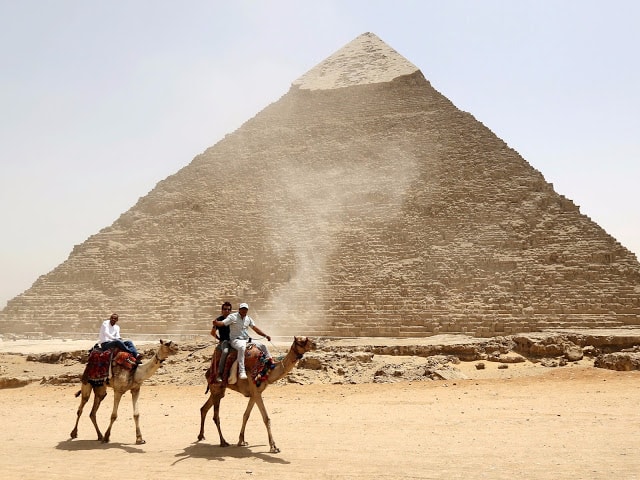 |
| Tourists stroll around the Pyramid of Khufu, one of the Great Pyramids of Giza, located on the outskirts of Cairo, on April 27, 2015. Photo: Reuters. |
The pyramids of ancient Egypt date back approximately 4,500 years. These magnificent tombs stand tall, defying the ravages of time, majestically set against a vast landscape, covered in a layer of imposing yellow dust.
Now, thanks to cosmic rays, humanity can learn a little more about these structures. Archaeologists have begun using this new technology to expand our understanding of the pyramids' internal structures.
The new "Pyramid Scan" project uses cosmic rays to map the "interior" of Egypt's most fascinating landmarks. The images reveal numerous winding niches inside the 4,600-year-old pyramid often called the Curved Pyramid – a structure 105 meters tall and located about 40 kilometers south of Cairo.
In ancient times, a pyramidal structure known as the Shining Pyramid in the South emerged. It is believed to be one of the earliest Egyptian designs. Its peculiar appearance suggests it was likely built during a transitional period, a shift from stepped pyramid construction to smooth, flat pyramids.
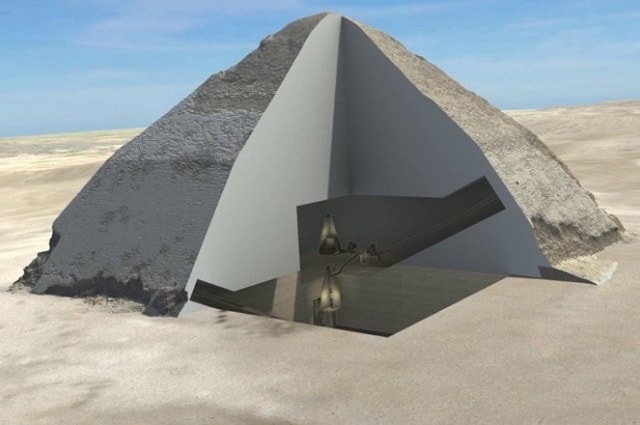 |
| Illustration: Cairo University/Egyptian Archaeological Survey. |
Cosmic rays are being used to illuminate architectural structures, and are comparable to X-rays. Scientists are using muons, the particles found in cosmic rays, to penetrate layers of rock and soil.
Through this process, researchers can measure the thickness of stone structures and map the internal components of those structures. From the moment the muon particles are released, it takes approximately 40 days to gather all the necessary information.
This is just the beginning; scientists will soon be studying many more famous pyramids in the mysterious land of Egypt.
Central South
(According to Business Insider)