

Russian and American hypersonic weapons: A close match.
Military experts believe that Washington and Moscow are proving to be evenly matched in the development of hypersonic weapons.
Hypersonic weapons are missiles and flying devices that travel at speeds five times the speed of sound (Mach 5, equivalent to 1700 m/s) or higher, designed to carry out lightning-fast attacks before the enemy's defenses can react.
With the potential to revolutionize weaponry and alter the global military balance, hypersonic weapons are being prioritized for development by all major military powers, including Russia and the United States, in order to gain an advantage over their rivals, according to Sputnik.
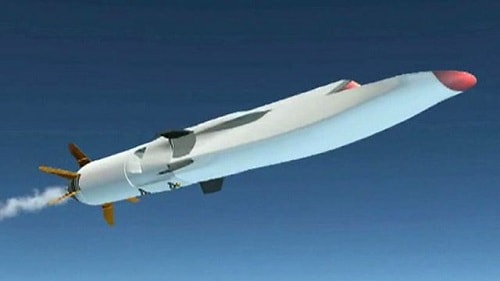 |
A model of the American X-51A missile. Photo: Military |
According to international military experts, the United States is ahead of Russia in the number of hypersonic weapons development projects. A report from the Congressional Research Service indicates that the Pentagon has spent hundreds of millions of dollars on hypersonic weapons projects, although details of these projects have not been disclosed.
The most effective hypersonic weapon project in the US to date is believed to be the X-51A missile. In a May 2013 test over the Pacific Ocean, the X-51A missile was launched from a B-52H bomber at an altitude of 15,240 m to a target 426 km away. Initially, the missile had a speed of Mach 4.8 (1,633 m/s), then reached a hypersonic speed of Mach 5.1 (1,735 m/s).
This was the longest distance the X-51A missile had ever traveled during its tests. The US Air Force deemed the test a complete success.
In addition, the Advanced Hypersonic Weapon (AHW) project, a US preemptive strike weapon system under the "Global Rapid Strike" program, capable of striking any target in the world within 60 minutes with a target deviation radius of only 10 meters, is also being actively developed by the Pentagon.
The AHW was first successfully tested on November 17, 2011, in the Pacific Ocean, when the missile was able to travel 3,700 km in 30 minutes before hitting its target.The US conducted a second test of the AHW in August 2014 at a test site in Alaska; however, the weapon exploded four seconds after liftoff.
Additionally, the US Air Force is also accelerating the Falcon HTV 2 hypersonic aircraft project with a maximum speed of Mach 20 (20 times the speed of sound, equivalent to 6,800 m/s).
In its first test flight in 2010, the Falcon HTV-2 rocket, launched from Vandenberg Air Force Base in California, completed a 7,600 km flight in 30 minutes and landed in Kwajalein Atoll, reaching a speed of approximately Mach 13 (4,300 m/s).
The US Department of Defense is also planning to develop a new generation of unmanned reconnaissance aircraft, the SR-72, capable of reaching speeds of Mach 6. The first prototype of the SR-72 could undergo testing in 2018 and enter service in 2020.
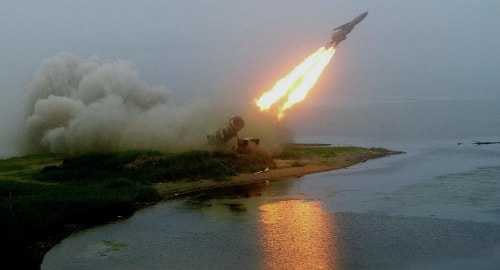 |
A Russian missile launch exercise. (Illustrative image)Sputnik |
The advantage of Russian tradition and quality.
While the US has an advantage in terms of quantity and variety, Russian military experts argue that Moscow also has a significant advantage in the tradition and quality of these weapons.Accordingly, starting in the 1970s, Soviet scientists made significant efforts to develop various types of hypersonic missiles with speeds approaching hypersonic levels, such as the X-80 Meteorit missile (Kh-80 or AS-X-19, NATO designation SS-N-24 Scorpion) with speeds reaching Mach 2.5 (850 m/s).
Around the same time, the Raduga Machine-Building Design Bureau successfully developed the X-90 GELA (Kh-90) hypersonic missile with a speed of Mach 3 (1,020 m/s). In 1991, the Soviet Union also successfully tested the Kholod missile with a speed of Mach 5 (1,700 m/s), however, this project was canceled after the collapse of the Soviet Union.
Building on past achievements, on March 17, 2016, the Russian military successfully tested the Zircon hypersonic cruise missile, which travels at six times the speed of sound. This event marked a major step forward for Russia in the race to develop hypersonic weapons against its direct rival, the United States.
According to Russian Deputy Defense Minister Dmitry Bulgakov, the Zircon's special fuel formula allows it to fly at speeds exceeding 6,125 km/h, making it virtually impossible to intercept.
Zircon has a range of at least 400 km, and potentially up to 1,000 km. With such a range, Zircon will not allow enemy warships to escape, overcoming a common problem with conventional anti-ship cruise missiles.
In addition, Moscow is developing a hypersonic warhead under the secret Project 4202, to equip the new RS-28 ballistic missile system, nicknamed Sarmat, with the first tests expected in late 2016.
"Although fewer in number, Russia's hypersonic weapon systems are considered more stable and have a higher probability of success than their American counterparts," a Russian military expert stated.
According to VNE
| RELATED NEWS |
|---|