

Quang Trung multi-story building, a relic of a bygone era.
(Baonghean.vn) -Editor's Note:The Quang Trung apartment complex was the first urban area built after the North Vietnam achieved peace. For a time, it was a symbol of Vietnamese-German friendship and a source of pride for Nghe An province. Before the complex is demolished to make way for a modern, convenient new building, we will publish a series of articles and images documenting the events and people associated with this apartment complex.
In February 1966, the poet Thach Quy wrote the poem "Broken Bricks of Vinh City," which included the following lines:
Is there any other city like this one?
The tall buildings are already dazzling with shades of pink.
Have you seen the pink smile in the rubble?
To this day, many consider this to be one of the best poems ever written about Vinh City. The people's wish was simple:
As long as the French are still here, there will still be rubble in Vinh.
The Westerners are gone; rubble has been transformed into high-rise buildings.
The heart of Mount Quyet embraces the power plant.
The path to the library is lined with towering pine trees.
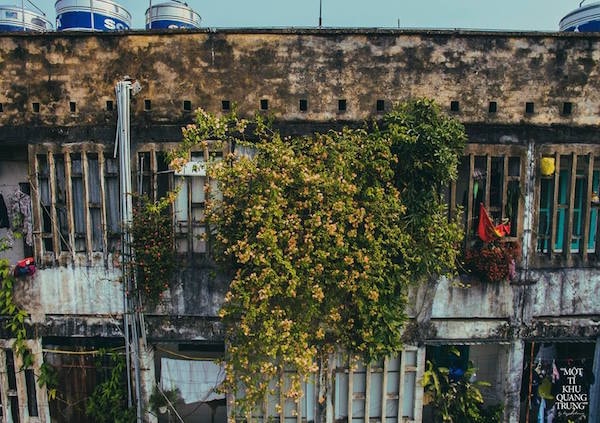 |
| 5th floor, building A6, Quang Trung apartment complex. |
But it wasn't until May 1st, 1974, that we were finally able to begin rebuilding the city. I remember that day, at the 12/9 Theater, the Nghe An Provincial People's Committee solemnly held the groundbreaking ceremony for the city's reconstruction. The location for laying the first brick was set up at the southeast corner of building A1 in the Quang Trung high-rise complex. The person who laid the first brick was Deputy Prime Minister and Minister of Construction Do Muoi, the Ambassador Extraordinary and Plenipotentiary of the German Democratic Republic Dieter Doring, and Comrade Nguyen Sy Que, Secretary of the Nghe An Provincial Party Committee, along with thousands of people joyfully welcoming the groundbreaking ceremony for the first new urban area in the North at that time.
Recall that immediately after the signing of the Paris Agreement on Vietnam in January 1973, countries within the socialist system divided up the task of helping Vietnam rebuild the country, such as: the Soviet Union helping to rebuild Hanoi, China helping to rebuild Thai Nguyen and Viet Tri, Romania helping to rebuild Nam Dinh, North Korea helping to rebuild Ha Bac, Poland helping to rebuild Hai Phong, and Czechoslovakia helping to rebuild Thanh Hoa.
On May 5, 1973, the Government of the Democratic Republic of Vietnam sent a diplomatic note to the Government of the German Democratic Republic officially requesting assistance in rebuilding Vinh city. On May 22, 1973, the Council of Ministers of the German Democratic Republic decided to send a delegation of officials from the Ministry of Construction to Vietnam to survey the situation.
On October 22, 1973, the agreement on assistance from the German Democratic Republic in rebuilding Vinh city was signed in Berlin between Prime Minister Pham Van Dong and the Chairman of the Council of Ministers of the German Democratic Republic.
Speaking of the early days of the city's reconstruction, everyone remembers the first German experts who came to Vietnam to work. The German Democratic Republic sent its best urban planners to Vinh City to survey and begin the work. The team, led by Dr. Karlheinz Schlesier and architect Hans Grotewohl, was tasked with developing the city's master plan, in which the Quang Trung high-rise area was considered a highlight, creating a self-contained, functional model urban area with gardens, schools, and kindergartens.
On the Vietnamese side, the Nghe An Planning and Design Institute was reinforced with several architects, construction engineers, and planning experts from the Ministry of Construction to collaborate on the project. The overall master plan was quickly agreed upon by both sides; the Quang Trung urban area will include 36 high-rise buildings, two schools, four kindergartens, and four nurseries.
At that time, due to the lack of elevators, both sides agreed to build only 5 stories high, using stairs instead. The "residential units" in the apartment complex were self-contained apartments with living areas ranging from 20 to 40 square meters, along with auxiliary areas including a kitchen, toilet, bathroom, and balcony. The buildings were arranged in blocks, each block being 5 stories high, with 4 apartments per floor. The living space allocated per person at that time was very limited, at only 4 square meters per person.
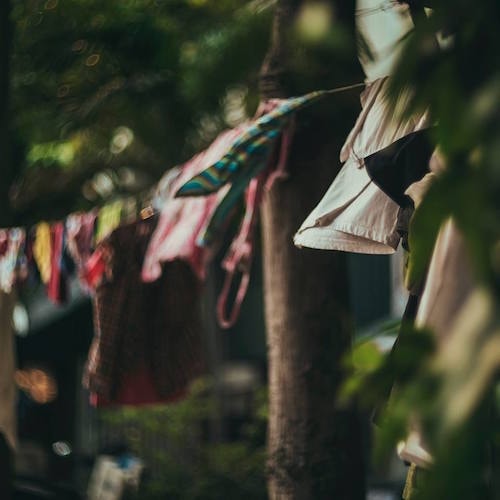 |
| The design of the Quang Trung residential complex sparked much debate among German and Vietnamese urban planners at the time. The result of this deliberation and dedication was an architecture and planning that is considered scientific and meets the living needs of the residents. |
According to the Quang Trung high-rise apartment complex plan, it includes both the land area to the East and West of Quang Trung road. The entire planned area is about 30 hectares, divided into 5 groups of houses. The East consists of 3 groups, group A has 6 houses, group B has 5 houses, group C has 9 houses, a commercial center, a primary school, two kindergartens, and two nurseries. The West consists of two groups, group D has 9 houses; group E has 6 houses, a primary school, a hotel construction area (3), two kindergartens, and two nurseries with a total of 2,480 apartments, providing accommodation for 15,600 people.
The detailed design of the apartments at that time was fraught with heated debates between German experts and Vietnamese architects and engineers. The German side wanted the toilets and kitchens located near the entrance, while the Vietnamese side argued that this was incompatible with the living habits of the local population. The German side proposed building a basement to protect against dampness and humidity, to be used as a storage area for motorbikes and bicycles, but the Vietnamese side argued that security concerns prevented this. Ultimately, to meet the deadline of May 1, 1974, the German and Vietnamese experts agreed to build buildings A1 to A4 in the planned area using the model of the Institute of Civil Engineering, Ministry of Construction, while the remaining buildings followed the German design.
The agreement was scheduled to be implemented over five years, but due to insufficient matching funds and construction materials, the two governments agreed to sign a supplementary agreement at the end of 1978, extending the implementation period by two years until December 31, 1980. At the end of the agreement, the Quang Trung apartment complex had completed the entire eastern section and one building on the western side (Group D).
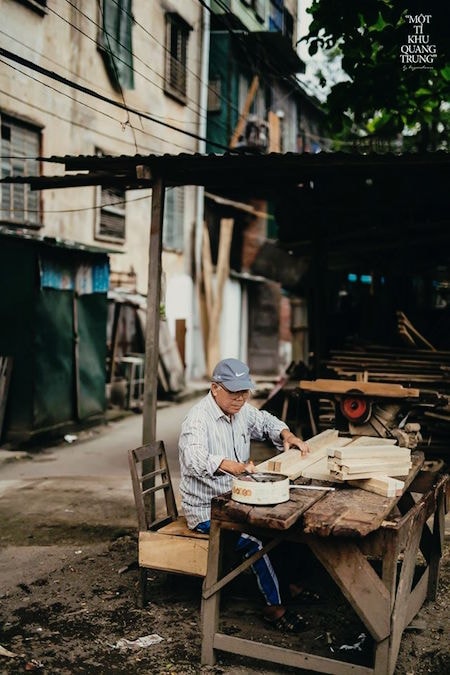 |
| Residents who remain loyal to the Quang Trung apartment complex can't help but feel regret upon learning that the building is about to be demolished. But deep down, everyone understands that it's an inevitable law of social development. |
The entire eastern part of Quang Trung is a complete residential area consisting of 21 five-story buildings with infrastructure including internal roads, electricity, water, and drainage systems, green spaces, playgrounds, as well as a primary school, kindergarten, and commercial centers… The Quang Trung apartment complex was once a source of pride for the people of Nghe An province, as it was the first urban area in the North built after peace was restored.
Now, after 40 years of existence, it is time for the old, dilapidated Quang Trung high-rise building complex to be demolished and replaced with a more modern plan. Urban planners and residents of the Quang Trung complex all agree that the architectural and spatial structure of the Quang Trung urban area remains an ideal model, retaining its value and serving as a scientific basis for further adjustments, additions, and development of future city planning.
N@T
Photo: Hazone