Jeremy Wade, host of the television show Monsters of the River, boasts an impressive collection that includes a 127 kg stingray, man-eating catfish, giant piranhas, and transgender fish.
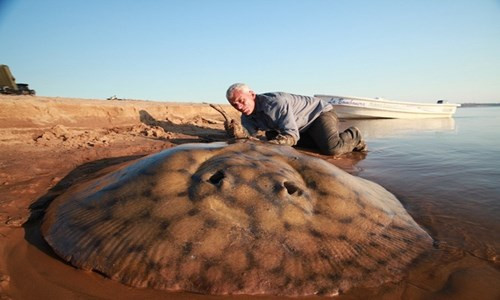 |
| Stingrays (Myliobatoidei). With over 30 years of fishing experience, Jeremy Wade travels the world to discover the most exotic freshwater fish. Easier to catch than saltwater fish due to their dark, low-light habitats, many of the monstrous fish in Wade's collection were caught for the first time on camera. Wade shared his experience hunting for rare fish with All that is interesting. "I caught this one in Argentina, on the Paraná River. Stingrays are generally not deadly, unless you step on them, then they'll sting your foot. That's simply self-defense. As you can see, they're quite good at camouflage." "I estimate the weight of this fish to be around 127 kg. It was the fish that took me the longest to catch, almost four hours of struggle. There are no special techniques for catching stingrays; you just need a heavy object and try to break the venomous spines on the underside of its body." |
 |
| Congo tigerfish (Hydrocynus goliath). "I found this fish in the middle part of the Congo River system, a place rarely visited by the outside world, so most people don't know about it. It's related to the piranha. In fact, it's a giant piranha, capable of growing to the size of an adult. Its teeth are three centimeters long, the same size as the teeth of a great white shark weighing 454 kg." |
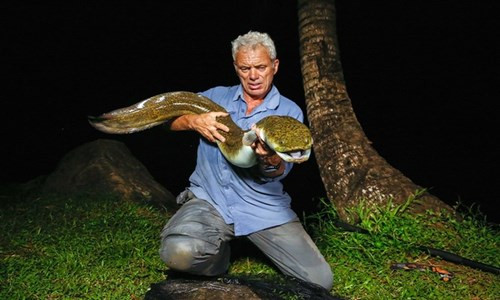 |
| Marble eel (Anguilla marmorata). "This fish was caught in Fiji. Eels are very interesting. They are one of the few species of fish that can live in both freshwater and saltwater, migrating back and forth between the two. Many people know that salmon swim into rivers to spawn, but freshwater eels do the opposite. They live in rivers but swim out to sea to spawn. Nobody knows exactly where they go." "There are rumors that marble eels attack people, which is why I went there to investigate. I think they might attack people, but many fish act that way because they don't know the creature they're attacking is a human. Without good eyesight in the water, they just see something in front of them and mistake it for a small fish. Sometimes, it could be someone's foot, but they don't know beforehand." |
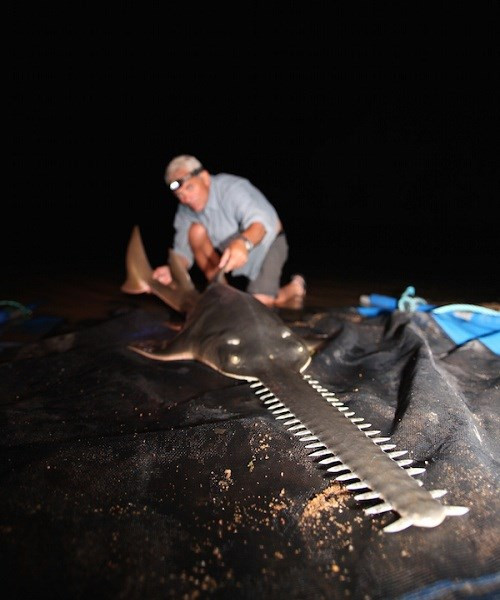 |
| Large-toothed sawfish (Pristidae). "This is a large-toothed sawfish that lives in freshwater. It's 2.1 meters long and is still a juvenile. This species can grow up to 6 meters, but adults have never been caught because they live in the sea. I caught this fish in West Australia. Large-toothed sawfish used to be widely distributed throughout the world, but their numbers have declined rapidly because they easily get caught in fishing nets. Instead of bothering to free the fish, fishermen often choose to kill them." |
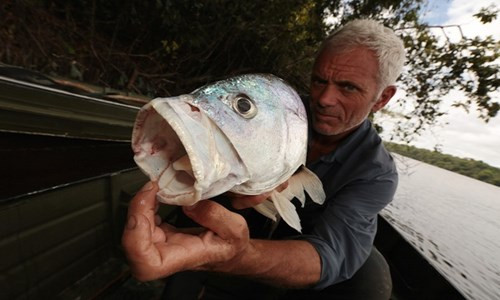 |
| Freshwater drumfish (Aplodinotus grunniens). "This fish lives in Guyana, on the northern edge of South America. They emit a low rumbling sound underwater, a bizarre noise second only to monkey howls. If you hear this sound from a boat, you'll feel like you're on a boiling kettle and might think you're hallucinating." |
 |
| River catfish (Bagarius yarrelli). "This fish comes from India, living at the foot of the Himalayas, in a tributary of the Ganges River. I've heard stories of people disappearing after being dragged underwater by strange objects. There are no crocodiles, pythons, river dolphins, or bull sharks there, so this fish is the most likely candidate." "The river water is very muddy, so these fish grab anything that moves in front of them. They'll bite it, then turn around and dive deep underwater. You won't easily escape the mouth of a river catfish because, unlike other catfish species, they have very long, sharp teeth and strong jaws." |
 |
| Giant catfish (Catlocarpio siamensis). "This fish is native to Thailand. Typically, giant catfish have their mouths drooping downwards as they feed at the riverbed, but this fish appears to have an inverted mouth, evidence suggesting it feeds in the middle of the water, or possibly at the surface. Giant catfish are very large, growing to over 70 kg." |
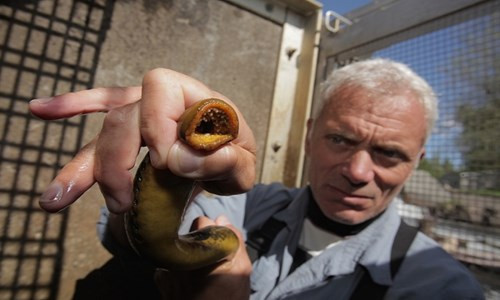 |
| Lamprey (Petromyzontiformes). "This fish lives in Lake Champlain, bordering Vermont and New York, USA. It's a primitive species. It has no backbone or jaws, only a suction mouth with rings of teeth inside. In the middle of the suction mouth is a tongue, and the tongue also has teeth. They usually feed by attaching themselves to the skin of other fish and sucking up bodily fluids." "I once let a lamprey attach itself to my neck to experience that feeling. Its suction mouth is very strong, and after only two seconds, the teeth start piercing your skin. When you pull it off, you lose a whole patch of skin." |
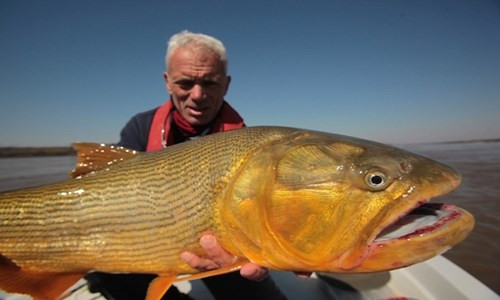 |
| Tigerfish (Salminus brasiliensis). "I caught the fish in a river between Argentina and Uruguay. They have very large and strong teeth and jaw muscles. There, we learned the story of a young man who lost part of his testicle, and this fish was definitely the culprit. Again, I must emphasize that the animal had no intention of attacking; it was due to poor eyesight. When it saw something moving underwater, it simply lunged and bit." |
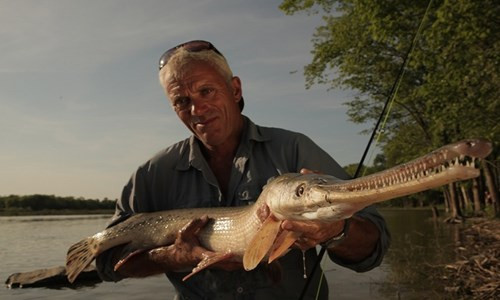 |
| Ray-finned fish (Lepisosteus ossius). "This species lives in Lake Champlain. They are very ancient fish. They can surface and swallow air, which allows them to live in low-oxygen water. This is a survival mechanism that helps them live in conditions where other fish cannot. They are not dangerous to humans, but in the US there is a larger ray-finned fish called the Alligator Gar weighing at least 136 kg and there are often rumors of victims being bitten." |
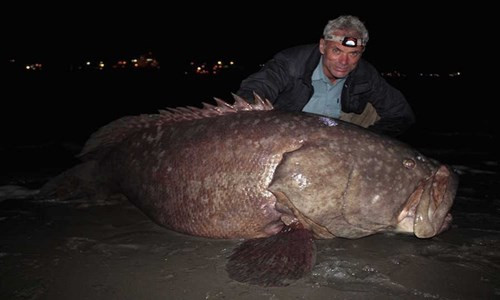 |
| Queensland grouper (Epinephelus lanceolatus). "I was hunting bull sharks and accidentally caught this one in the Brisbane estuary, Australia. Groupers are one of the species that can change sex from female to male. In the case of one male and multiple females, if the male is caught or dies, the largest female will become the male." |
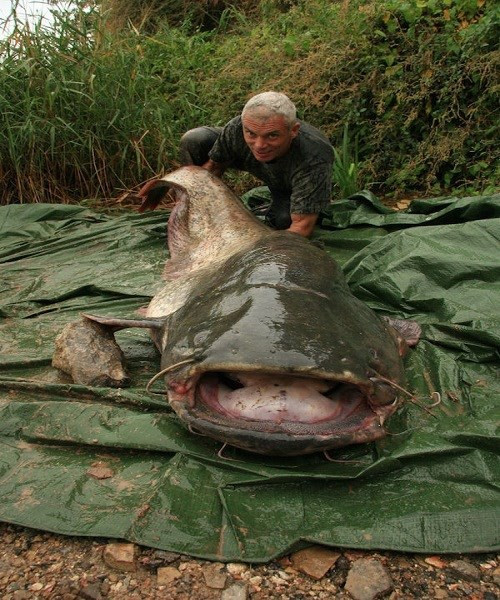 |
| European catfish (Silurus glanis). "This species lives in Europe, and I caught the fish in the photo in Spain. It weighed 73 kg and was 2.1 meters long. Its bite is easily recognizable because the small teeth are close together, forming a slightly curved line about 25 cm long. The interesting thing about this fish is that they bite people even in clear water, and they know people are there. This is because they protect their nests very well. If someone swims too close to the nest, they will bite to warn them. For the victims, it's quite a terrifying experience due to the pain and surprise." |
According to VnExpress

