
What does Formosa release into the environment?
Formosa's factories currently discharge approximately 11,000 cubic meters of wastewater into the environment each day, along with substances such as acids, alkalis, oils, grease, and solid waste.
Formosa's factories currently discharge approximately 11,000 cubic meters of wastewater into the environment each day, along with substances such as acids, alkalis, oils, grease, and solid waste.
Mr. Hoang Duat Thuyen, Director of Safety at Formosa Group, stated that Formosa has built a wastewater treatment system with a total cost of 45 million USD. The wastewater discharge permit was granted by the Ministry of Natural Resources and Environment according to standard 52/2013.
 |
Mr. Hoang Duat Thuyen, Director of Safety at Formosa. Photo: Duc Hung |
The system began testing in March 2015 and received a license from the Ministry of Natural Resources and Environment in December 2015.The wastewater discharge system has an initial projected capacity of 43,000 m3 per day.However, since the company has not officially started operations, the amount of wastewater discharged each day is currently only 11,000 cubic meters.m3.
In addition, Formosa imports various chemicals to stabilize water quality in the cooling tower and flush the pipelines. Over time, a certain amount of chemicals such as acids and alkalis accumulate.Oils, fats, nitrogen, solids...These chemicals are released into the environment. They pass through the company's treatment system, and once they meet standards, they are released.
Explaining why sewage pipes have to be buried underground, heChu Xuan Pham, Deputy Head of External Relations at Formosa Ha Tinh Company, said that because this is a large pipeline.(one meter wide, 1.5 km long)Therefore, it's impossible to build it on the water's surface. Every day, the port area sees a large number of ships passing through, which would affect the pipeline and pose a risk of rupture. "This isn't a pipeline we built illegally; it was licensed by the Ministry of Natural Resources and Environment," Mr. Pham said.
How to control wastewater quality?
According to Mr. Thuyen, Formosa's automated wastewater discharge system monitoring staff are divided into three shifts, on duty to check the system. Whenever the machine's parameters exceed the standards, the system notifies the operator, then instructs the water to be pumped and treated again from the beginning until the standards are met before being discharged.
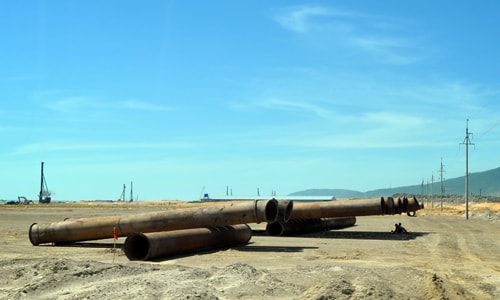 |
Large-diameter pipelines are being installed at the Formosa Ha Tinh project. Photo: Nhat Minh |
In addition to that system, employees on each shift manually collect samples for analysis to compare with the automated monitoring system for any discrepancies and to avoid errors.Hire an independent company to test wastewater samples once a month.On each occasion, samples of influent and effluent wastewater, as well as seawater samples, were collected for monitoring. The monitoring data was sent to the Ha Tinh Economic Zone Management Board and the Provincial Department of Natural Resources and Environment.
"Since the system became operational, there has never been a technical malfunction or the need to return wastewater for further treatment. Currently, the levels of pollutants released into the natural environment, such as solid waste, oil, grease, and nitrogen, all meet the maximum limits," Mr. Thuyen pledged.
Regarding the control of wastewater quality, Mr. Pham added,Formosa Ha Tinh is a project of the Formosa Group (Taiwan), so it must comply with all regulations of the parent company. Every month, the group sends personnel to monitor the regulations on wastewater discharge. Therefore, the wastewater has been tested multiple times before being released into the environment.
""Steel production certainly impacts the environment. The government has issued general standards for wastewater parameters, and Formosa always complies with them. The company also always strives to import the most up-to-date equipment and technology from Japan into the project to improve efficiency," Mr. Pham said.
What to do with nearly 300 tons of chemicals?
With 296 tons of imported chemicals, Mr. Pham stated that the company uses them not only for cleaning pipelines, but each chemical serves a specific function. The company employs four methods: cleaning with air, clean water, steam, and chemicals such as NaOH (Sodium Hydroxide) and HCl (Hydrochloric Acid). Wastewater generated after cleaning is passed through an industrial wastewater treatment plant before being discharged into an automated monitoring system.
Currently, there is nothing unusual around the wastewater discharge system; the fish and shrimp are still alive. "We haven't inspected the area for the past few days, but some government agencies have inspected it and confirmed that no fish have died in that area," Mr. Thuyen said.
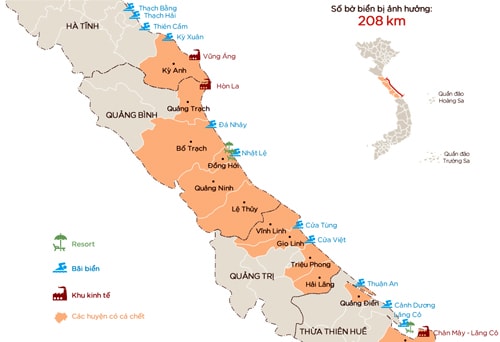 |
How did the fish kill spread in central Vietnam? Details |
Answering a question about the mass fish deaths, Mr. Thuyen said:Since the cause is unknown, I cannot offer an opinion at this time.
"Formosa is confident in its ability to handle environmental issues well, and doesn't consider it its responsibility. State agencies are investigating, and everything will become clear once the conclusions are reached."Regarding the recent mass fish deaths, we are also under a lot of pressure and hope that the authorities will quickly issue a conclusion so that the company can continue production with peace of mind. Public opinion is currently outraged; no one will believe Formosa even if they say a hundred things, so we have to wait for the authorities to issue a conclusion," he said.
In early April, fish raised in cages near the Vung Ang economic zone (Ky Anh town, Ha Tinh province) began dying. This unusual phenomenon then spread to farmed fish and shrimp using seawater, as well as wild fish along 200 km of coastline from Ky Anh (Ha Tinh) to Lang Co (Thua Thien - Hue). By April 25th, nearly 60 tons of dead fish had washed ashore, mostly bottom-dwelling species. The cause is still under investigation by authorities and no conclusion has been reached yet, but in recent days suspicion has focused on Formosa Ha Tinh Hung Nghiep Steel Company Limited, as this company has a wastewater discharge pipeline buried at the bottom of the sea.A few days before the mass fish deaths occurred, the company carried out a pipeline flushing operation. Approximately 300 tons of chemicals imported for this purpose were deemed extremely toxic. |
According to VNE