

Whales 'stranded on shore' signal a bountiful fishing season.
(Baonghean.vn) - In the beliefs of coastal fishermen, the whale is considered a "guardian deity" that helps them have smooth sailing on their voyages. The sight of a whale washed ashore is considered a good omen, signaling a bountiful harvest and good fortune for those who work at sea.
The worship of the Whale God has become a long-standing and distinctive cultural feature of the coastal people of Nghe An. For them, the whale is the "sacred fish" of the East Sea, often helping fishermen in distress at sea. Because of their reverence, fishermen call it Whale God, Fisherman God, or the God of the South Sea.
Therefore, fishermen absolutely do not hunt or eat whales. Whenever they encounter a stranded whale, they do their best to rescue it and return it to the sea. Once the whale is back in the sea, the fishermen even throw rice and salt down to provide food for the whale to return safely to the ocean.
When fishermen in this area encounter dead whales washed ashore, they consider it a good omen, a blessing, because this land has been chosen by the whale god as a resting place, and the whale god has entrusted them with the task of burial.
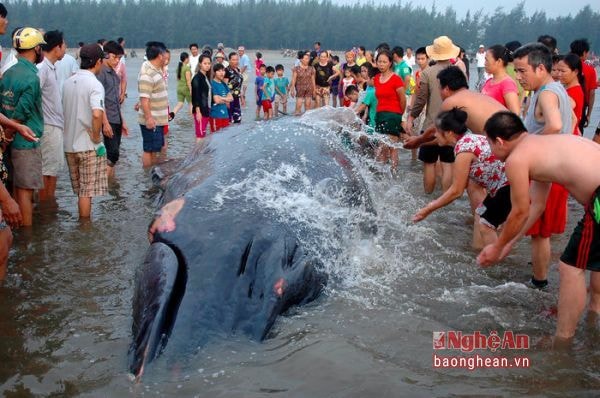 |
| Thousands of people rushed to the beach to rescue a 10-ton whale that had washed ashore in Dien Chau on May 25, 2016. Photo: Thanh Cuong |
Nghe An province currently has nearly 10 temples and shrines dedicated to the Whale God, stretching from Hoang Mai town to Cua Hoi. Quynh Luu district has the largest number with 5 temples and shrines, mainly concentrated in the communes of Quynh Tho, Quynh Long, and Tien Thuy. Each place is associated with a story, historical value, and holds a special place in the spiritual and religious life of the fishing community.
The Lang Hieu Temple (Hai Thanh Hamlet, Nghi Hai Ward, Cua Lo Town) is considered the temple with the most whales in Nghe An province, with 85 whale graves buried over time. Each grave is associated with a story about fishermen who found whale carcasses at sea and brought them back for burial according to the customs of the fishing village.
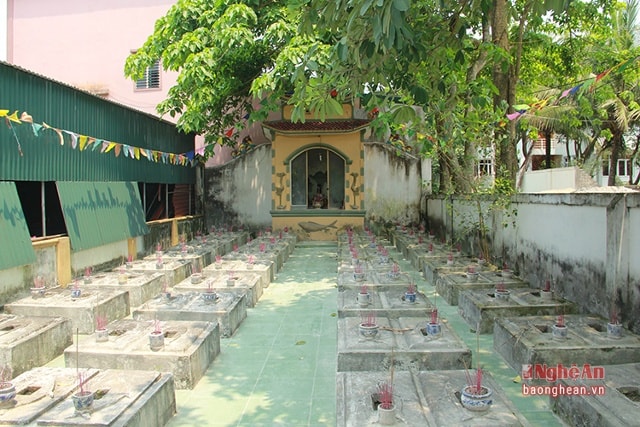 |
| The Lang Hieu Temple can be considered the largest whale shrine complex in Nghe An province, with 85 tombs built and regularly worshipped. |
The story of whales that washed ashore, were carefully buried, and respectfully worshipped is still passed down among the people. It was in 1942 that a whale washed ashore on the coast of Quynh Tho commune (Quynh Luu district) still alive. The locals tried to return it to the sea, but it returned to Cua Lach, and on March 17, 1942, it passed away.
In August 2010, a giant whale, weighing nearly 10 tons, washed ashore on Tien Thuy beach, causing a stir in the entire coastal area. Fishermen had to mobilize six fishing boats to tie the whale's carcass to ropes and pull it ashore. In late March and early April 2016, four more whales washed ashore in the Cua Hoi and Cua Lo areas, where they were carefully buried and worshipped by the local people.
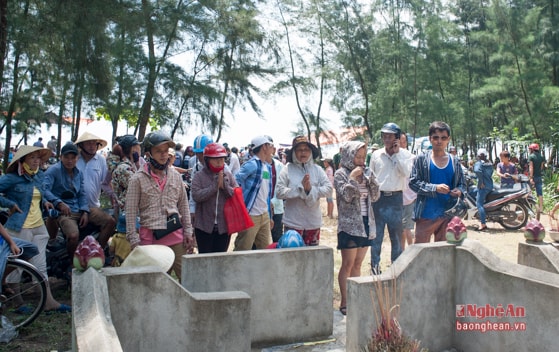 |
| A large number of people from Dien Chau came to light incense at the whale's grave on the beach. Photo: Thanh Cuong |
Most recently, on the morning of May 27th, fishermen in Dien Chau discovered a dead whale floating in the waters off Nghe An province, about 3 to 4 nautical miles from the shore. Authorities are currently working to salvage the whale and bring it ashore, along with burying it according to traditional customs. Two days prior, residents of Dien Thinh commune discovered a giant whale stranded on the beach. Authorities mobilized three excavators to dig a drainage ditch leading to the sea to rescue the whale.
To show their reverence for the Whale God, every year at the beginning of the new year, fishermen in coastal areas organize a fishing festival. This festival originates from the custom of worshipping the Whale God among coastal residents, and is a deeply spiritual activity with the hope of praying for a new year of favorable weather, calm seas, smooth sailing, and high yields for fishermen at sea.
This is also an opportunity for people to encourage each other to stay committed to fishing, helping local people become closer, more united, and build a meaningful cultural way of life.
 |
| Offering sacrifices at a fishing festival in a coastal village in Nghe An. |
Phan Cong Vinh (54 years old, Xuan Loc hamlet, Nghi Xuan commune, Nghi Loc district), a fisherman from Cua Hoi coastal area, said: “According to the beliefs passed down from our ancestors, whenever boats go out to sea and encounter strong winds and waves, the whale always comes to the rescue, bringing the boats and fishermen back to shore safely. The stranding of a whale on the shore is considered a good omen for the people here, so when they discovered the whale carcass, they carefully buried and worshipped it.”
Mr. Nguyen Huu Hoa (43 years old, Tan Nho Hamlet, Nghi Hai Ward, Cua Lo Town) – the person who discovered the whale carcass washed ashore near Cua Hoi Lagoon on April 8th – said: “The Whale God is a deity of the South Sea, who has been kind to the fishermen of this coastal area. Therefore, when we found the whale dead, the fishermen from the surrounding villages, along with me, held a funeral and performed the necessary rituals for him. I am considered the eldest son (son of the South Sea God) and I mourn him for two years to show the affection of the fishermen of this coastal area towards the animal that saved their lives.”
According to local fishermen's beliefs, a whale stranded on the shore in a particular area of the sea is considered a good omen for the fishermen of that region. The death of a whale washing ashore is seen as a good sign, as it signifies that the whale, having exhausted itself saving people, chose land as its final resting place.
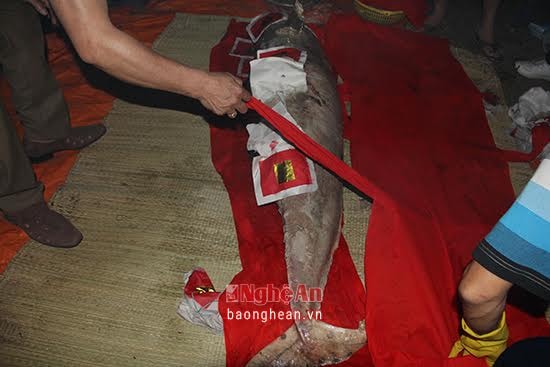 |
| The whale carcass was discovered by Mr. Nguyen Huu Hoa and, together with fishermen from Nghi Hai (Cua Lo), was buried on April 18, 2016, in Cua Lo. |
Scientists explain the phenomenon of whales rescuing people. When the weather is bad and turbulent, whales dive deep to find peace. The rougher the sea, the deeper the whales dive. However, because they need to breathe, they occasionally surface.
If the constant surfacing and diving continues for days and nights, the whale will become exhausted and die, drifting with the current and being carried ashore by the waves. In addition, frequent storms at sea are another reason why these whales often seek refuge, such as fishermen's boats. Unable to hide for long in deep water due to the suddenness of the storm, whales wait for boats to pass by, then approach the side of the vessel, leaning against it to avoid the storm, and are carried ashore by the waves.
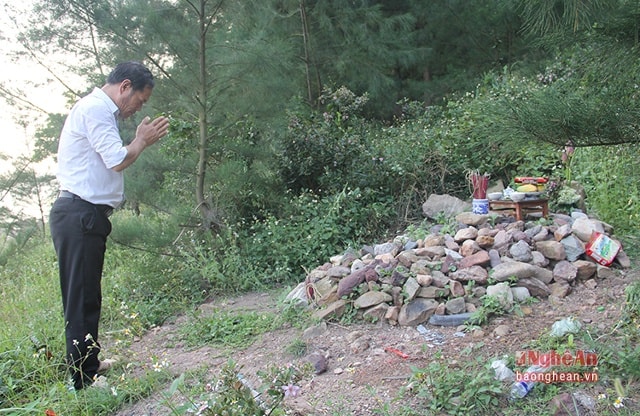 |
| Mr. Vo Minh Hung respectfully lit incense at the whale's grave in Nghi Thiet fishing village, Nghi Loc district. |
Mr. Vo Minh Hung (59 years old, Rong hamlet, Nghi Thiet commune, Nghi Loc district) said: “On Rong mountain, right next to Lach Lo, there are hundreds of whale tombs that have been buried over a long period of time. For the people here, whales are a species that always bless and protect fishermen as they travel and fish at sea. Therefore, whales stranded on the shore are a good omen for fishermen, and worshipping whales is a cultural belief and a responsibility that every person in this coastal area must fulfill.”
Wang Yun