

The "splitting" move - a 'specialty' of the football fields in Nghe An province.
Searching for the origin
All players from the SLNA academy are proficient in this move, regardless of their position, even goalkeepers can slide tackle very well when needed. The difference with the SLNA academy's sliding tackle is that the player can immediately get up to continue contesting for the ball, a technique that is not easy at all. Previously, the central defenders of the Nghe An Provincial team often used the "stretching" move, a variation of the instep kick, when clearing high balls. Players like Dinh Dai, Hai "Vau", and Ha Thinh would take advantage of the momentum to extend their leg straight at the opponent.
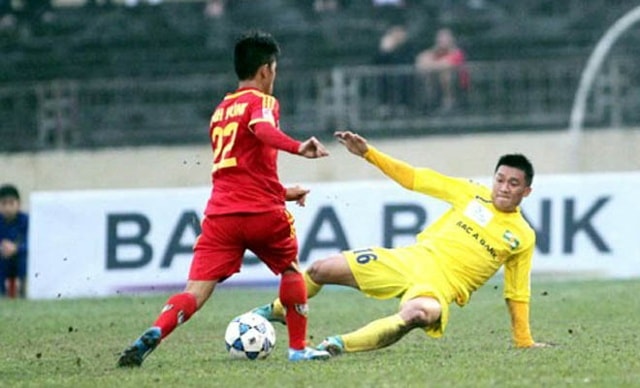 |
| Sliding tackles have become a trademark of players who have come through the SLNA youth academy. |
Later, this move was often penalized by referees for high-kick fouls, so it wasn't until the time of Thanh Long, Van Luu, and Huu Thang that they practiced their signature sliding tackle, lowering their height to win the ball. In the early days, Vietnamese football fans were quite averse to the two-footed tackles made by SLNA defenders, culminating in the red card received by defender Tuan "Thao" (now SLNA's assistant coach) for fouling a Customs player at Thong Nhat Stadium during a National Cup match. When playing, center-back Van Luu, midfielders Phi Hung, Van Tien, Duy Ghi, Anh Tuan, and Duc Lam also frequently used this "signature move," and SLNA became known for its aggressive, physical play during that era.
Huu Thang, who used to play as a central defender, is considered the creator of the "Made in SLNA" sliding tackle that defenders from Nghe An province now often use. SLNA defenders usually put one foot forward, locking it into the joint near the inner ankle, while the other foot, besides getting to the ball, tries to touch the opponent's heel. At first glance, it seems harmless and legal (if it hits the ball) because both feet are close to the grass, but if the opponent doesn't quickly jump up, they can easily twist their ankle and limp for several weeks.
It was similar to a move from the Nhat Nam martial art of Master Ngo Xuan Binh, which was popular in Vinh at that time. When he was still playing, Hong Son, a player with some of the best individual skills in Vietnam, still feared the SLNA defenders when he came to Vinh stadium, and that's why. Especially since the SLNA defenders played in a "sliding" style; if the player in front missed, the next one would follow. On one occasion, after dodging three such tackles, Hong Son was too exhausted to face Van Luu.
The most fundamental characteristic of this sliding tackle is that it doesn't use full force (similar to the basic principle of traditional martial arts), so players from Nghe An province can get up and chase the ball immediately after using it. Huu Thang was the one who introduced this sliding tackle to the Southeast Asian arena, and Kiatisak was the player who frequently had to jump high to avoid this tough defender. Huu Thang is left-footed, so he usually puts his right foot forward to block, and Kiatisak, after having to jump high to avoid it, falls down and can no longer control the ball.
Raise the bar
When discussing life and career with former SLNA players about the distinctive style of play from the Nghe An academy, the "Made in SLNA" sliding tackle is universally acknowledged as being associated with the captain wearing jersey number 4. In fact, back then, besides SLNA, center-backs like Hong Hai (Lam Dong) and Thien Quang (Ho Chi Minh City Police) also used this tackle, but at a lower level. It's said that in the 1996 Tiger Cup match between the Vietnamese national team and Laos, this number 4 center-back carelessly threw himself into a sliding tackle on a Laotian player from midfield, resulting in a red card and leaving Vietnam trailing 1-0 and playing with ten men. Fortunately, Vietnam managed to equalize 1-1 thanks to Huynh Duc's goal.
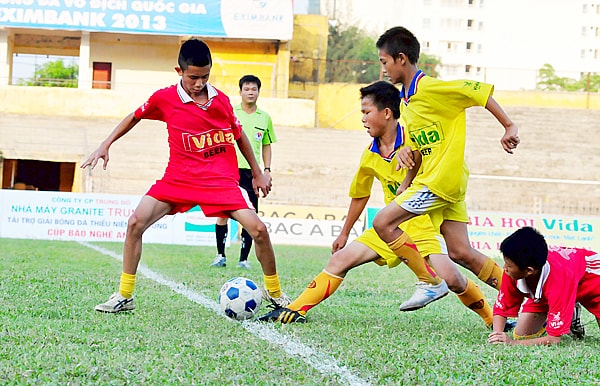 |
| The young players of SLNA are inheriting and gradually improving the traditional sliding tackle technique of SLNA. |
After the match, Huu Thang and three other players in the starting lineup were confronted by German coach Weigang, who asked, "How much did you guys get for selling this match?" If it weren't for the intervention of the late team manager To Hien, he would have been sent home. Ultimately, Huu Thang was allowed to stay to atone for his mistakes. In the semi-final match against Thailand, left-back Tuan "Hue" was repeatedly beaten by Kiatisak, and the Vietnamese team collapsed within the first 24 minutes, conceding three goals scored by Kiatisak and Srithong-in (2 goals).
Huu Thang was brought on as a left-back by Weigang, and he successfully filled the void, but ultimately Vietnam still lost 2-4 (Hoang Buu and Hong Son scored). However, Huu Thang's classy tackles and tenacious playing style were officially recognized by Southeast Asian fans at the Singapore National Stadium.
Following Huu Thang, Huy Hoang, Quoc Vuong, and now Minh Duc and Ngoc Hai are the "successors" contributing to elevating the "Made in SLNA" sliding tackle to a new level. SLNA defenders' sliding tackles are not just about clearing the ball, but also about keeping it at their feet; they don't tackle when at a disadvantage in a contest, but proactively do so.
Nicknamed Catcosan Vinh, a long-time follower of Nghe An football, said, "For people from Nghe An, watching SLNA play without seeing a sliding tackle is like a regular meal missing a tomato." However, this sliding tackle has repeatedly caused trouble for Nghe An players, especially those from the SLNA youth academy, as it has resulted in injuries and condemnation from fans.
| RELATED NEWS |
|---|