
The truth is, potato chips are like pig feed: Who would dare eat them?
With just 2,000 dong, students at many schools across the country buy all kinds of eye-catching snacks and candies with various flavors from coffee and fruit to shrimp and beef… A reporter from Tien Phong newspaper infiltrated the production "factory" and witnessed the manufacturing process of the snacks that are swarming around school gates.
With just 2,000 dong, students at many schools across the country buy all kinds of eye-catching snacks and candies with various flavors from coffee and fruit to shrimp and beef… A reporter from Tien Phong newspaper infiltrated the production "factory" and witnessed the manufacturing process of the snacks that are swarming around school gates.
Role-playing as a snack food processing worker.
The traditional craft village of La Phù (Hoài Đức, Hanoi) is known as the capital of counterfeit and fake goods. It's also home to dozens of snack factories, selling tons of snacks to the market every day.
When there is a shortage of workers, the owner of a snack factory will go to the "labor market" in Tay Mo (Tu Liem, Hanoi) to find people.
After spending several days at the Tay Mo labor market, a reporter from Tien Phong newspaper was hired as a worker by the owner of the TL snack production facility.
The TL factory is hidden away in the Chùa Tổng hamlet (La Phù commune). From the entrance of the alley, the aroma of snacks wafts out, but all four doors are locked and bolted.
We stopped in front of a workshop enclosed by green corrugated iron sheets. The owner pushed open the gate for us to enter, then quickly closed it tightly. The workshop (about 20m wide and 50m long) was divided into two separate areas.
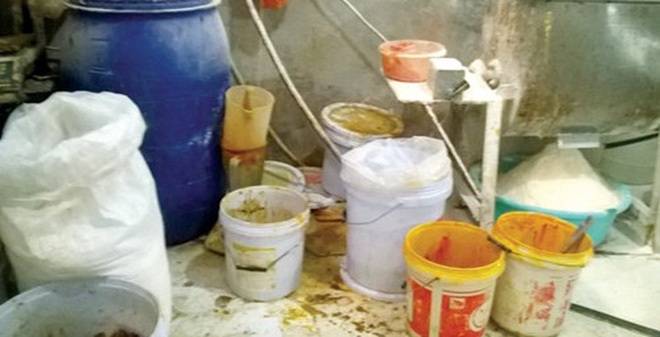 |
| Mixing area for producing snacks. |
The outer half contains finished, packaged potato chips. Along the entrance, hundreds of cans of oil for frying the chips are lined up. The inner half of the factory contains machinery and production materials (flour, sugar, salt, flavorings).
To produce the finished product, the snack making "production line" consists of four stages: mixing and pouring the ingredients (flour, spices, food coloring) into the snack making machine; scooping the snacks into the frying oven; roasting the seasoning; and packaging.
The mixing process takes place separately, enclosed by a high sheet of corrugated iron. On the dark, sticky cement floor, flour, food coloring, spices, and cooking oil are scattered everywhere.
Next to it were the toilets and bathrooms. Every time they needed to use the toilet, wearing the same pair of slippers, the workers walked across the filthy factory floor straight into the toilet, then casually stepped on the sheet metal containing the snacks.
To avoid revealing the "secrets" of the production process, the owner only instructed trusted individuals on the dough mixing stage. New workers like me were assigned to the packaging section. After nearly half a month of work, I was finally allowed to assist the workers in mixing the ingredients.
Witness the processing technology firsthand.
Ms. Hai, a worker mixing the dough, instructed me on the recipe for making crispy potato snacks: "Pour 1 bag of wheat flour (25kg), 1 packet of food coloring, 1 cup of sugar, salt, and water (enough to make 3kg), add 1 cup of cooking oil, and mix well."
Then, the batter is put into the popping machine. Once the chips are popped, they are poured onto the floor of the factory outside, where people collect them and put them into the frying oven.
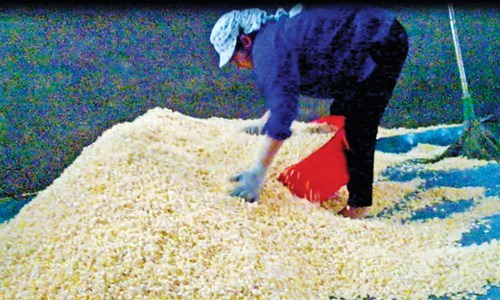 |
Barefoot and barehanded, sweat-drenched workers casually carry tubs of chips into the frying oven. Photo: PV. |
"In the mixing area, the cement floor was pitch black and sticky with flour, food coloring, spices, and cooking oil. Next to it were the toilets and showers. Every time someone went to the toilet, they would step on the sheet metal containing the snacks after coming out of the restroom with the same pair of worker's slippers."
Next to the dough mixer was a small plastic bowl containing packets of food coloring; individual bags of sugar, salt, and a bucket of water.
When I asked about the food coloring packet, Ms. Hai shook her head, saying she didn't know. She explained that the factory owner had instructed them to follow the instructions, and the employees didn't know what the substance was because there were no labels or names on it.
According to Ms. Hai, depending on the type of snack, the factory owner will instruct on the quantities of ingredients to mix. "This step helps to mix the flour evenly with food coloring, sugar, and salt. The seasoning will be added after frying until crispy," Ms. Hai added.
After the chips are popped, they are dumped on the factory floor. A female worker named Hanh scoops them into buckets and pours them into a thick, dark oil oven, frying hundreds of batches of chips.
In the sweltering heat of the oil furnace, Hanh, drenched in sweat, walked barefoot into the middle of the floor filled with snacks, scooping each container onto the steps and pouring them into the furnace. Then, using a rake, she stirred the snacks for about a minute before transferring them to the drying machine.
After draining off the excess oil, the chips are then put into a seasoning mixer. The seasoning mixer has a similar structure to a concrete mixer.
After pouring the bag of chips into the filthy, black machine, Thuy added a spoonful of yellow food coloring taken from a spice bag with Chinese characters on it, which lacked any Vietnamese label.
After mixing the spices thoroughly, Thuy used an iron bar to push the container upside down so that the chips spilled into large baskets, which were then poured onto a floor area of about 2 square meters.
The packaging of the snacks is handled by Ms. Hoa. Using a plastic shovel, she fills each plastic bag with 15 kg of snacks and places them on the tiled floor.
Then, they would attach a single quality assurance sticker, tie the package tightly, and stack the items in piles for transport to distributors. The product quality assurance sticker listed the ingredients as: potato starch, wheat flour, refined sugar, chili salt, cooking oil, and MSG.
The label clearly states "no artificial colors, no preservatives." This label ignores the use of Chinese-made food coloring and flavoring.
To verify the type of unlabeled food coloring that TL snack factory is using in its snack production, a reporter from Tien Phong newspaper took a package of the food coloring to the National Institute of Food Safety and Hygiene Testing for analysis.
According to test results, this is the artificial coloring agent Tartazine (E102). In food, E102 is only allowed to be used within permitted limits (maximum 7.5mg/kg of body weight per day).
Consuming more than the permitted amount can potentially cause cancer, genotoxicity, and neurotoxicity, leading to hyperactivity in children.
However, the labels on the finished snack products from the TL factory omit the use of this food coloring and clearly state "no color, no preservatives".
Associate Professor Dr. Nguyen Duy Thinh (Institute of Biotechnology and Food, Hanoi University of Science and Technology) assessed that the TL snack factory's failure to list the E102 food coloring as an ingredient constitutes fraud and deceives consumers.
“E102 can be used, but only in permitted amounts, and this needs to be clearly stated on the packaging so consumers are aware. For establishments that are dishonest and ignore the use of E102, the authorities need to intervene and take action,” Mr. Thinh stated.
According to Vietnam.net
| RELATED NEWS |
|---|