
People in Vinh City need to hunt brackish water fish.
(Baonghean) - Many anglers confide that the first time they caught a sea bass in the Lam River was like a first time.
(Baonghean) - Many anglers confide that the first time they caught a sea bass in the Lam River was like a first time.ayoung manandamucahandmani con gasilentìnhtrostrongOh.
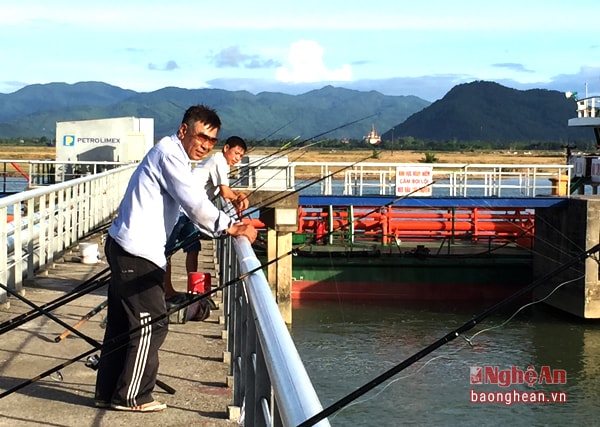 |
| The gas station bridge is an ideal fishing spot for many brackish water anglers in Vinh City. |
I've been dabbling in brackish water fishing for the past few months. At first, watching others fish didn't seem like much: a few dead shrimp as bait, a spinning rod, some lead weights, a box of hooks, and that's it.
I grabbed my supplies and sped down to the Hung Dung oil pier. People commonly refer to this concrete pier as the "oil pier." In reality, it's a pier used for docking and mooring ships to pump and extract fuel from the oil depot located inside the dike, belonging to the Nghe Tinh Petroleum Company. And why do many "brackish water anglers" choose this spot to fish? Because the water here is swirling and very deep, making it an ideal hiding place for various types of fish, especially large ones.
Returning to my story of learning river fishing by eavesdropping, getting a fish ashore wasn't easy at all. I tried and tried but couldn't catch a single one, while everyone else was catching big and small fish. It turned out I lacked experience, and my equipment was far too simple.
Then someone, impressed by my persistence, advised me: "You need to buy a decent fishing rod. Who fishes in the river with a rod as thin as a hair? Get a line reel for a few hundred bucks, heavy lead weights (about 30-40g, the size of your thumb, oval with a hole for threading), floats, and size 12-14 hooks; for bait, buy live freshwater shrimp, and you'll need a container and an air pump to keep them alive for the whole fishing session."
I immediately hailed the first person who taught me how to fish as my "master." His name was Le Thanh Dung, but anglers still called him by the nickname Dung "Trung" or Dung "Tec." Dung is 40 years old this year, living in Trung Do ward (Vinh City), and his main occupation is trading construction materials. Later, when I became closer to this handsome man with a touch of rebelliousness and stubbornness, I heard stories about his "fishing life." "I've known how to fish in brackish water for almost 20 years. Before this oil bridge, there were countless fish. I never came home empty-handed; sometimes I caught a couple, sometimes five or seven. They were all over 1 kilogram. The biggest fish I caught at this oil bridge weighed 9 lo, it was a carp," Dung boasted excitedly.
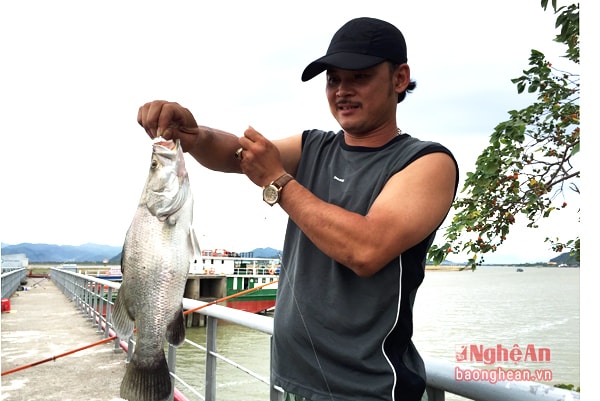 |
| Mr. Le Thanh Dung with the sea bass he just caught. |
"Mè kẻ" is another name used by coastal residents for the sea bass – a species considered the most aggressive and cunning in brackish water, and also a specialty of the lower Lam River region. Catching "mè kẻ" requires considerable skill. This fish, with its long snout, silvery-white scales, and bright red eyes, possesses strong, sharp teeth; its dorsal fin and gills are all considered weapons for self-defense.
Basically, the favorite food of the barramundi is river shrimp, a type of freshwater shrimp, although sometimes they unexpectedly bite the bait, which is a live loach. According to professional anglers, it's simply because they "dislike the sight" of the loach. Barramundi usually hunt in deep, swirling water, about 1.5-2 meters below the surface, depending on the depth of the river. To trick them, anglers use a live shrimp hooked to the tail or head, as long as the shrimp can still swim. Because they are surface-feeding species, a float must be used when fishing for barramundi.
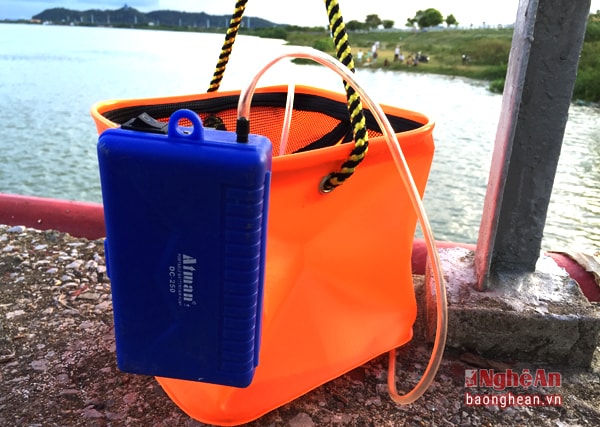 |
| Containers and aerators for anglers used to raise bait shrimp. |
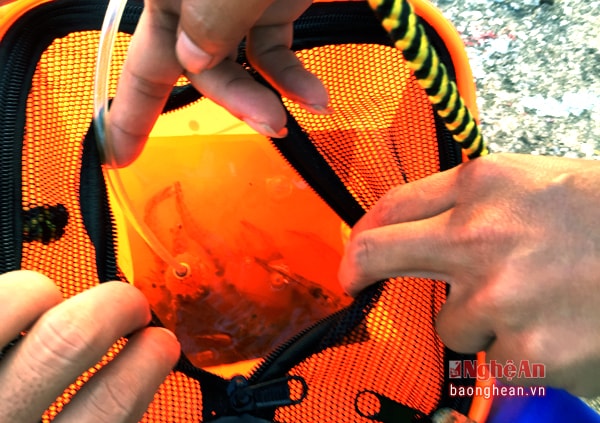 |
| Battery-powered aerators can help keep shrimp bait alive all day. |
Speaking of the cunning nature of this "king" of brackish water fish, Mr. Dung said: "Brackish water fish usually bite the hook and feed according to the tide, and the same goes for the silver carp. They usually hunt when the tide is rising or falling, and the river water must be clear and not murky to catch silver carp. Especially when the water is still (not flowing), silver carp can hunt by clamping their gills – that is, instead of using their jaws, they can catch prey with their gills." Dung further demonstrated his knowledge: "To accurately predict the tide, you need to know the tidal calendar. There are days with high tides, super high tides, and days with low tides, super low tides. In a month, there are usually two days of high tide, meaning the water is completely new and on these days the water level remains relatively stable, neither low nor high, so you can fish at any time of day and still catch fish."
New anglers like myself truly admire Dung's experience and fishing skills. Related to this middle-aged man's "fishing life" is the memory of his more than a year in prison due to a conflict over river fishing. "After coming out of prison, I went back to fishing in the river. There were plenty of fishing spots, so I went to Nghi Tan, Nghi Thiet, Nghi Quang (Nghi Loc). Then there was Xuan Song (Nghi Xuan), Do Diem (Ha Tinh) many times too. Once you're addicted to fishing, don't even think about quitting," Dung shared, gesturing with his hat. Few would guess that this man has four children, three boys and one girl; the oldest is in 12th grade this year, and the youngest is only three years old.
It seems I started getting addicted to brackish water fishing, just like Dung did almost 20 years ago. If Dung is considered the number one among the regular brackish water anglers at the oil and gas station, then the second place goes to a dark-skinned, thin, meticulous man who never misses a day of the year by the river. Everyone calls him Hung "Little." I haven't interacted much with him, but I've never seen him come home empty-handed. Even among fellow anglers, many admire Hung's tenacity. With just a can of beer and a loaf of bread, he can sit and watch his line from early morning until late afternoon.
Fishing in brackish water isn't as easy as fishing in lakes or reservoirs; you can't use bait or groundbait to lure the fish. Therefore, days without a single bite are quite normal. The perseverance of the anglers deserves praise. Each person fishing in the river usually carries 3-5 rods, casting their lines in spots they believe will catch fish. Mr. Hung, for example, casts his line at least 10 times each time he goes fishing. Besides using spinning rods, this "killer" fish also uses submerged fishing tubes. These tubes are wrapped with line, weighted with lead and hook, and bait is dropped to the riverbed. This method is commonly used to catch brackish water snapper. After sea bass, snapper is the next most aggressive species, a prized delicacy, and it's not the same as the American snapper or the red snapper.
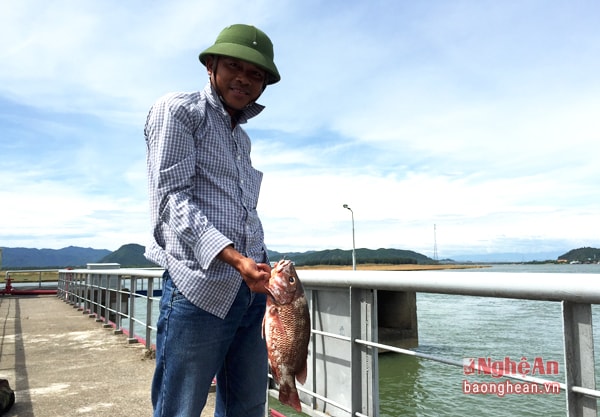 |
| Mr. Dinh Bat Hai, from Quynh Ngoc commune (Quynh Luu district), took advantage of the summer break to visit his wife's hometown in Vinh City and go fishing at the gas station. The photo shows a red snapper he just caught. |
Unlike the common carp, brackish water snapper usually feeds on the riverbed, where there are many submerged rocks. And to catch them, experienced anglers, as Mr. Nguyen Van Hien, another angler in Ben Thuy ward (Vinh City), put it, have a 50/50 chance of success or failure. That means accepting the reality: the line might break, the sinker or hook might be lost, or you might manage to pull the fish up. However, experienced anglers know how to bring snapper ashore when they bite. Mr. Nguyen Phuc Tho is one who knows this "secret." "When you know a snapper is hooked, you have to stay calm and keep the line taut. If it has gone into a rock crevice, you have to be even calmer, choosing the right water conditions and position to pull the fish up. Anyone who keeps trying to pull will just break the line. All day you'll only get one catch, and it's all for nothing," Tho explained, showing his experience. I asked Tho why he kept using the broken rod that only had three sections left. "Replace it," I said. Thọ laughed innocently: “It’s my lucky charm! It helped me catch a 'backpack-sized' bass, and dozens of red snappers from 1 to 2 lots. Don’t underestimate this ‘short stick,’ I can catch a few lots in one go.” - Amused by the innocent way the 30-year-old unmarried man spoke, I was even more surprised that recently, thanks to that same “short stick,” Thọ caught a bass weighing over 1kg.
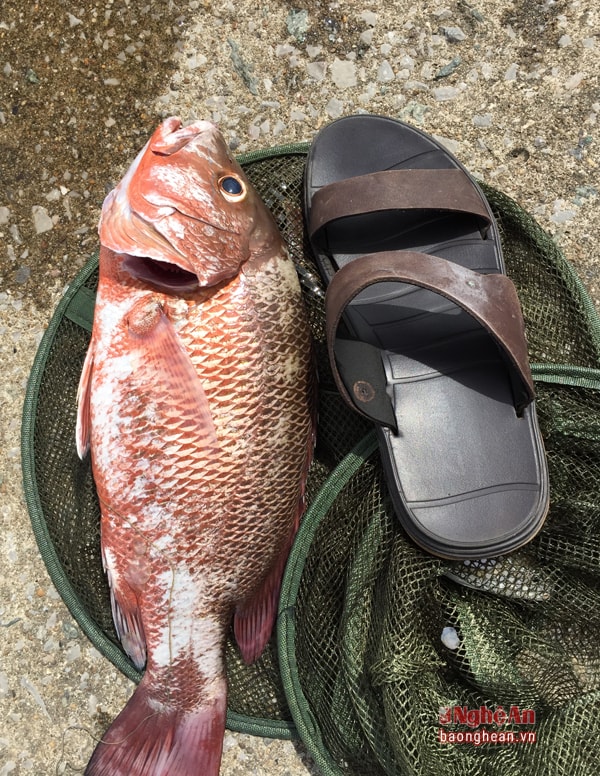 |
| A snapper caught near the gas station weighed nearly 1.5 kg. |
People who fish in lakes and dams often hunt for swallowtail fish, but for brackish water anglers, even a small fish is considered precious. "In these times when gold and brass are mixed together, brackish water fish are number one," shared Mr. Nguyen Van Hien. Speaking of this man in his sixties, Mr. Hien said that he and his wife are retired factory workers, and he drives a small truck around the city every day. After 5 pm, he goes down to the oil bridge to "check in," fishing until midnight, sometimes even until dawn. He doesn't get discouraged if he doesn't catch anything, because, as he shared, "the love of fishing is in my blood."
As evening fell, the entire jetty along the Lam River dike buzzed with talk of grouper fishing. People were saying, "Since freshwater shrimp are scarce this season, we'll use live whiteleg shrimp or eels as bait." "You never know what to expect from birds and fish. Luck is better than skill." They also shared tips on keeping the bait shrimp alive longer: "Buy an oxygen aerator, use water from a shrimp farm, or if you don't have one, find some oxygen for aquaculture and mix it with brackish water; the shrimp will stay healthy all day..." Then there were weights, hooks, reel types, and rod types... The whole downstream area was bustling with activity. I joined in the lively conversation, sharing the late afternoon's joy with everyone.
Quoc Son
| RELATED NEWS |
|---|