

President Ho Chi Minh highly valued family feelings.
(Baonghean.vn) - Family affection is a beautiful and enduring foundation of patriotism and love for the people. As someone who dedicated his entire life to the country and its people, President Ho Chi Minh highly valued family affection.
In 1929, Uncle Ho returned to Thailand from Europe. During his time in Thailand, Uncle Ho helped Vietnamese expatriate cadres consolidate and develop the expatriate organization and refine the propaganda content of the newspaper "Than Ai" (Affectionate). Uncle Ho often visited the headquarters of these expatriate organizations. Once, on his way to visit these headquarters, halfway there, it got dark, so Uncle Ho stopped at the home of an expatriate family who worked as carpenters and stayed overnight. That night, the hostess recited the Tale of Kieu to lull her child to sleep. Uncle Ho listened. The next morning, while traveling, Uncle Ho said to his traveling companion, Comrade Tran Lan, in a very affectionate tone:
"Away from home for decades"
Last night I heard the gentle sound of a mother singing a lullaby to her child.
Even the lullaby sung by the Vietnamese-American landlady moved President Ho Chi Minh so deeply, evoking such strong feelings of family!
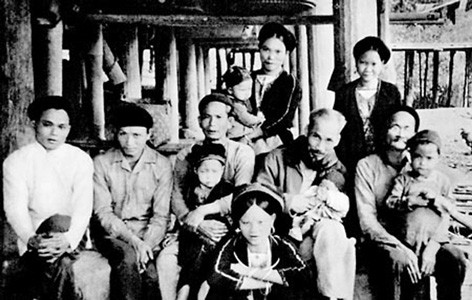 |
| In Viet Bac, President Ho Chi Minh often visited families of ethnic minorities. |
In late 1946, at the Government House in Northern Vietnam, President Ho Chi Minh met his older sister, Nguyen Thi Thanh. After more than thirty years of separation, upon meeting his sister, President Ho Chi Minh embraced her tightly and emotionally said, "Oh, sister, how are you?" They talked for more than half an hour in the Government Guest House, and both President Ho Chi Minh and Mrs. Nguyen Thi Thanh had tears in their eyes.
Also at the end of 1946, at the Presidential Palace in Northern Vietnam, Uncle Ho met his older brother, Nguyen Sinh Khiem. The two brothers met after more than thirty years of separation. Uncle Ho, visibly moved, said: “Brother, you’ve just arrived. How are you? It’s such a pleasure. How is Thanh doing back home? She came here today, but I was too busy to see her much… I invited her to stay until the afternoon, but she left.” Mr. Nguyen Sinh Khiem replied: “Thanh left and told me that you’re very thin, and you’re busy with work all day…” Uncle Ho listened to his brother and then recited:
"In the blink of an eye, it's been decades."
"As long as there is land, water, and people, there will be today."
After receiving the Xa Doai oranges from his brother, President Ho Chi Minh immediately recited a folk song from Nghe An province:
"Our homeland, Nam Dan, is known for its sweet sugarcane."
Sweet potatoes from Cho Ro market, fragrant oranges from Xa Doai.
When you go home, will you remember me?
"We are like oil that burns brightly all night long."
After reading those folk verses, Uncle Ho blinked and asked his older brother about the situation in Nghe An province, Nam Dan district, the activities of the local government and organizations, and the number of relatives and friends from his childhood. In response, Mr. Khiem praised Uncle Ho, saying, "You've been away for so long, yet you have such a good memory."
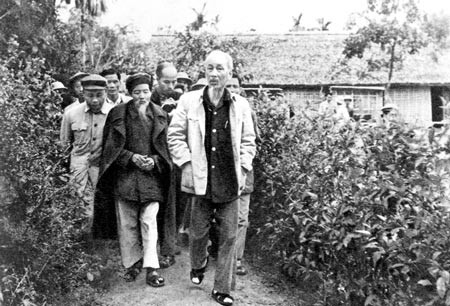 |
| President Ho Chi Minh visited his hometown of Kim Lien (Nam Dan, Nghe An) in 1961. |
In 1950, upon hearing of the death of his elder brother, Nguyen Sinh Khiem, and unable to return home for the funeral due to the circumstances of the resistance war, on September 11, 1950, President Ho Chi Minh, from the Viet Bac resistance zone, sent telegram number 1229 to the Inter-Regional IV Resistance Administrative Committee, requesting that it be forwarded to Kim Lien village, Nguyen Sinh clan. “Hearing of my eldest brother’s death, my heart is filled with sorrow. Because of the heavy burden of national affairs and the long distances, I could not care for him when he was ill, nor could I attend to his passing. I beg forgiveness from my brother’s spirit and ask for the understanding of my family for sacrificing family affection for the sake of national affairs.”
In late 1954, the Office of the President received a document from Zone IV sent to Hanoi informing them of the death of Mrs. Nguyen Thi Thanh (President Ho Chi Minh's sister). The document arrived late. President Ho Chi Minh carefully examined it, pondered deeply, then carefully folded it, placed it in an envelope, and put it in a separate place in his bookshelf. Around the same time, among the documents from the South sent to the Office of the President, there was a letter addressed to President Ho Chi Minh and a photograph of our soldiers standing on either side of the tomb of Deputy Scholar Nguyen Sinh Sac in Cao Lan. The photograph was small and blurry, but the inscription on the tombstone was still clearly visible. The Office of the President forwarded the letter and photograph to President Ho Chi Minh, but he did not return them.
It wasn't until mid-September 1969, after his death, that the letter and photograph were found in an inlaid wooden box containing printed greeting cards, placed on the highest shelf in his study at his stilt house. For his family, his mother, father, sister, and brother, Uncle Ho held them dear in his heart; his heart belonged to his family, his clan, his hometown of Nghe An, the country of Vietnam, and all the people of Vietnam.
Peace(Synthetic)
| RELATED NEWS |
|---|