

The ASEAN joint statement did not mention the 'nine-dash line' ruling.
The Association of Southeast Asian Nations issued a joint statement today but made no mention of China or the ruling from the Arbitration Tribunal on the "nine-dash line".
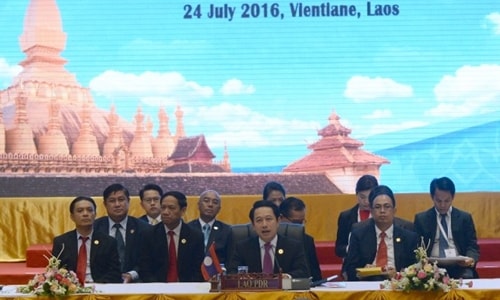 |
Lao Foreign Minister Saleumxay Kommasith (center) speaks at the plenary session of the ASEAN Foreign Ministers' Meeting on July 24. Photo: AFP. |
In a joint statement, the 10 member states of the Association of Southeast Asian Nations (ASEAN) reiterated their "deep concern" about "land reclamation and escalating activities," calling on all parties to exercise restraint in the South China Sea, AFP reported. ASEAN called for peaceful solutions to disputes in the South China Sea in accordance with international law, including the United Nations Convention on the Law of the Sea (UNCLOS).
"We are deeply concerned about recent and ongoing developments, noting the concerns of some foreign ministers about land reclamation and escalating activities in the region that erode trust, increase tensions and could harm regional peace, security and stability," the joint statement read.
ASEAN foreign ministers, gathered in Vientiane, Laos for a summit, spent several days discussing how to respond to the Arbitration Tribunal's ruling on the "nine-dash line." The Tribunal concluded that China has no legal basis to claim historical rights to the resources within its unilaterally drawn "nine-dash line," which encompasses most of the South China Sea.
Cambodia reportedly does not want to draw criticism against China. Meanwhile, most ASEAN members want the association to maintain pressure on China's illegal island-building campaign in the South China Sea.
However, according to ASEAN principles, decisions must be made by consensus, meaning any country has the right to veto proposals. According to AP, this time, Cambodia exercised its veto power. In 2012, Cambodia also prevented ASEAN from addressing the South China Sea dispute, resulting in the first foreign ministers' meeting failing to produce a joint statement.
The joint statement was issued after last-minute negotiations found a way to overcome the deadlock.
"We just wanted to avoid the risk of collapse," an ASEAN diplomat said, referring to the 2012 incident."It's a compromise statement. And in a compromise statement, someone has to give way," another diplomat said.
According to VNE
| RELATED NEWS |
|---|